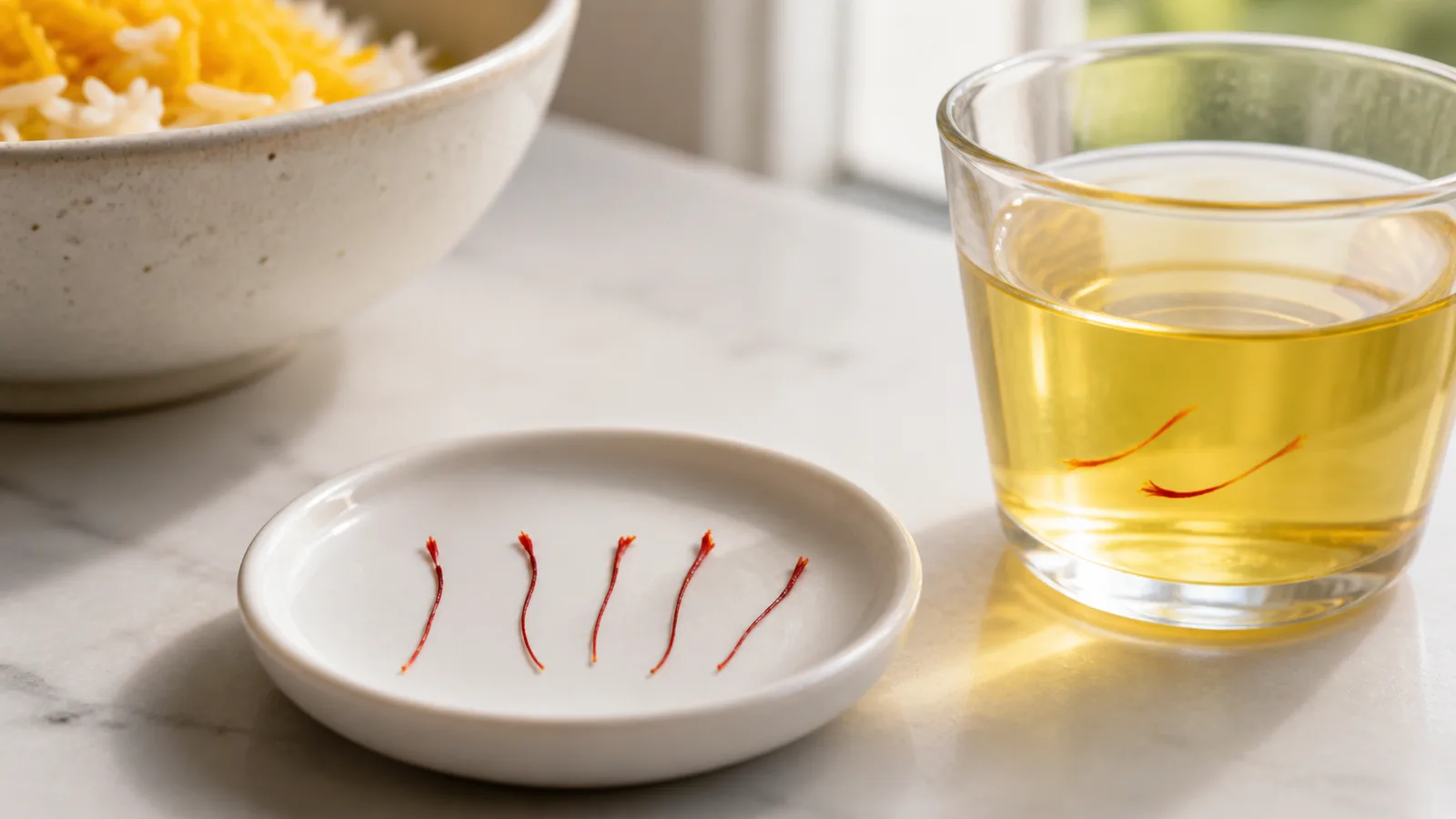


A practical estimate is 150,000 to 200,000 Crocus sativus flowers to make 1 kg of dried saffron. That saffron flower yield is a range, not a universal conversion: authoritative estimates run from about 120,000 to 250,000 flowers per kilogram.
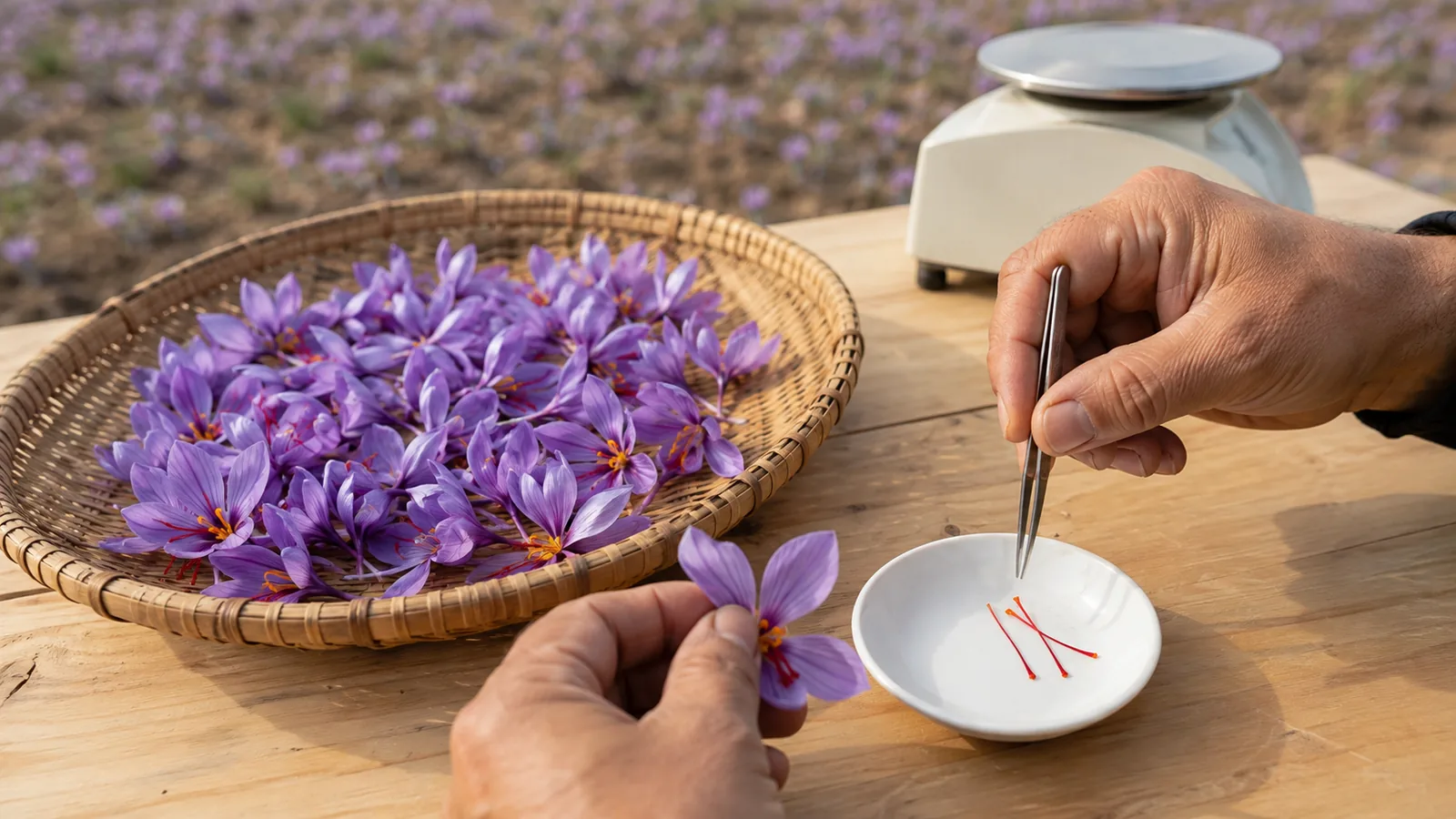
How many flowers are needed to make 1 kg of saffron?
For planning or explaining the labour involved, use roughly 150,000–200,000 flowers for 1 kg. Each flower supplies only three red stigmas, so that range represents about 450,000–600,000 individual stigmas that must be picked, separated, and dried.
The estimate is easy to remember, but it should not be quoted as a laboratory constant. Flower size, stigma weight and length, the amount of pale style retained, final moisture, grade, growing conditions, and handling losses all change the number of flowers needed for a finished kilogram.
What do authoritative sources say?
Published figures do not all match, and that is useful evidence rather than a problem to hide:
- The Royal Horticultural Society says about 150 flowers produce 1 g of dry saffron. Multiplied by 1,000, that gives approximately 150,000 flowers per kilogram in its saffron growing and harvesting guide.
- A Food and Agriculture Organization report states that about 450,000 stigmas—or 150,000–170,000 flowers—produce 1 kg, in its Afghanistan saffron production manual.
- Penn State Extension estimates about 4,000 blossoms for one ounce of saffron. Converting 35.27 ounces to a kilogram gives roughly 141,000 flowers, consistent with the lower part of the common range; see its home-production guide.
- An International Organization for Standardization article gives a higher illustrative figure of about 250,000 flowers per kilogram in its overview of saffron quality.
Those sources support a range, not the claim that exactly 150,000 flowers always equal exactly 1 kg. For a clear general answer, 150,000–200,000 remains reasonable. For a saffron farming budget or production contract, use measured yield from the actual cultivar, grade, drying method, and site.
Why does one kilogram require so many flowers?
The spice is only a tiny part of the flower. Saffron comes from the three red stigma branches in the centre of each purple bloom. Petals and yellow stamens are not culinary saffron, and including a long pale style adds weight without the same concentration of valued red stigma.
Fresh stigmas also contain water. Drying removes most of that mass while developing and stabilising the spice’s aroma and colour. The kilogram in the question is a kilogram of dried saffron ready for trade, not a kilogram of freshly separated wet floral material.
This combination—a small usable organ and substantial moisture loss—explains the low saffron flower yield before labour is even considered.
How many flowers make smaller amounts?
Using the RHS benchmark of about 150 flowers per dry gram gives these useful approximations:
- 1 gram: about 150 flowers.
- 5 grams: about 750 flowers.
- 10 grams: about 1,500 flowers.
- 1 ounce (28.35 g): about 4,250 flowers; Penn State’s separate estimate is roughly 4,000.
- 1 pound (453.6 g): about 68,000 flowers.
- 1 kilogram: about 150,000 flowers at that benchmark.
These calculations scale one reference value; they are not additional measured studies. Real batches may sit above or below them for the same reasons the published kilogram estimates differ.
Flowers, plants, bulbs, and corms are not interchangeable
“How many saffron plants for 1 kg?” does not have the same fixed answer as the flower calculation. A flowering-size corm may produce one bloom in an early season and several in a stronger later season. Small daughter corms may not flower at all until they mature.
Gardeners often say saffron bulbs, but Crocus sativus grows from corms. It is sterile and is propagated by dividing those corms, not by ordinary saffron seeds. A listing for “saffron seeds” may describe a different plant and cannot be converted into a kilogram yield.
To estimate corm requirements, a grower needs local records for flowers per corm, flowering percentage, flower weight, dry stigma yield, and losses. Dividing 150,000 flowers by an assumed flower count per corm without those data creates false precision.
How the harvest turns flowers into dried saffron
Flowers are picked in a narrow window
Saffron blooms in autumn over a short season. Flowers are collected as they begin to open, ideally when dry, before wilting or soil contamination reduces quality. During peak bloom, picking may be needed every day.
The three red stigmas are separated
Workers open each flower and remove the red stigma branches by hand. The University of Vermont’s saffron harvesting guide distinguishes the red stigma from the yellow stamen and purple petals and recommends prompt, careful handling.
The stigmas are dried
Drying is not a cosmetic final step. It reduces water, develops the characteristic aroma, and produces a stable spice. Time, temperature, air movement, cleanliness, and final moisture affect both quality and saleable weight.
The batch is sorted and packed
Foreign matter and unwanted flower parts are removed, then the saffron is protected from humidity and light. A kilogram of a red-stigma grade may therefore require a different raw flower count from a grade that permits more style.
Why flower count is only part of saffron’s price
The large number of blooms is important because each one must be handled during a short seasonal window. Labour continues after picking: separating hundreds of thousands of stigmas, drying them consistently, sorting, testing, packing, storing, and moving the product through a traceable supply chain.
Land, healthy corms, irrigation or rain management, weeding, crop losses, wages, quality grade, origin, certification, packaging, and wholesale or retail margins also affect price. A flower estimate alone cannot calculate the fair price of a kilogram.
That is also why an unexpectedly cheap kilogram deserves scrutiny. Low price does not prove fraud, and high price does not prove purity, but a credible seller should be able to explain form, origin, net weight, batch identity, and quality evidence.
Can farmers improve saffron flower yield?
Yield can improve when growers start with healthy flowering-size corms, choose a suitable climate and free-draining soil, manage weeds and moisture, preserve foliage after harvest, divide overcrowded beds, and handle flowers promptly. None of these practices makes the three stigmas inside one flower multiply.
Flower numbers also change by year. A new bed can be sparse, while established corms produce daughter corms and may give more blooms in later seasons. That makes one year’s flowers-per-corm result a poor universal forecast.
Our guide to saffron growing time explains first flowering and stronger later yields. If you want to try a small harvest yourself, see the practical steps for harvesting saffron at home.
The figure to remember
Use about 150,000–200,000 flowers for 1 kg of dried saffron as a responsible general estimate. State that it is a range, name the source when precision matters, and expect real production to vary. At three stigmas per flower, even the lower end means handling roughly 450,000 tiny red stigma branches.
For culinary quantities that do not require a field of flowers, you can compare the thread formats in our saffron shop.