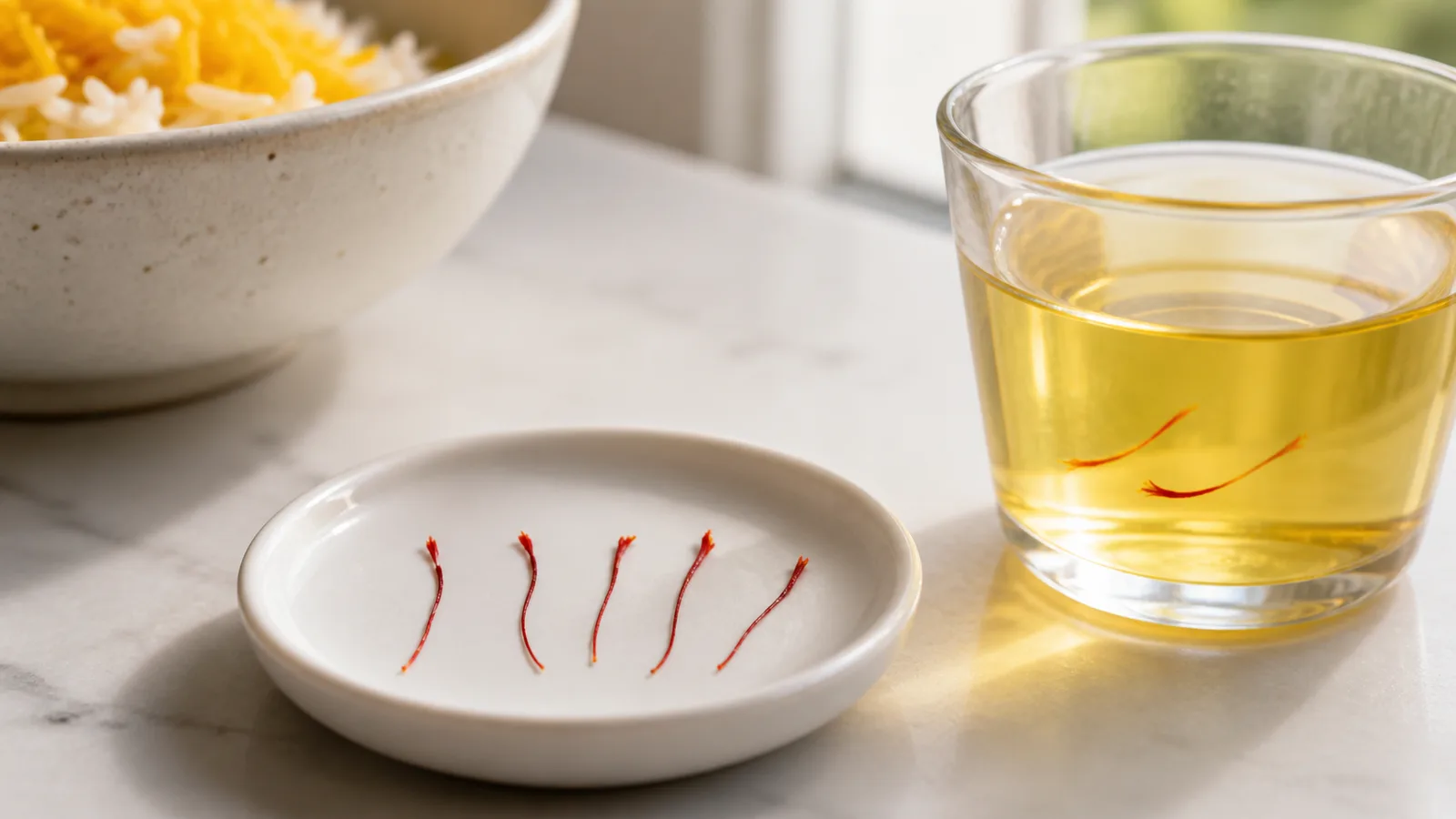
There is no permanently “most expensive” saffron type. At one seller, a scarce, verified Kashmir-origin product may cost the most; at another, a carefully selected Iranian Negin lot or a protected European origin may carry the highest price. The most expensive saffron type is simply the genuine product with the highest comparable unit price at that time—not a universal winner fixed by country name.
Why “type” can mean several different things
Before comparing prices, check what the seller means by type. The word may refer to:
- product form: whole filaments, cut filaments or powder;
- thread selection: how much red stigma and yellow style the product contains;
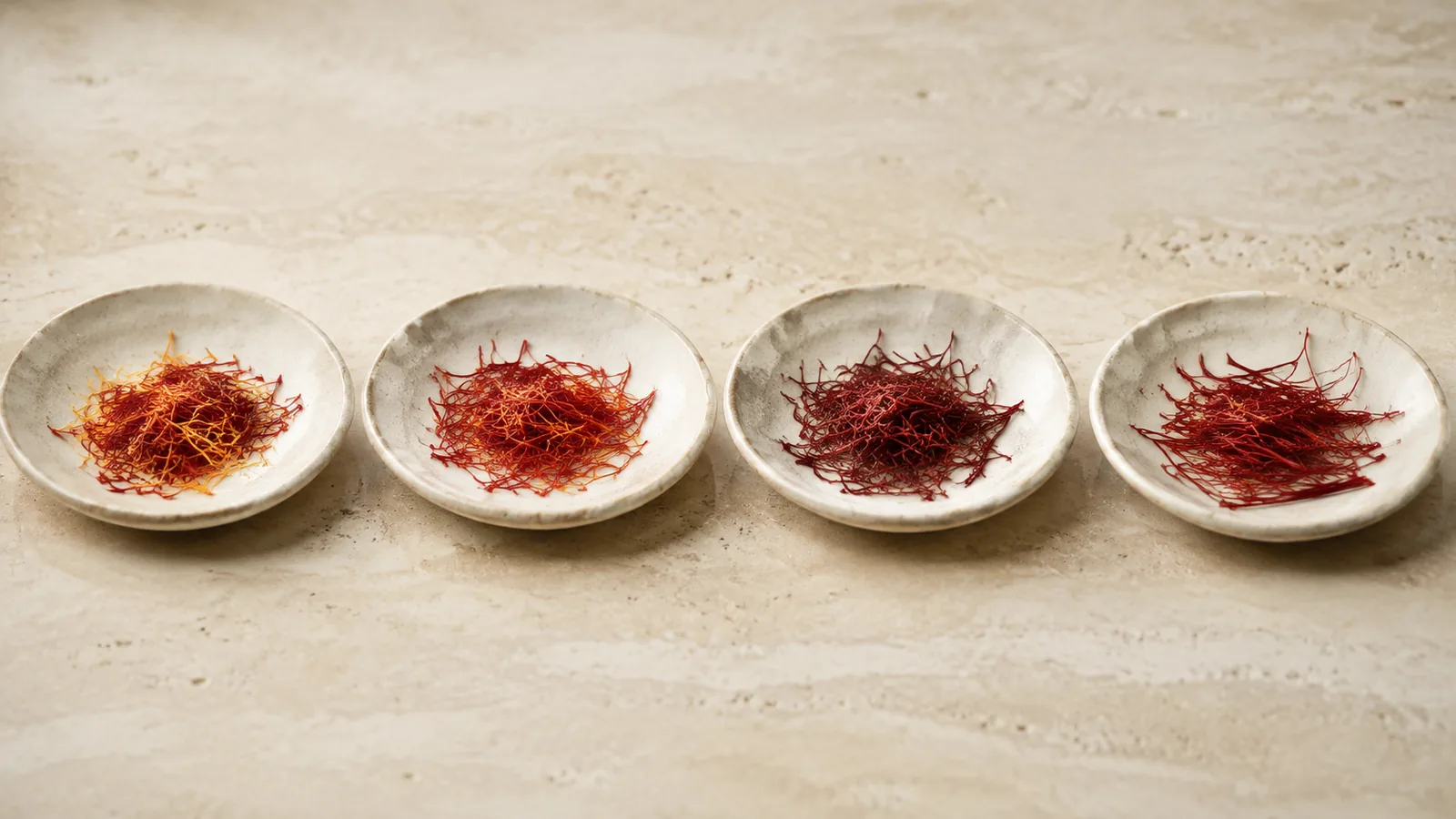
- commercial trim: names such as Negin, Sargol, Pushal or Bunch in the Iranian trade;
- geographical origin: Iran, Kashmir, Spain, Greece, Morocco or another growing region;
- protected origin: a product that meets the rules of a geographical indication;
- laboratory category: a result assigned under a named standard and test method.
Those are not interchangeable classifications. “Kashmir saffron” describes origin, while “Negin” describes an Iranian thread selection. A seller cannot place the two labels on one simple quality ladder without explaining the actual products.
Which Iranian saffron type is usually costly?
Within Iranian commercial trimming, selected Negin products are often positioned at the premium end. They contain separated, predominantly red stigma filaments chosen for an attractive whole-thread appearance. “Super Negin” is also common retail language, but it is not a magic phrase that guarantees a particular price or laboratory result.
Sargol consists of separated red stigma portions that may be shorter or broken. Pushal retains some attached style, and Bunch or Dasteh keeps the stigma and a larger portion of the style together in a tied bundle. A peer-reviewed study of Negin, Sargol, Pushal and Dasteh saffron classifications shows that these market categories are based strongly on visible form and expert sorting.
Selection takes labour and a visually uniform whole-thread pack can command a premium. Still, a Negin label does not make every batch fresher, more aromatic or purer than every Sargol batch, and it is not proof of purity. Appearance and measured composition answer different questions.
Is Kashmiri saffron always the most expensive?
No. Genuine Kashmir saffron can be expensive because production is limited, regional identity carries value and supply outside its home market can be restricted. India’s registry confirms that Kashmir Saffron is a registered geographical indication. The registration supports the identity of the protected origin; it does not publish a permanent global retail price.
Kashmir saffron may be the highest-priced option in a particular shop. It may also be absent, discounted, sold in a different pack size or compared with an unusually selected product from elsewhere. That is why a blanket ranking of Kashmiri first, Iranian second and Spanish third will eventually be wrong somewhere.
Origin can add value without proving quality
Origin matters. It can represent a farming community, production tradition, protected name and traceable supply chain. It can also affect scarcity and transport costs. What it cannot do on its own is prove the strength, freshness, flavor, aroma or condition of an individual packet.
Iranian saffron spans a large market with many trims and quality levels. Spanish saffron can include protected regional products with their own production rules. Kashmir has a protected geographical identity and a smaller supply. Any of these may become costly when the product is scarce, carefully selected, independently checked or presented for a specialist market.
What recognised standards assess
The current ISO 3632-1 specification applies to dried Crocus sativus saffron in filament, cut-filament and powder forms. The ISO 3632-1:2025 standard page identifies the scope; companion methods are used to examine defined product characteristics.
The joint FAO/WHO Codex collection also lists CXS 351-2022 for dried saffron. These frameworks deal with what the product is and the requirements or measurements used to assess it. They do not set a retail price or declare one country permanently more expensive.
If a high-priced pack claims a category or test result, look for the standard edition, method, laboratory, date, sample or lot identifier and actual values. A certificate from a different harvest or an unconnected sample tells you little about the packet in your hand.
What makes one saffron product cost more?
Saffron begins with a labour-intensive crop. Harvesting the flowers, separating the small stigmas, drying them and protecting the finished spice all require care. The final shelf price can then reflect several additional costs.
- Stigma selection: removing style and choosing visually consistent filaments takes more handling.
- Yield and harvest conditions: supply changes from season to season.
- Protected or verified origin: documentation and controlled supply chains can add cost.
- Testing and quality control: representative batch testing is a real expense.
- Age and storage: current, well-protected stock may be worth more than poorly stored material.
- Pack size: a tiny retail container usually costs more per gram than a larger trade pack.
- Packaging and distribution: jars, presentation boxes, shipping, duty and seller margin change the shelf price.
This explains why two packets carrying the same type name can have very different prices.
How to compare saffron prices fairly
- Convert both offers to price per gram. Do not compare a one-gram jar with a five-gram pouch by sticker price alone.
- Use the same currency and checkout total. Include tax, delivery and any import charge you will actually pay.
- Match form with form. Whole selected threads, style-rich material and powder are different products.
- Check the declared origin and grade. Do not assign a protected origin or premium trim from a photograph.
- Compare evidence. Lot-linked testing, useful dates, traceability and proper storage deserve more weight than adjectives.
- Notice the packaging premium. Decide whether you are paying for saffron, a gift box or both.
How much does saffron cost per ounce?
For an ounce comparison, use 28.35 grams and multiply a genuine per-gram price by that amount. Retail saffron is rarely bought by the ounce, and large-pack pricing is not simply a small jar multiplied 28 times, so treat the calculation as a common-unit comparison rather than a quote.
Does costly saffron mean better saffron?
Sometimes a higher price pays for real value: more red stigma, careful sorting, fresher stock, protected provenance, suitable testing or better handling. Sometimes it pays for ornate packaging, a small pack, an importer’s costs or a marketing story. Price can be a warning when it is implausibly low, but it is not proof when it is high.
Thread colour is not enough either. Dyed or substituted material can be made visually persuasive, while genuine saffron naturally varies. Use the checks in our guide to buying high-quality saffron and compare the seller’s evidence before paying a premium.
Common questions about costly saffron
What is the most expensive type of saffron?
There is no permanent worldwide answer. Carefully selected all-red thread products, scarce verified origins and protected regional saffron often occupy the premium end, but the highest current comparable price must be checked in the market where you are buying.
Is Negin more costly than Sargol?
A selected whole-thread Negin product often costs more because of its presentation and sorting. A fresh, well-tested Sargol lot can still cost more than an ordinary or stale Negin lot. Compare the actual grade specification and batch.
Is saffron expensive in Iran?
Iran’s large production base can make local prices different from imported retail prices, but saffron remains labour-intensive and values change with harvest, grade, currency and market conditions. A country-level yes or no is not a useful live quote.
Is powdered saffron the most expensive?
Not necessarily. Powder is convenient but hides the thread structure, so traceability matters greatly. Compare genuine net weight and batch evidence; do not pay more merely because a powder promises instant colour.
Is a more expensive origin automatically stronger?
No. Origin, laboratory quality and price are related in some markets, but they are separate facts. Only batch-specific evidence can support a strength comparison.
The practical answer
If you want the costliest retail presentation, premium selected threads or a scarce verified origin may lead the shelf. If you want the best value for cooking, choose genuine, fresh saffron with clear provenance and appropriate evidence, then compare the complete price per gram. The most expensive packet is not automatically the best one for your dish.
Read more about why saffron is expensive and the different saffron types and quality terms. You can also review our saffron products or ask about a current product specification.