To buy high-quality saffron, start with traceability rather than a colour trick. Choose a seller who identifies the product and its origin, provides a lot number and useful date information, and can explain any quality report. Whole threads are easier to inspect, but powder can also be genuine. Price, aroma and a home water test are clues—not proof.
Decide what “high quality” means for your purchase
Authenticity, purity, freshness and strength are related, but they are not the same. Authentic saffron comes from the pistils of Crocus sativus. Purity means the pack is not bulked with unrelated material. Freshness reflects age and storage. Commercial quality also considers characteristics linked to colour, aroma and flavour.
A seller may show a strong colour result without proving that every possible adulterant has been excluded. Likewise, genuine saffron can lose aroma after poor storage. Look at the evidence as a whole instead of letting one attractive number or photograph decide.
1. Read the label before judging the threads
A useful label or online listing should tell you:
- the botanical identity, Crocus sativus;
- whether the product is whole saffron, cut filaments or powder;
- net weight and country of origin;
- a lot or batch number;
- a packing date, best-before date or harvest information;
- the name and contact details of the responsible business;
- storage instructions.
A country name is useful, but it does not certify the individual pack. Iran is the leading producer, while protected or origin-linked saffron is also associated with Spain’s La Mancha, India’s Kashmir and Afghanistan’s Herat. The more important question is whether the seller can connect the claim to this lot.
2. Prefer a seller who can answer specific questions
When comparing Persian saffron suppliers—or any Iran saffron brand—look for more than an origin claim. A reputable seller should be able to explain where its saffron was grown, which form or grade it sells, how the crop was dried and stored, and what a certificate actually measured. The same standard applies to any origin.
If you are comparing the “best Iranian saffron brand,” look beyond the brand name. Check whether the business gives consistent product details, a real address or support channel, clear delivery and return terms, and evidence that belongs to the displayed lot. An anonymous marketplace listing copied between several sellers is a weaker signal.
Ask for clarification when a listing uses broad phrases such as “lab certified,” “premium” or “100% pure” without naming the laboratory, report date, test methods or sample number. A polished certificate that cannot be matched to the pack may be little more than decoration.
3. Understand what standards can tell you
The Codex Alimentarius standards collection includes CXS 351-2022 for dried saffron. ISO 3632-1:2025 specifies requirements for saffron in filament, cut-filament and powder forms, while ISO 3632-2 describes test methods.
Laboratory results can assess defined aspects of a representative sample, including foreign material and characteristics associated with colouring strength, bitterness and aroma. Read the scope and date. An ISO category or strong colour value is useful evidence, but it should not be stretched into a claim that no adulterant exists or that the saffron will suit every cook.
4. Inspect whole saffron without overtrusting appearance
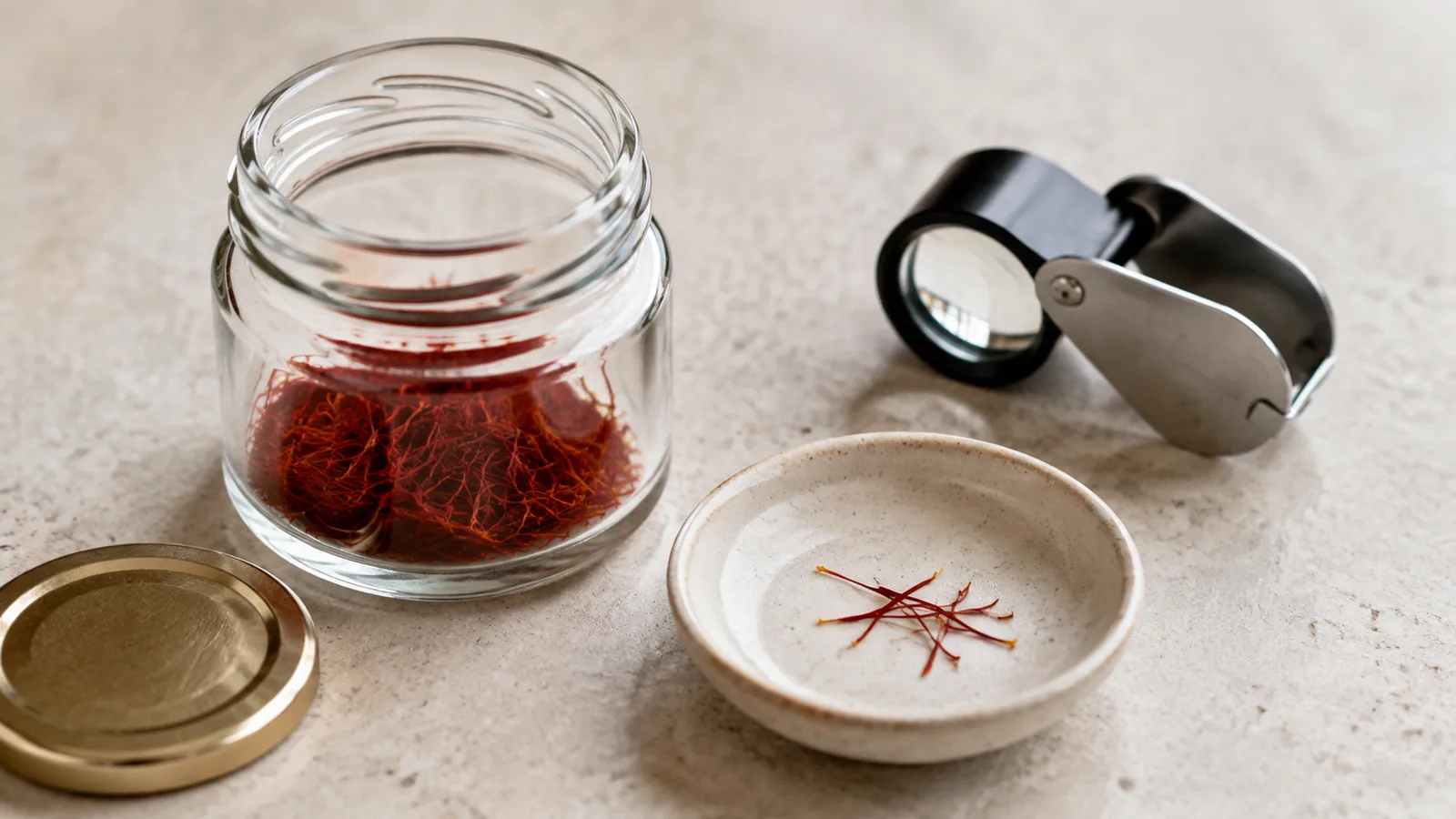
Whole stigmas give you more structure to examine than powder. Genuine threads are typically deep red to orange-red and naturally irregular, often widening toward one end. Some attached yellow or orange style tissue can be genuine; its presence does not automatically mean filler.
Be cautious if the material looks like flat strips of identical width, paper fibres, unrelated petals or heavily coated strands. Even then, the naked eye has limits. A peer-reviewed microscopy study of saffron look-alikes found that convincing dyed materials can resemble real filaments, which is why visual inspection is a screen rather than certification.
5. Treat aroma as a freshness clue
Well-kept saffron should have a noticeable, complex aroma. People describe it in different ways—floral, grassy, hay-like or honeyed—with an underlying bitter character. A musty odour suggests poor storage, while no aroma may indicate age or weak material.
Sealed packaging may prevent you from smelling the product before purchase, and added fragrance can mislead. Aroma helps once you open a known food product; it cannot establish purity on its own.
6. Use price as a warning signal, not a quality score
Saffron requires labour-intensive harvesting and processing, so an implausibly cheap offer deserves scrutiny. But “most expensive” does not mean “best.” Retail format, origin, packaging, shipping, seller margin and scarcity all affect price.
Compare the price per gram, not just the pack price. Buy an amount you can use while it is still aromatic, because a large bargain pack stored badly may deliver less value than a small fresh one.
7. Know what a water test can and cannot do
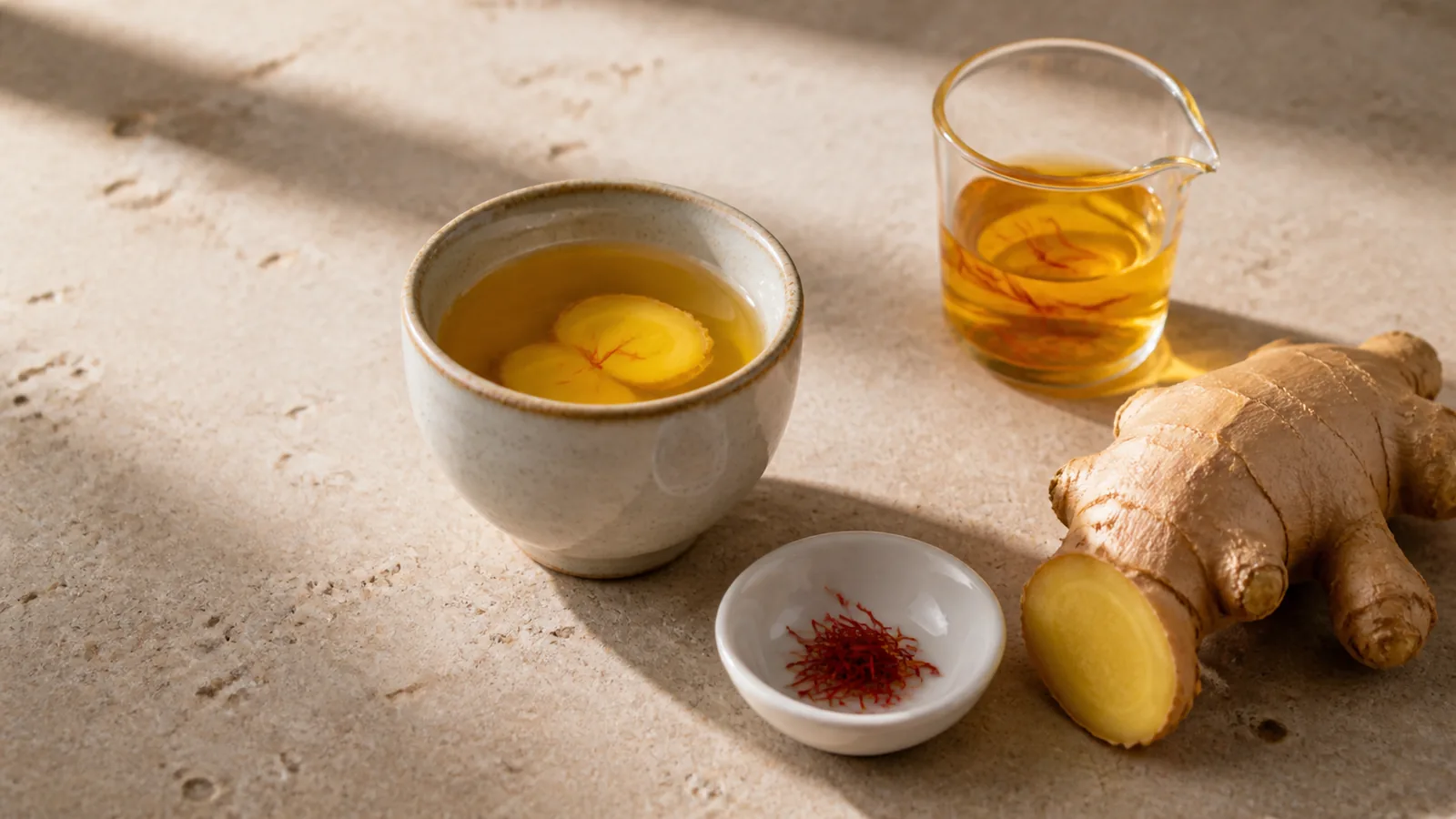
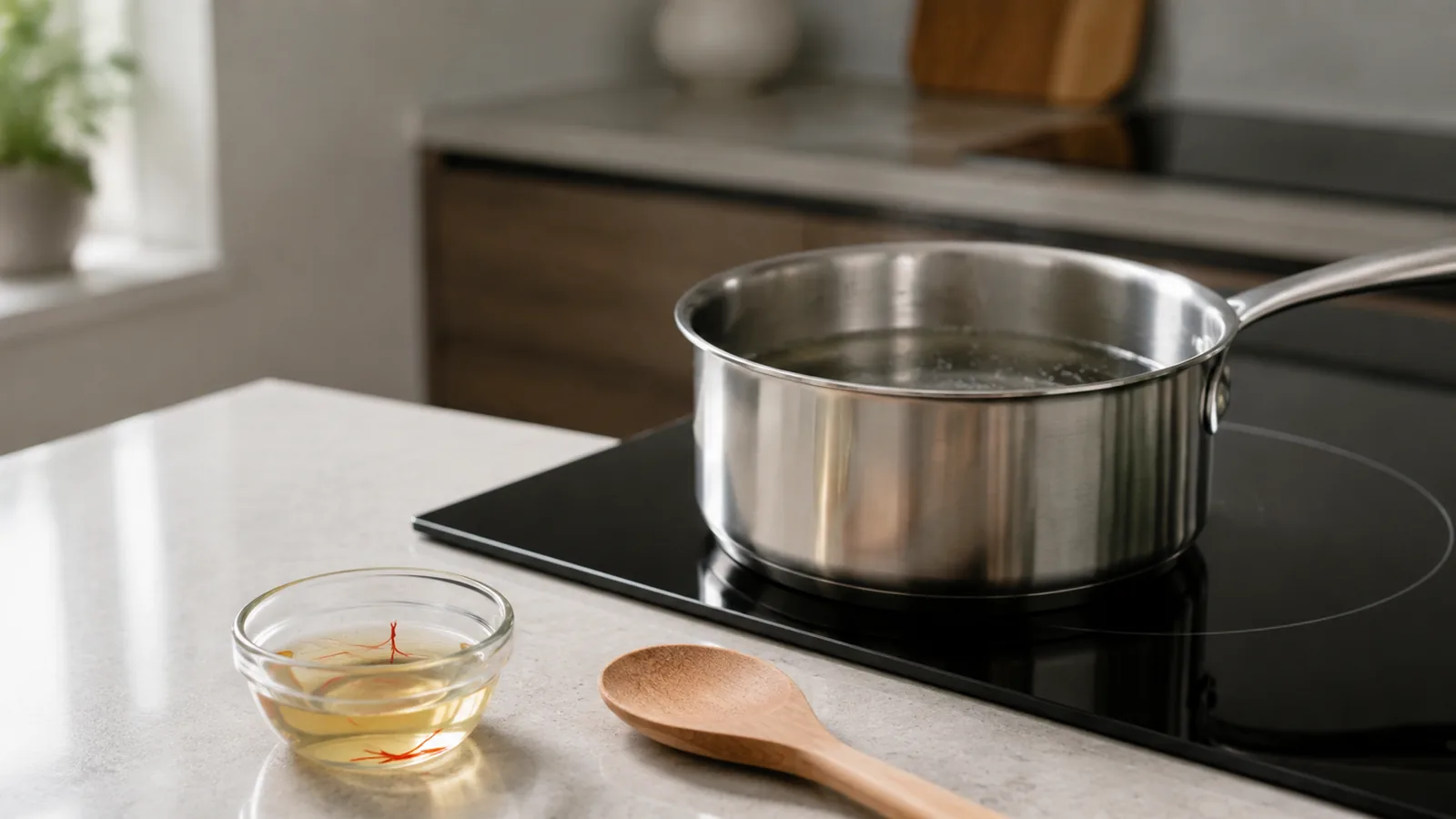
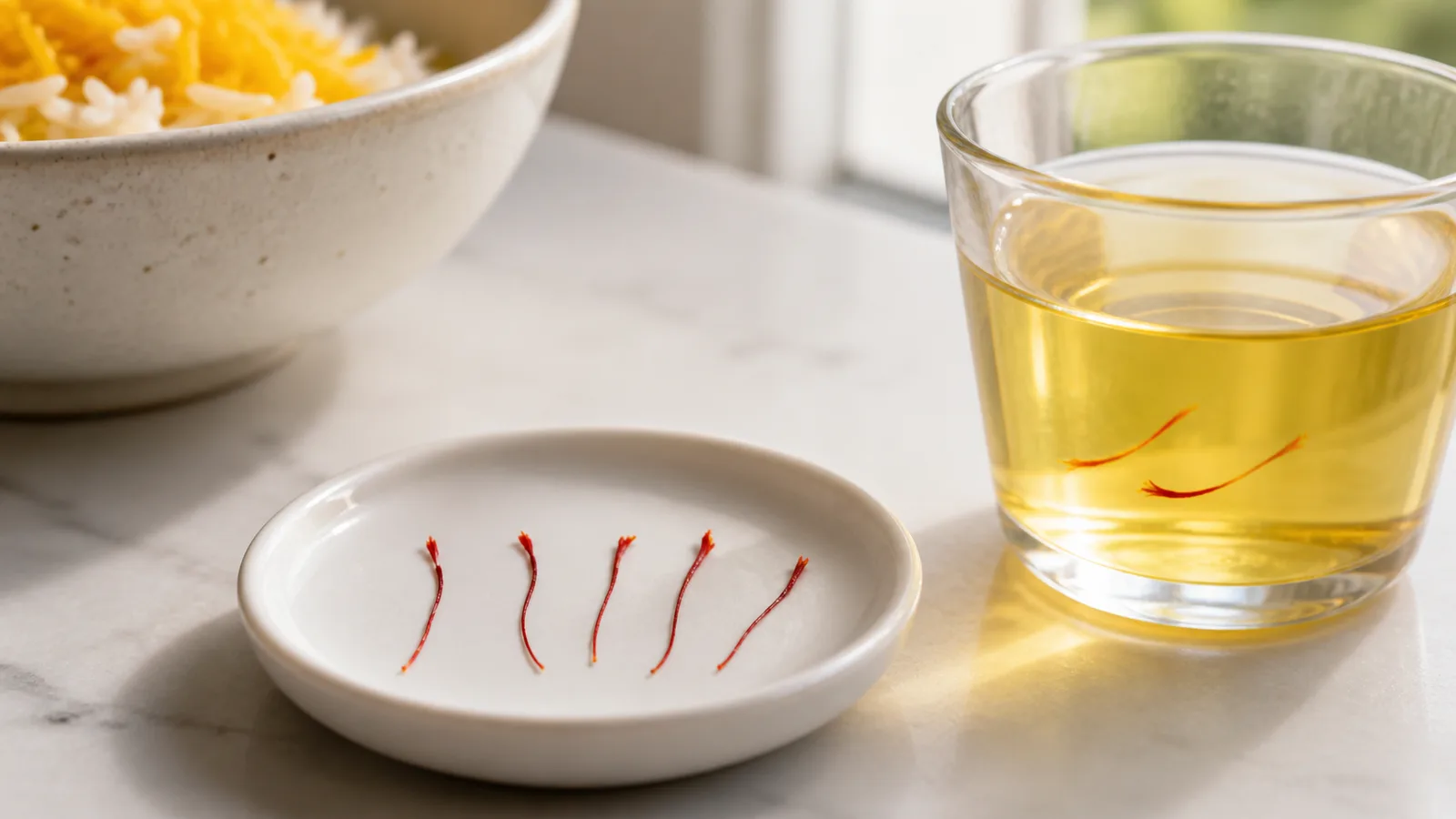
After purchase, a few threads placed in clear warm water should gradually colour the liquid yellow to golden while remaining recognisable. This can reveal some obvious problems.
It cannot prove purity. Release speed changes with temperature, thread size, cutting, age and storage, and dyed substitutes can imitate a plausible result. Do not reject or approve an entire pack because of an internet rule such as “real saffron always takes exactly ten minutes.” For the limits of these checks, see how to tell whether saffron is pure.
8. Powder is not automatically inferior
Powdered saffron can be authentic and high quality. It is simply harder for a buyer to inspect because grinding hides the plant structure and makes undeclared additions easier to conceal. Buy powder when the supplier offers strong traceability and credible lot testing, or grind inspected threads at home.
Do not assume that whole threads preserve strength forever. Both forms need protection from light, heat, air and moisture, and both can be mishandled.
Online saffron buying checklist
- Confirm Crocus sativus, form, net weight and stated origin.
- Look for lot and date information, not only lifestyle photography.
- Read the full delivery, return and contact terms.
- Check whether a quality report matches the product and lot.
- Compare price per gram with similar forms and origins.
- Start with a modest pack if the seller or crop is new to you.
- Save the listing, receipt and lot details until you have inspected the delivery.
Red flags that justify walking away
Pause when the seller hides the net weight or origin, uses contradictory product descriptions, promises medical cures, shows a certificate with no identifiable lot, or offers a price that makes no sense for the stated product. Do not use a delivered pack if it is damp, mouldy, contaminated, unexpectedly coated or in damaged packaging.
“Guaranteed authentic” is only as reliable as the seller and evidence behind it. Good purchasing information should help you verify the claim rather than pressure you to accept it.
How to buy saffron with confidence
Choose the most transparent lot you can reasonably afford: clear identity and origin, useful dates, responsible seller details, suitable packaging and evidence whose scope you understand. Then keep the pack sealed, cool, dry and dark.
You can review the available saffron products by form and pack information. For questions about a displayed product or lot, contact the team before ordering.