You cannot prove that saffron is pure with one home test. If you are asking how to tell if saffron is real or how to check original saffron at home, judge pure saffron authenticity in layers: check the seller and label, inspect whole threads, observe how a small sample behaves in water, and use independent laboratory testing when certainty matters. Each home check can reveal a warning sign, but none is conclusive by itself.
What “pure saffron” actually means
Pure saffron should contain only the dried pistil material of Crocus sativus, in whole, cut or powdered form, as declared. It should not be bulked out with plant stems, safflower, calendula, dyed fibres, paper, minerals, sugar or another substance.
Quality and purity are related but different. A batch may be genuine saffron yet have weak colour or aroma because it is old, damp or poorly processed. Another sample may contain good saffron mixed with cheaper material. Appearance alone cannot reliably separate every case.
How to tell if saffron is pure at home
To check purity of saffron responsibly, use the following steps as a set of clues rather than treating any single result as proof.
1. Start with the label and seller
Before opening the pack, look for the botanical name Crocus sativus, net weight, country of origin, a lot or batch identifier, packing or harvest information, and a real business contact. A very low price, vague origin or missing traceability is a reason to be cautious, not automatic proof of fraud.
Country names are not an authenticity test. A phrase such as “Turkish saffron,” “Indian saffron” or “Spanish saffron” can be used inconsistently, so check the botanical identity and contents rather than trusting a regional word on its own.
2. Inspect whole threads closely
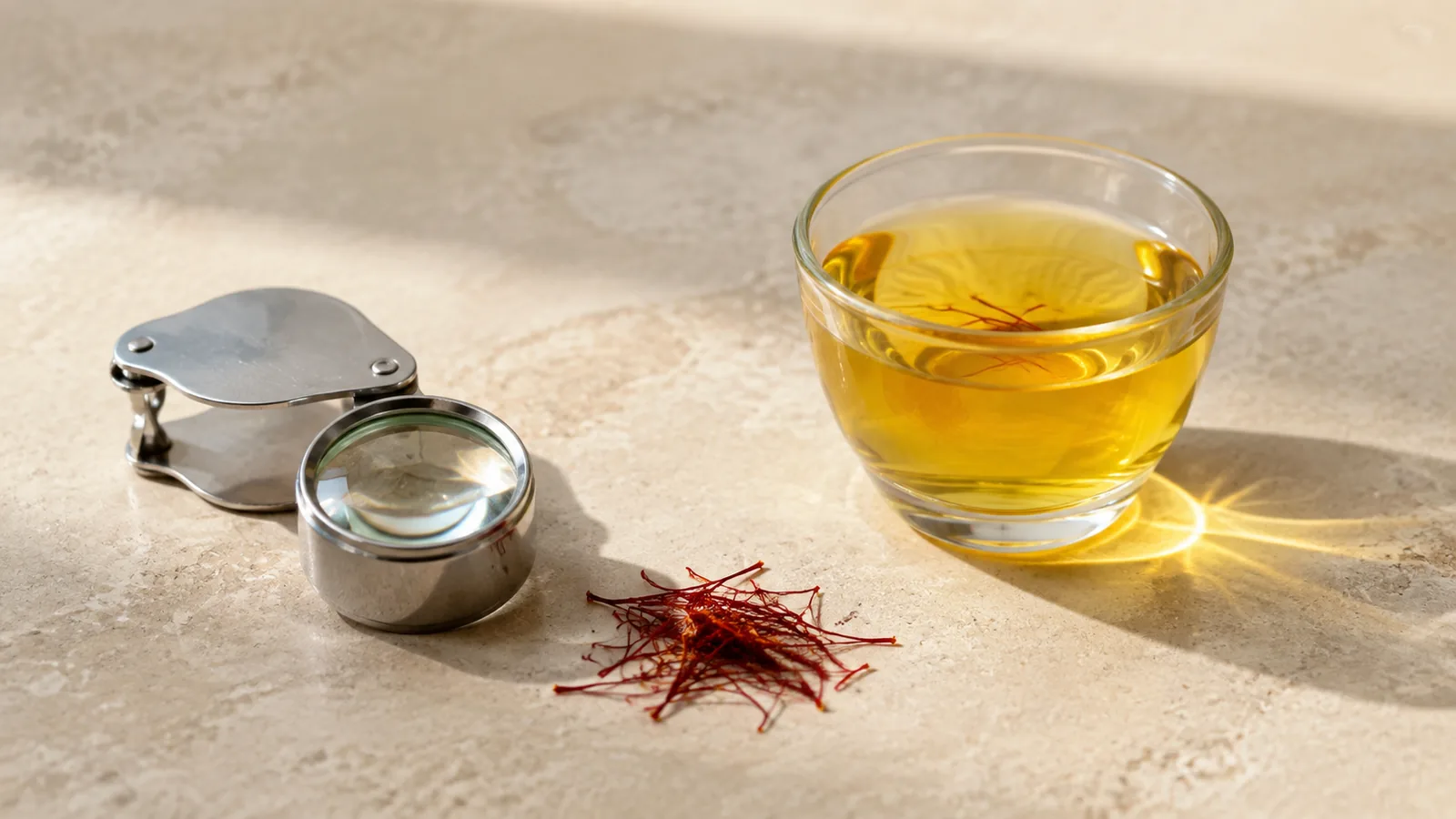
Genuine saffron stigmas are deep red to orange-red and naturally irregular. Under magnification, an intact stigma usually narrows toward one end and broadens into a trumpet-like tip. Research comparing real filaments with look-alikes found that microscopic papillae at the widened rim were more discriminating than colour or a serrated edge alone. The peer-reviewed saffron microscopy study also showed why convincing dyed fibres can fool the naked eye.
A little yellow or orange style tissue can be genuine, depending on how the saffron was trimmed and graded. Perfectly uniform length is not a purity requirement. Conversely, smooth flat strips of identical width, obvious paper-like fibres or a large amount of unrelated plant material deserve closer examination.
3. Use water as a screen, not a verdict
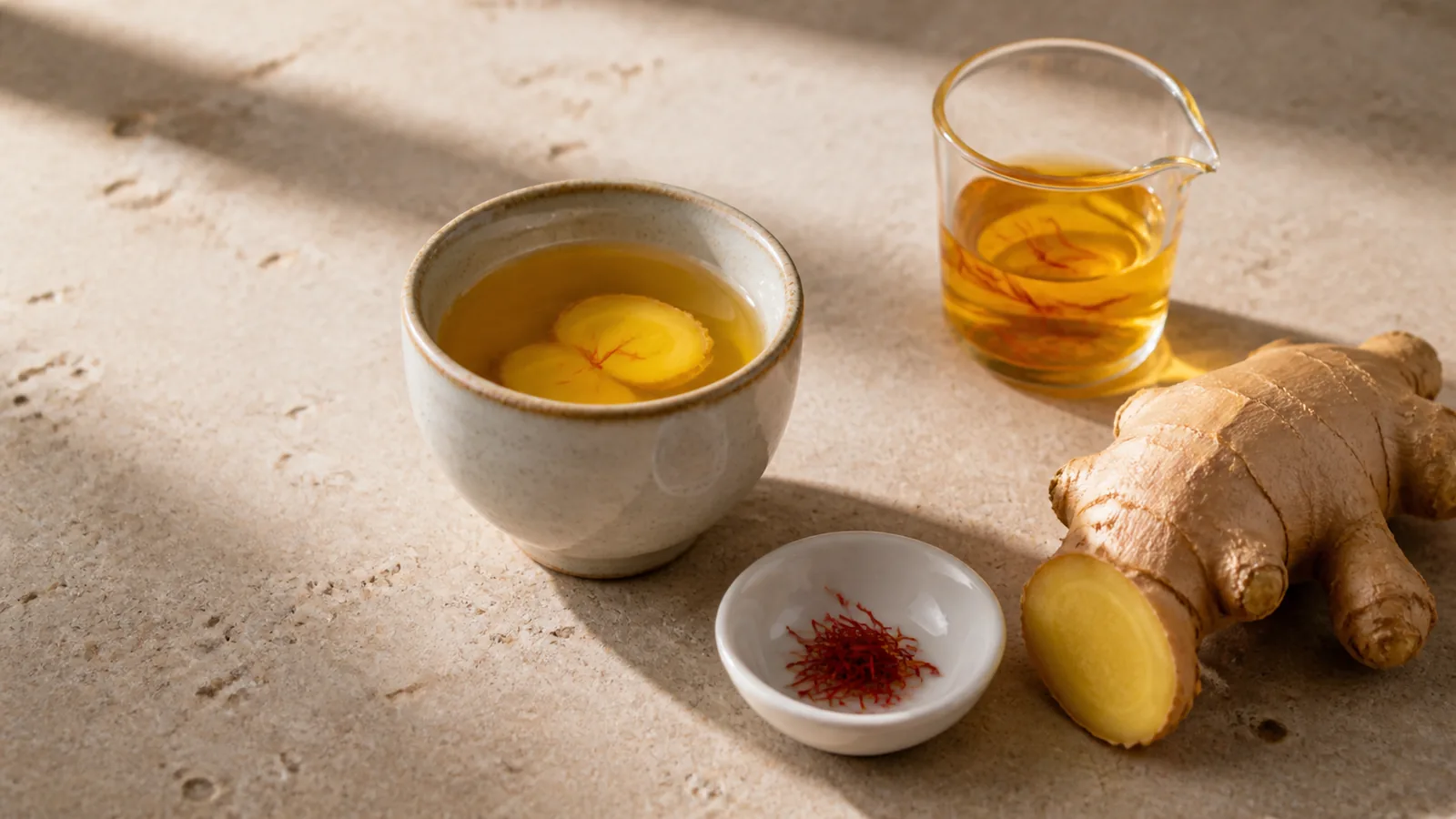
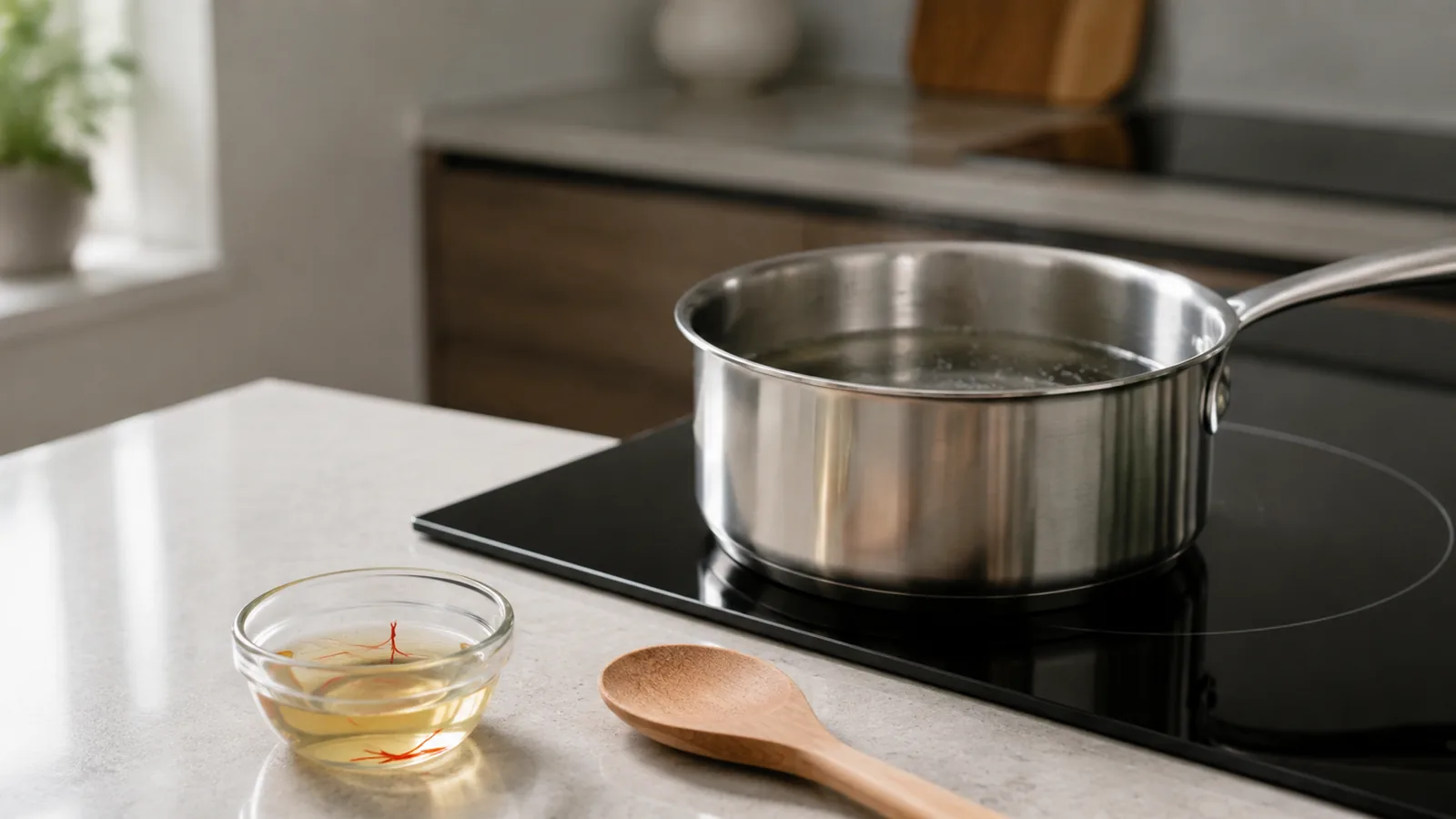
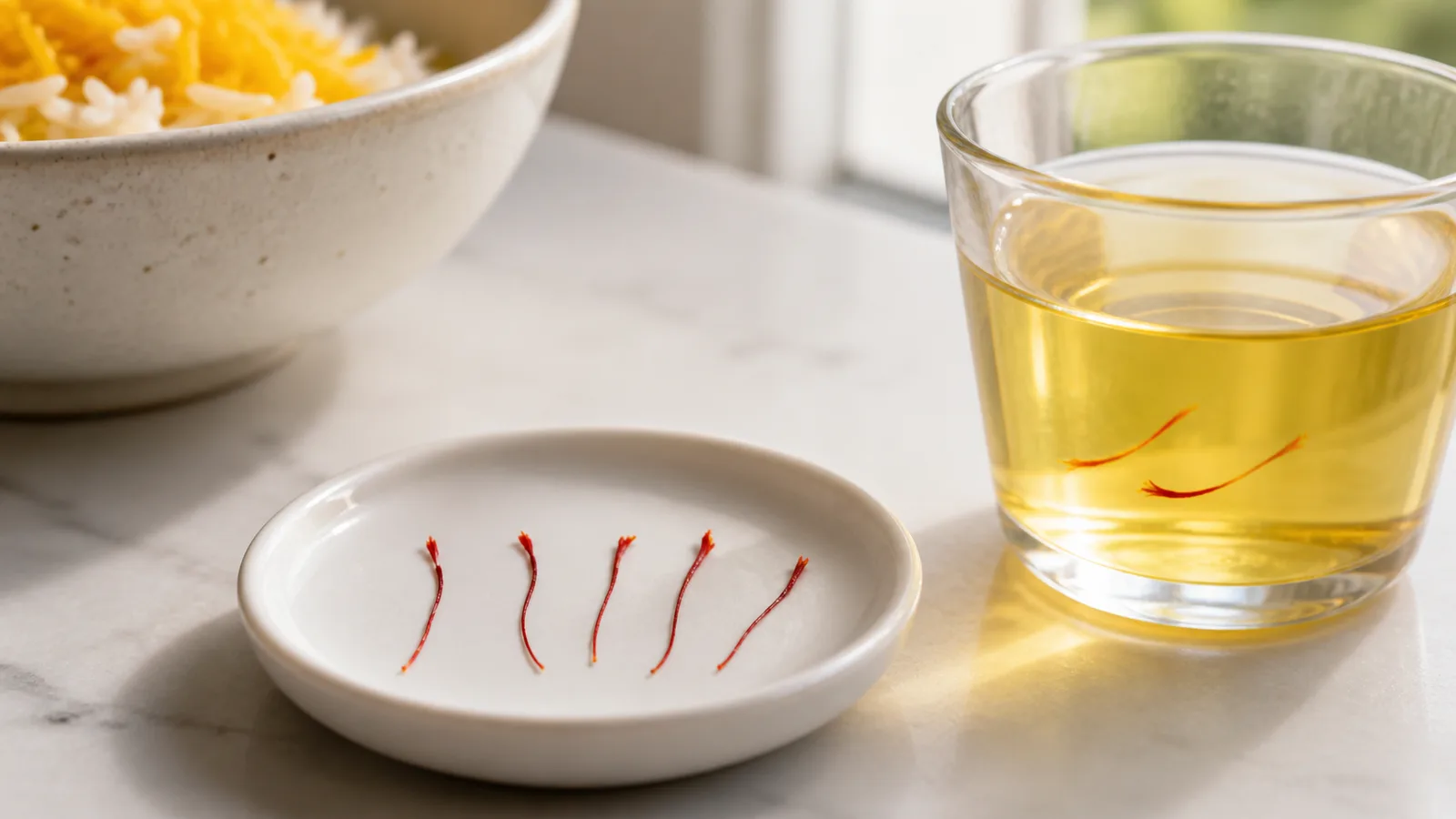
Place a few threads in clear room-temperature or warm water. Genuine saffron should colour the surrounding water yellow to golden while the threads remain recognizable. Note the aroma and the shape of the threads before and after wetting.
Do not rely on a fixed rule such as “real saffron always takes exactly 10 minutes” or “red water always means fake.” Release speed changes with water temperature, thread size, cutting, age, storage and quality. Dyed substitutes can also be designed to imitate a plausible colour change. The saffron water test is useful for spotting an obvious problem, but it does not certify the rest of the pack.
4. Assess aroma carefully
Well-kept saffron is strongly aromatic, often described as floral, grassy, hay-like or honeyed, with an underlying bitter character. A musty smell can indicate poor storage. A harsh artificial perfume, no aroma at all or a sugary smell is a warning, but aroma varies with age and processing and can be imitated.
There is no need to taste a product you suspect is contaminated. If you do use a known food sample, saffron should not taste sugary. Extreme saltiness, sweetness or a chemical aftertaste warrants caution, but sensory impressions still cannot identify every adulterant.
5. Prefer threads when visual inspection matters
Powdered saffron can be completely genuine; the old claim that pure saffron exists only as whole threads is false. Powder is simply harder for a buyer to inspect because grinding hides the plant structure and makes fillers easier to conceal. Buy powder only when the seller provides strong traceability or testing, or grind verified threads yourself.
Which common home tests are unreliable?
Milk does not establish purity. Fat, protein, temperature and the amount of saffron all change how colour appears, while a dye can colour milk too. Rubbing threads on paper can reveal added oil or loose colour in some cases, but it cannot confirm botanical identity.
Avoid flame tests, chemical cleaners, acids or other improvised reactions. They create unnecessary safety risks and still do not provide the controlled conditions or reference materials used by a laboratory.
What can laboratory testing confirm?
Professional testing can examine the plant material under magnification, measure moisture and foreign matter, assess characteristic colour-, aroma- and taste-related compounds, and screen for dyes or other adulterants. The ISO 3632 framework includes methods for both filaments and powder; modern laboratories may also use chromatography, spectroscopy or DNA-based approaches.
A review of saffron quality and authentication methods explains that crocins, picrocrocin and safranal help describe commercial quality, while more targeted analytical methods may be needed to identify adulteration. An ISO category or a strong colour result is not, on its own, proof that every possible adulterant has been excluded.
What to ask a seller
- Is the product whole saffron, cut filaments or powder?
- Can the pack be traced to a lot and origin?
- When was it harvested or packed?
- Was the batch tested, and by which laboratory?
- Which methods and results appear on the report?
- Does the report identify the same lot shown on the pack?
A report is most useful when it names the sample, date, method and issuing laboratory. A generic certificate image with no matching lot number tells you much less.
Warning signs that justify stopping
Do not use the product if you find obvious non-food material, an unexplained coating, signs of moisture or mould, damaged packaging, or an odour that suggests contamination. Keep the packaging, lot details and receipt, photograph the issue, and contact the seller or the relevant food-safety authority.
For purchase-time checks—rather than testing an opened sample—see the features to review when buying authentic saffron.
The most reliable approach
To tell whether saffron is likely to be real, combine traceability, thread structure, aroma and a cautious water observation. To establish purity, rely on a representative sample tested by a competent laboratory. That may sound less dramatic than a one-minute kitchen trick, but it is the honest distinction between screening for warning signs and confirming what a product contains.