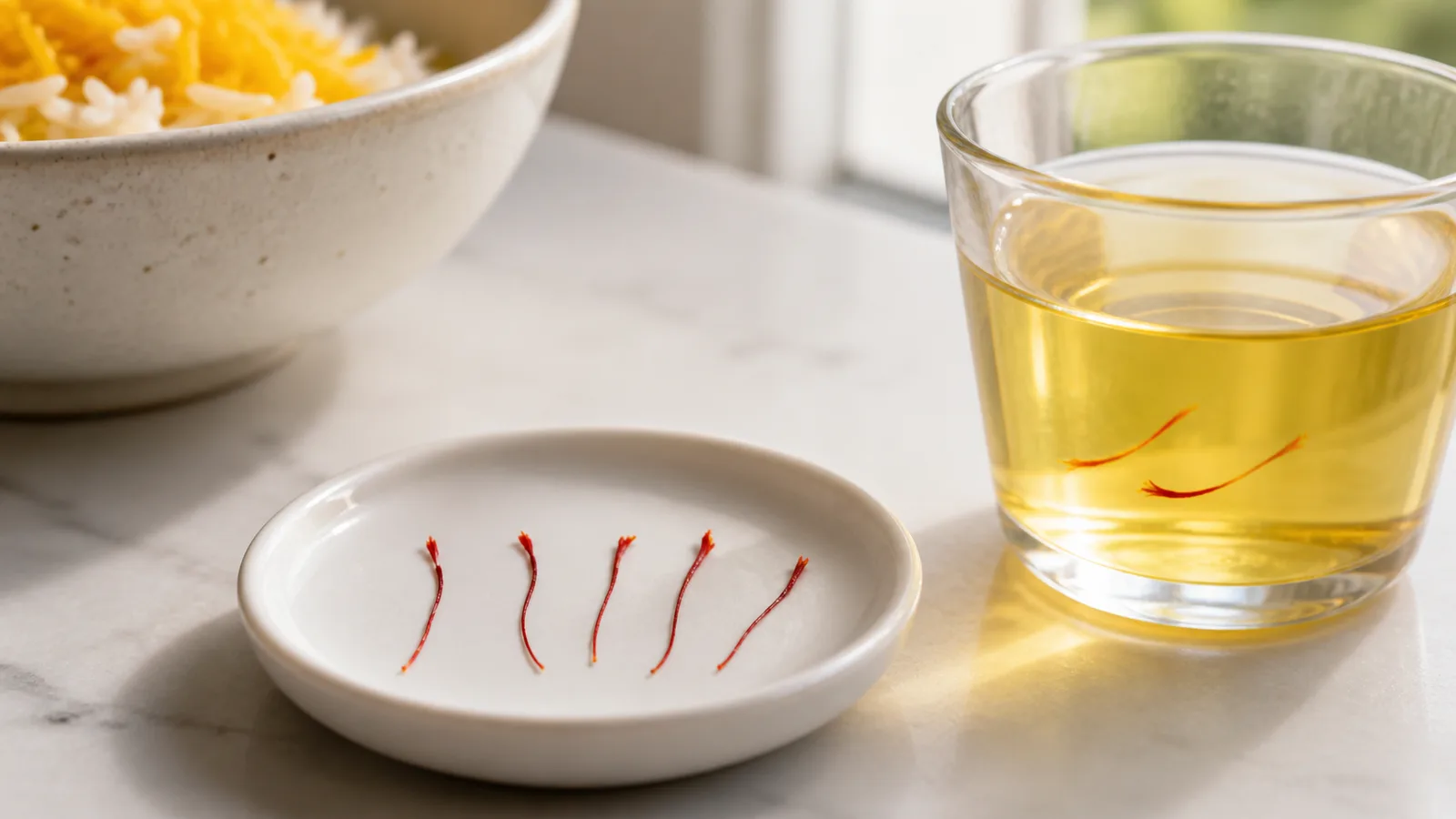
If one country must be named, Iran has the strongest overall claim: it is the world’s largest saffron producer and is home to a long-established industry, particularly in Khorasan. But the highest quality saffron country is not decided by origin alone. A carefully harvested, properly dried and traceable batch from Iran, Kashmir, La Mancha or Herat can be excellent; a poorly stored batch from any famous origin can be disappointing. For a buyer looking for the best saffron in the world, the safest conclusion is to compare origin and lot evidence together.
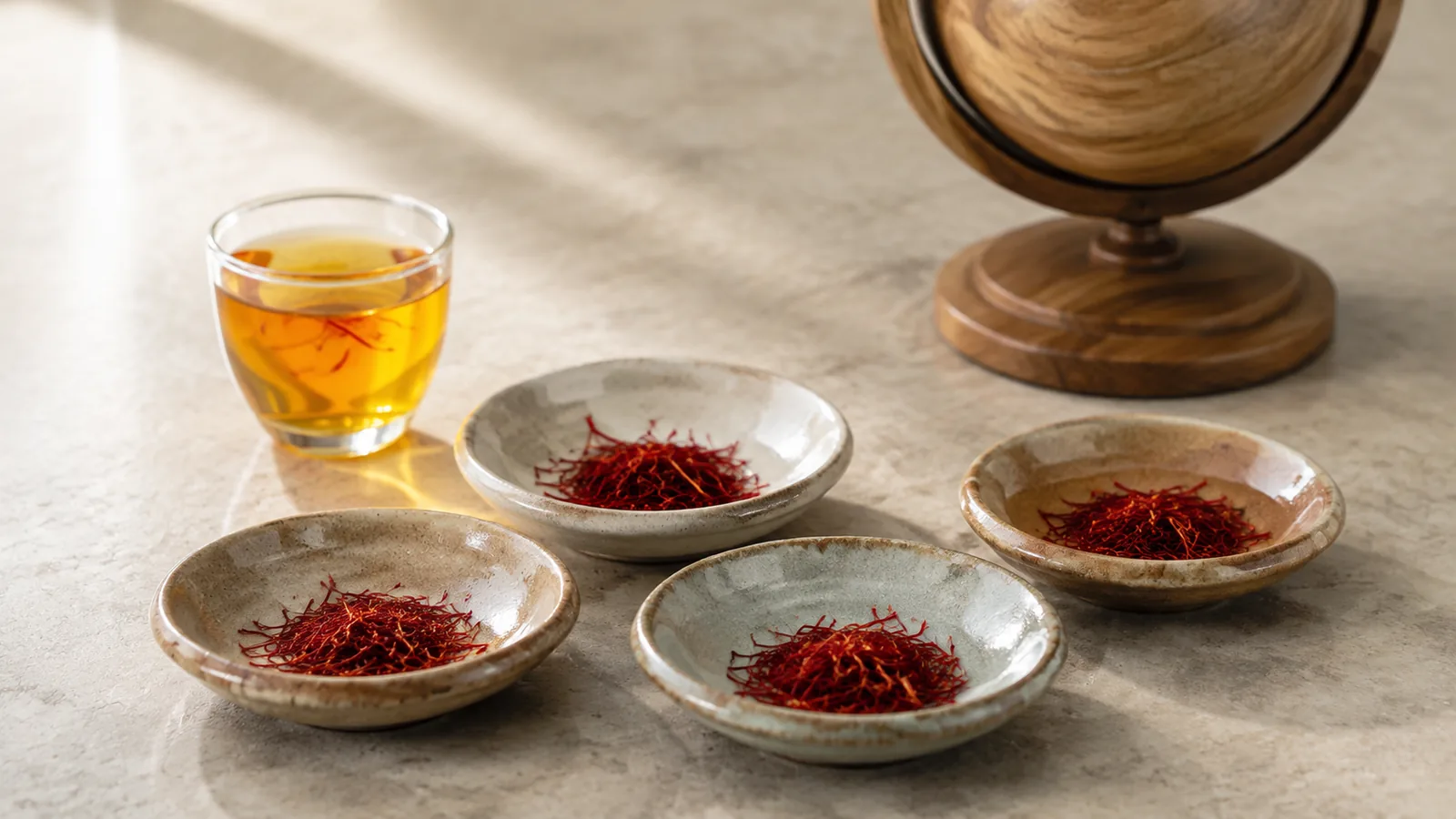
Quality and production volume are not the same thing
“Which country has the best saffron?” sounds like a simple question, yet it combines two different ideas. Production volume can be measured by country. Quality belongs to a particular lot of saffron and depends on the plant material, harvest timing, separation of the stigmas, drying, moisture, storage, purity and age.
The current ISO 3632-1:2025 specification applies to saffron made from Crocus sativus pistils in filament, cut-filament and powder forms. It sets requirements for the product rather than declaring one nation the permanent winner. That is the useful principle for buyers: origin can tell you about a tradition and production system, but the pack in your hand still needs its own evidence.
Why Iran is usually the first answer
Iran is both the largest producer of saffron in the world and the dominant force in global supply. In a 2026 value-chain update, the Food and Agriculture Organization described Iran as producing 85–90% of the world’s saffron. Production is concentrated in Khorasan Razavi and South Khorasan, where cultivation knowledge has been passed between generations.
That scale matters. Iran has deep experience in growing, picking, separating and drying saffron, and buyers can find many thread styles and commercial grades. Iranian saffron can deliver strong colour, a clear aroma and the characteristic bitter flavour cooks expect. It is therefore reasonable to answer “Iran” when someone asks which country produces the best saffron in broad terms.
It is not reasonable to assume that every Iranian pack is automatically superior. Handling varies between farms, processors and sellers. Saffron may also be exported in bulk and later packed or traded through another country, so the country on a distributor’s address is not necessarily the place where the flowers grew.
Other countries known for distinctive saffron
India: Kashmir saffron
Kashmir has a recognised saffron tradition and a protected geographical identity. India’s official GI register lists Kashmir Saffron as a registered geographical indication, with registration currently valid through December 2028. A genuine GI-labelled product gives the buyer a defined origin and traceability framework; it does not remove the need to check freshness and the individual pack.
Spain: Azafrán de La Mancha
Spain has a smaller production base but a well-known protected origin in Castilla-La Mancha. The Spanish agriculture ministry records Azafrán de La Mancha as a protected designation of origin with a current product specification and an official control body. The designation applies to compliant, certified saffron from that area—not to every jar packed or sold in Spain.
Afghanistan: Herat-Bastan saffron
Herat has developed a recognised origin-linked saffron sector. The FAO’s official profile for Herat-Bastan Saffron describes thread saffron from specified districts of Herat Province and links its physical and sensory characteristics to the local environment and production practices.
Other growing regions
Greece and Morocco are also established saffron origins, while smaller projects exist in other countries. These places belong in a discussion of saffron-producing countries, but a long list is not a quality ranking. Output changes from season to season, and small production does not mean weak saffron any more than very large production guarantees an outstanding batch.
How to compare saffron from different countries
Start with information that follows the actual lot, not with a flag or a broad marketing phrase.
- Botanical identity: the label should identify Crocus sativus and state whether the product is whole, cut or powdered.
- Traceability: look for a lot number, a named producer or responsible seller, and a clearly stated country or protected region of origin.
- Harvest and packing information: newer is not automatically better, but a date helps you judge age and storage history.
- Independent testing: a useful report identifies the same lot and states the methods and results. A generic certificate image proves very little.
- Condition: the pack should be dry, clean and well sealed, without mustiness, condensation or unrelated material.
- Value: compare the evidence and usable quantity, not simply the highest price. Expensive saffron can still be old or poorly handled.
Whole threads allow more visual inspection than powder, although genuine saffron can be sold in either form. Country, thread appearance and aroma are useful clues; none can replace lot-specific quality and authenticity testing when certainty matters.
Which origin is best for cooking?
For most home kitchens, a fresh, aromatic and traceable pack matters more than winning a country debate. Iranian saffron is widely available in different grades and is a versatile choice for rice, drinks, desserts and savoury dishes. Protected-origin Kashmir, La Mancha and Herat products can appeal when regional provenance is part of what you want to buy.
Use the same comparison for all of them: open the pack, note the aroma, brew a small measured sample, and see whether the colour and flavour suit the dish. A famous name cannot rescue saffron that has spent too long in light, heat, air or moisture.
Questions buyers often ask
Which country produces the most saffron?
Iran. It is the world’s leading saffron producer by a wide margin. That production answer should not be confused with a guarantee that every individual Iranian batch is the best.
What are the top saffron-producing countries?
Iran is the dominant producer. India, Afghanistan, Spain, Greece and Morocco are among the other established commercial origins. Exact rankings below Iran can change with the crop year and with the data source, so an undated “top 10” list is less useful than current, traceable information.
Is Iranian saffron the best?
Excellent Iranian saffron deserves its reputation, and Iran is the strongest general answer to where the best saffron comes from. Still, quality varies by lot. A buyer should prefer well-documented, fresh saffron from a responsible producer over a vague pack that relies only on the word “Iranian.”
Does “packed in Spain” mean the saffron was grown there?
Not necessarily. Packing location, seller location and agricultural origin are different facts. If Spanish origin matters to you, look for an explicit origin statement or a valid Azafrán de La Mancha PDO label rather than inferring it from the address of the packer.
A practical answer
Iran is the best-supported single answer to the question because it combines enormous production, long cultivation experience and the ability to produce exceptional saffron. The more accurate buying answer is narrower: choose the best documented batch, not merely the most famous country name.
You can compare the current saffron products by form and pack information, or contact the team if you need origin or lot details before ordering.