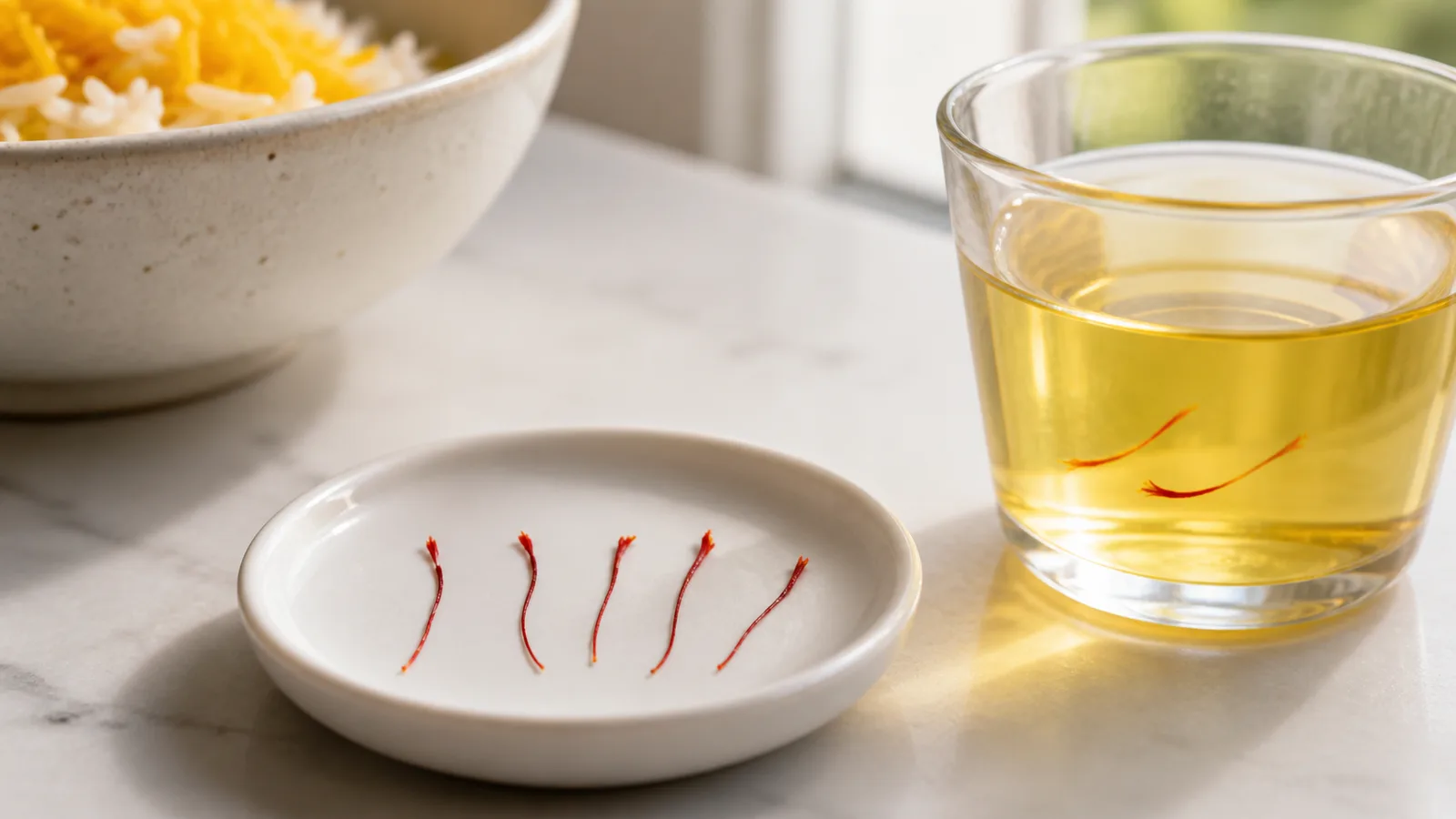
Why is saffron expensive—or, put another way, why does saffron cost so much? Each flower supplies only three red stigmas, and a short harvest has to be picked, separated and dried with care. That creates a high price per kilogram, but because a recipe uses a small pinch, the cost per dish is usually far lower than the headline price suggests.
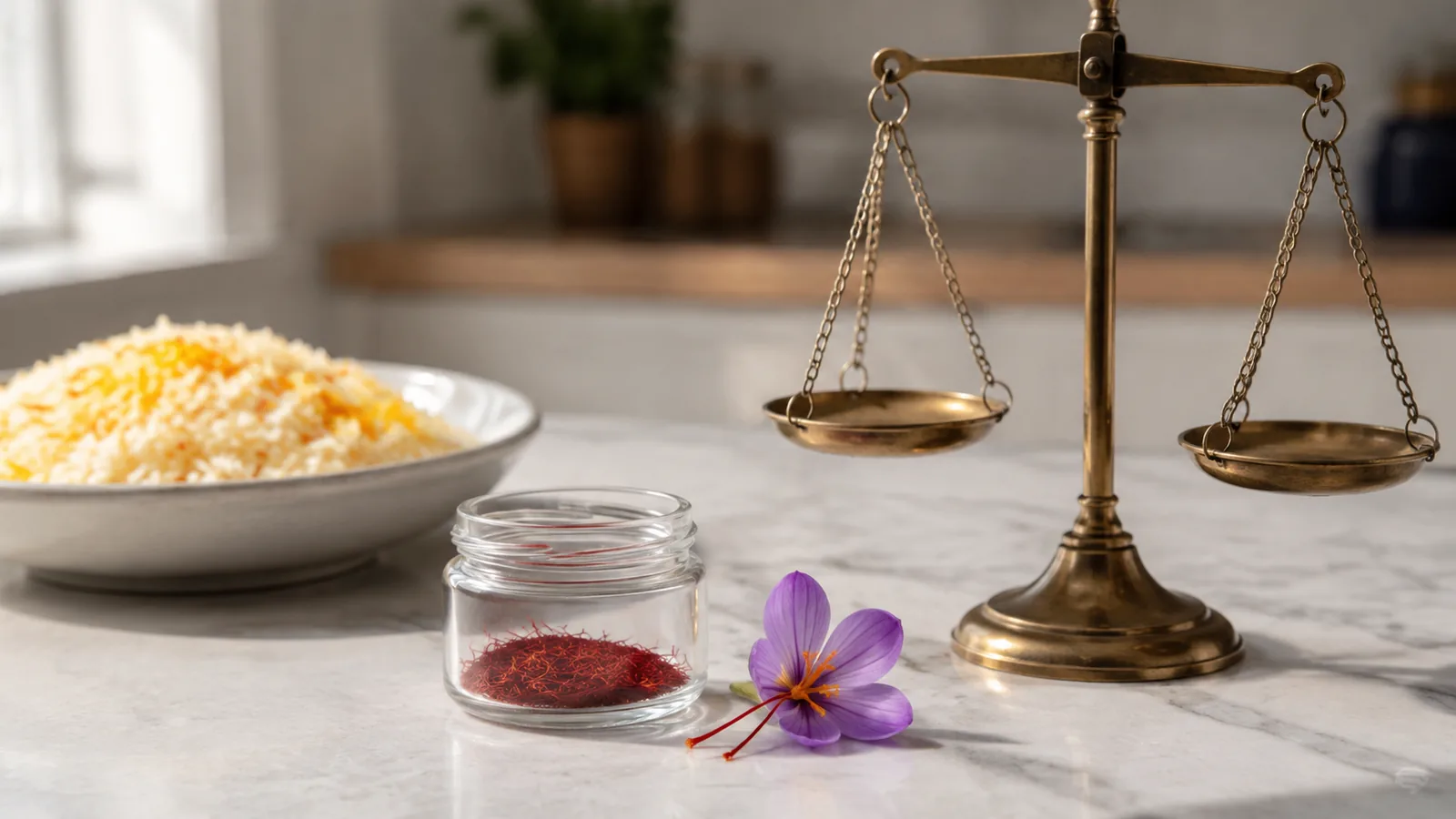
What is saffron, and why is it so expensive?
Saffron is the dried stigma of Crocus sativus, an autumn-flowering crocus. The threads carry the spice’s distinct flavour, aroma and colour. They are tiny, light and easily damaged, so producing a saleable amount takes far more flowers and handling than most kitchen spices.
It is often called the most expensive spice in the world by weight. That description compares price per unit weight, not the cost of using it in a meal. A kilogram is a commercial quantity; a home recipe may use only a fraction of a gram.
The main reasons saffron is expensive
The reasons saffron is expensive begin in the field and continue after harvest:
- each flower yields only three stigmas;
- flowers open during a concentrated seasonal window;
- delicate picking and separation remain labour-intensive;
- fresh stigmas must be dried without losing their useful qualities;
- sorting, testing, packaging and protected storage add cost;
- small retail packs cost more per gram to handle than bulk lots.
No single point explains the whole price. Cheap labour cannot change the flower’s small yield, and a large harvest still loses value if drying or storage is poor.
What makes saffron so expensive at harvest?
Crocus sativus flowers once in its annual cycle, with much of the bloom arriving over days or weeks. Pickers have to keep pace while flowers are fresh. The stigmas are then separated from petals and pollen-bearing parts before careful drying.
“Early morning” is often given as a universal harvest rule. Cool, fresh flowers can be easier to handle then, but the operational point is prompt collection and processing, not one clock time in every climate.
The University of Vermont’s Saffron by the Numbers uses an estimate of about 167 flowers for one gram of dried saffron and observed that stigma separation took longer than picking the same number of flowers. The ratio varies with stigma weight, trimming and final moisture, but it shows why tens of thousands of flowers are needed for a pound and roughly hundreds of thousands for a kilogram.
Limited supply does not mean saffron grows in only four countries
Iran is the leading producer, and India, Spain and Greece have well-known regional traditions. Saffron is also grown in Afghanistan, Morocco, Italy, the United States and other countries. The old claim that only a few locations have an “ideal” climate is too absolute.
Commercial supply remains concentrated because climate is only one requirement. Farms need healthy corms, draining soil, water at the right stages, harvest labour, drying capacity, quality systems and viable buyers. New growing areas can broaden supply without instantly producing export-scale volumes.
Why is kesar so expensive?
Kesar is a common South Asian name for saffron, so the underlying cost is the same. Kashmir-grown saffron may carry additional value for origin, regional reputation, harvest size and supply-chain reasons. The name “kesar” by itself does not prove origin, purity or grade.
Compare the actual product: net weight, whole threads or powder, seller identity, origin wording, batch information, packaging and any credible testing. A romantic regional description is not a substitute for those details.
Why can Spanish saffron be expensive?
Spanish-grown saffron can reflect European labour costs, limited regional output, origin controls for qualifying products, testing, packaging and distribution. Not every pack traded or packed in Spain is Spanish-grown, so the exact origin statement matters.
The same principle applies elsewhere: country name can explain part of the offer but cannot by itself prove freshness, colour strength or purity. Different grades, crop years, forms and pack sizes should not be compared as if they were identical.
Quality control, testing and authenticity have a real cost
Saffron’s high value makes dilution, added foreign material, artificial or synthetic colouring and misleading origin claims commercially tempting. Visual inspection can catch obvious problems but cannot answer every quality question for a commercial lot.
The official ISO 3632-1:2025 saffron specification covers dried saffron in filament, cut-filament and powder forms. Representative sampling, laboratory work, traceable handling and secure packaging cost money. They can also prevent an adulterated cheap product from being mistaken for a bargain.
A high price alone is not evidence that those controls were used. Quality claims should be supported by the product and seller information, not inferred from premium packaging.
Demand and rarity influence price, but need context
Saffron is used in Persian, Indian, Mediterranean and other cuisines, and it is marketed for cosmetics, traditional uses and research-related products. Wider demand can tighten a limited seasonal supply, especially after a smaller harvest.
Medicinal interest and talk of health benefits should not be used as a blanket explanation of value. Culinary threads do not become a proven treatment because saffron has been studied, and a supplement extract is not interchangeable with a pinch used in cooking.
Saffron is rare by finished weight, but genuine product is sold worldwide. Our article on why saffron is so costly follows the production-cost chain in greater detail; this page focuses on what that price means for a buyer.
How expensive is saffron?
There is no timeless average. A useful price needs a date, currency, country, unit and trade level. Farm-gate kilograms, export lots, wholesale packs and a tested one-gram retail jar can have very different per-gram prices.
Check the arithmetic before comparing offers. Divide the total price by the net grams, account for shipping and tax, then compare like form, grade, origin evidence and pack size. Our saffron price page provides dated context rather than pretending one number applies everywhere.
Is saffron worth the price?
It can be when its aroma, colour and flavour matter to the dish and the product is genuine. Value depends on performance in use, not simply how expensive the jar looks.
Buy an amount you can use while it is in good condition. Whole threads are generally easier to inspect than powder. Store them airtight, away from light, heat and moisture, and measure small amounts rather than assuming more always tastes better.
A suspiciously low offer deserves scrutiny, but the most expensive option is not automatically the best. Our guide to buying high-quality saffron explains what to check before paying a premium.
Why saffron is so expensive, in one answer
Why saffron is expensive comes down to small biological yield, concentrated manual work, careful drying and the cost of delivering a clean, verifiable product in tiny packs. Origin, grade, demand and distribution then move the final price. That makes saffron expensive by weight without necessarily making a well-measured serving extravagant.