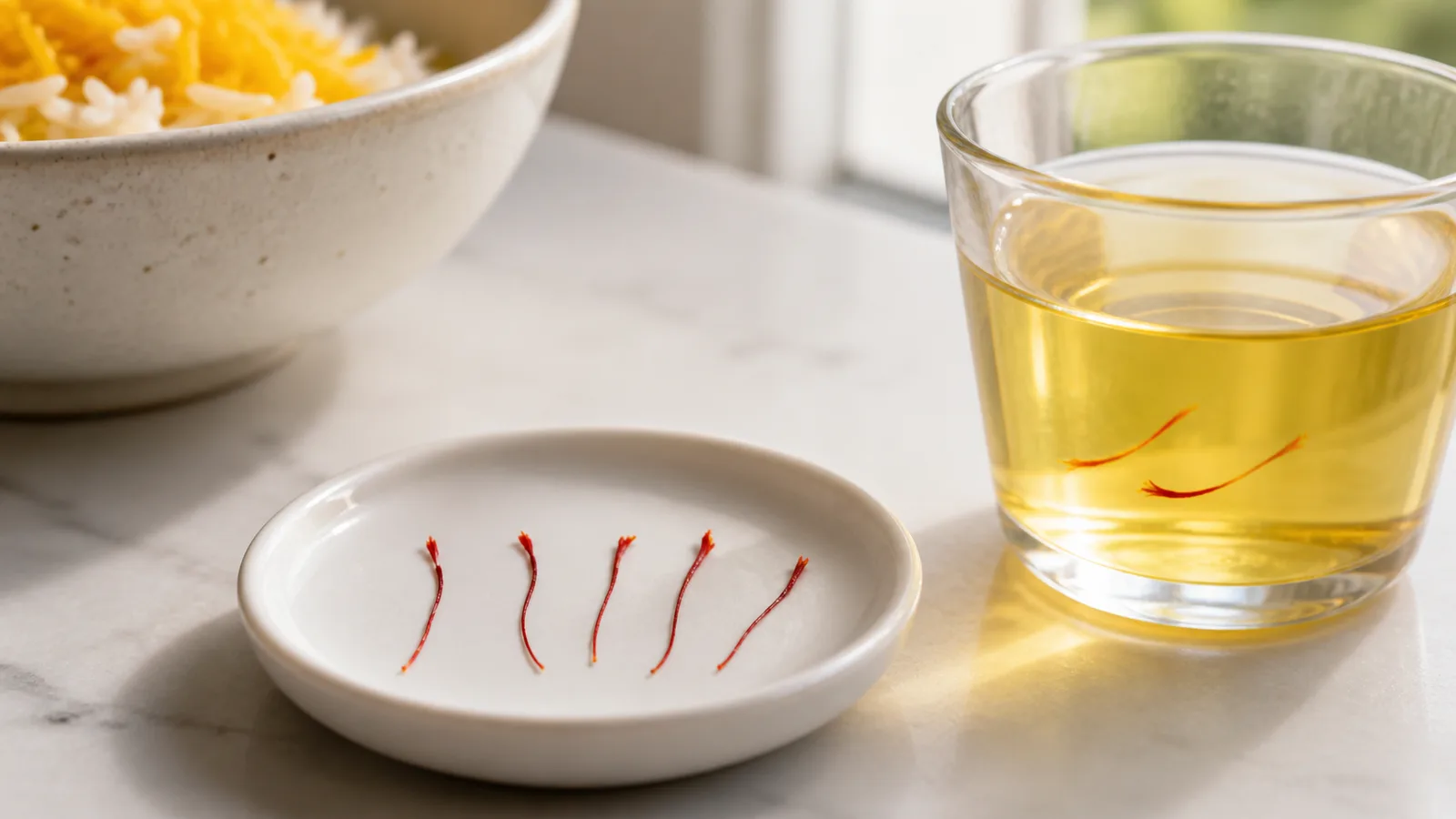
Which type of saffron is best? For most cooking, the best choice is fresh, genuine saffron sold as whole, predominantly red threads with a clear origin, harvest or lot information, and credible quality testing. Iranian Negin or Sargol can both be excellent; certified Kashmir saffron and Spain’s protected Azafrán de la Mancha can be excellent too. The country name or trade grade alone does not prove that one jar will have better colour, aroma and flavour than another.
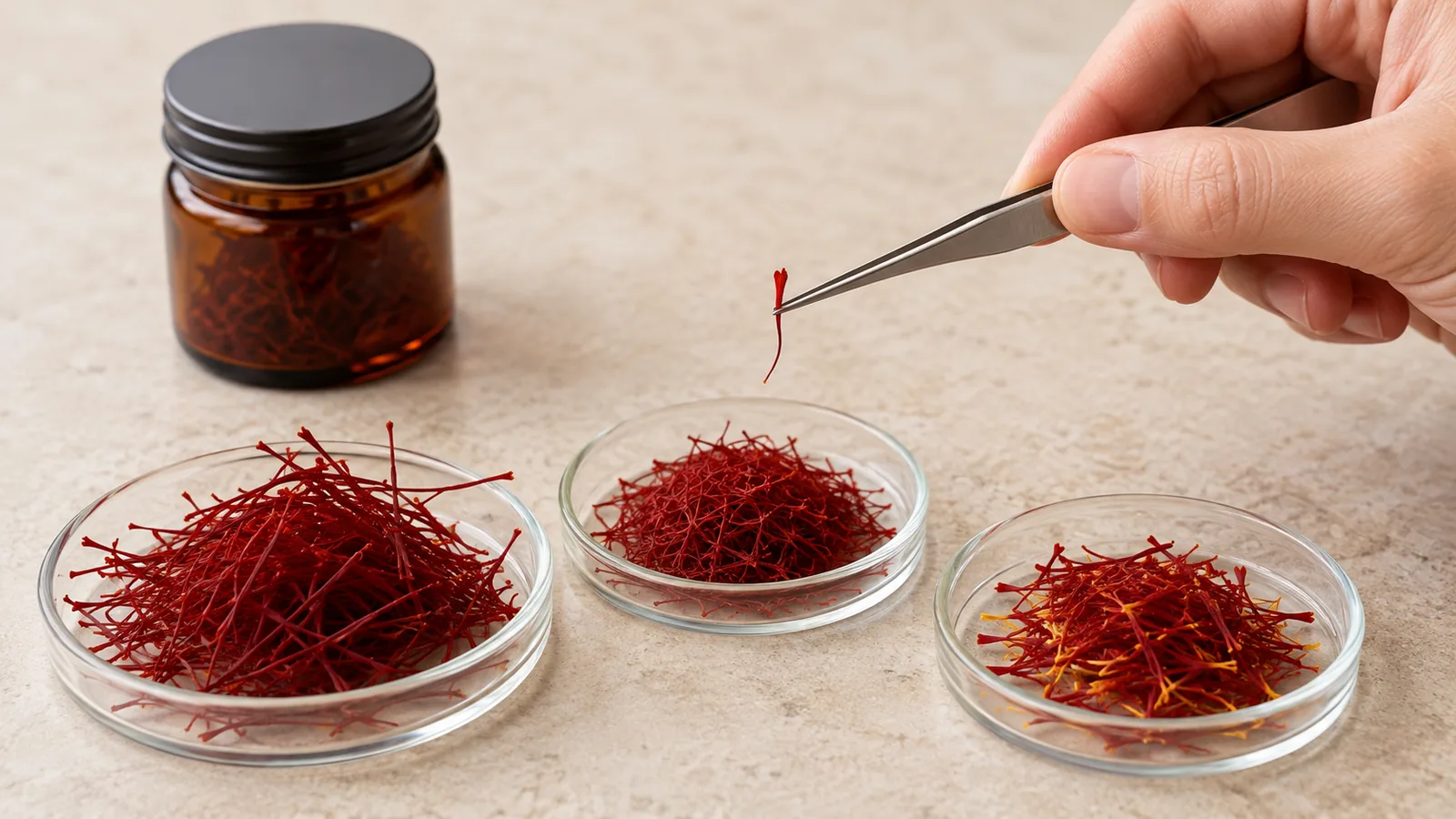
Which type of saffron is best?
If you want long, intact threads for presentation as well as strong culinary performance, a well-sorted Negin is a practical choice. If you mainly want all-red threads for everyday cooking, good Sargol often offers a sensible balance of quality and price. For a regional recipe or a traceable gift, a protected origin such as Azafrán de la Mancha PDO or registered Kashmir Saffron may matter more than the Iranian cut name.
The word “best” still needs evidence. Saffron quality changes with the crop, drying, storage and handling. A fresh, properly stored Pushal sample can be more useful in the kitchen than old or poorly handled Negin. A laboratory result can tell you more about a particular batch than a sweeping claim that one country always produces the best saffron in the world.
“Type” can mean origin, thread cut or tested quality
Almost all culinary saffron is the dried stigma of Crocus sativus. The different types of saffron named in shops are therefore better understood as origins, cuts or grades than as entirely different spices. Names on the package do not all describe the same characteristic, and apparently similar saffron varieties may be marketed under different systems:
- Origin names such as Iranian or Persian, Kashmiri, Spanish, Afghan and Moroccan tell you where the saffron is said to come from.
- Commercial trim names such as Negin, Sargol and Pushal describe how much of the red stigma and paler style remains and whether the threads are intact.
- Protected names such as Azafrán de la Mancha PDO and Kashmir Saffron GI have defined geographical and certification rules.
- Quality categories or test results concern measurable properties of the actual saffron sample.
The current ISO 3632-1:2025 saffron specification covers dried saffron as filaments, cut filaments and powder. ISO 3632-2 provides test methods for those forms. These standards are a better foundation for quality claims than colour adjectives on a shop page, although a buyer still needs a trustworthy result tied to the batch being sold.
Iranian saffron types: Negin, Sargol, Pushal and Bunch
Iran is the world’s largest saffron producer. The UN Food and Agriculture Organization describes Iran as supplying more than 90% of global production in its account of the Qanat-based saffron farming system in Gonabad. Iranian saffron therefore appears under several well-established commercial cuts.
Negin and Super Negin saffron
Negin is made from separated red stigmas that are mostly whole and free of crushed filaments. Its long, clean appearance suits dishes where the threads will remain visible, as well as premium retail presentation. “Super Negin” is commonly used by sellers for especially long, straight and carefully sorted Negin threads, but it should not be treated as a universal international grade with identical criteria at every company. Ask what the seller’s term means and whether the batch has test documentation.
Sargol saffron
Sargol contains the red part of the stigma without the yellow style. The pieces are generally shorter or more broken than Negin. A peer-reviewed study of Iranian saffron classification identifies Negin, Sargol and Pushal as the three principal market classes and explains their visible differences.
Good Sargol is often the best type of saffron for a cook who values predominantly red material but does not need long display threads. “Shorter” does not automatically mean weak: the condition and tested properties of the sample still matter.
Pushal or Pushali saffron
Pushal retains the red stigma with a small amount of the paler style attached. That visible connection can make the flower structure easier to recognise. It also means a gram contains a different proportion of red material than all-red Sargol or Negin, so comparing price per gram without noticing the cut can be misleading.
Bunch, Dasteh and Konj
Bunch saffron, also called Dasteh or Dokhtarpich, keeps the stigmas and a larger portion of style together in a small bundle. Konj or style is mainly the pale lower portion and has far less colouring potential. These forms help explain the full anatomy of the saffron strand, but they are not equivalent to an all-red cut by weight.
The names are useful descriptions, not substitutes for authenticity and freshness. Long, flawless-looking threads can still be old, damp, dyed or mislabelled. The US Food and Drug Administration maintains a current supplemental examination method for saffron, reflecting the need to check adulteration and foreign or defective material rather than judge the product by a premium label alone.
Origin comparison: Persian, Kashmiri, Spanish, Afghan and Moroccan saffron
Origin can influence cultivation, processing traditions and protected-name rules. It does not create a dependable league table for every harvest. When comparing origins, look for traceability and batch quality first.
Iranian or Persian saffron
Persian saffron and Iranian saffron generally refer to the same national origin. Its advantages are a mature production system, broad availability and a choice of recognisable cuts, including Negin, Sargol and Pushal. These forms are versatile in rice dishes, pilafs and stews. The best Iranian saffron is not defined by a brand name alone; the seller should be able to explain the cut, origin, packing date and any analysis.
Kashmiri saffron
Kashmir saffron is valued as a geographically distinctive product, not simply as a colour description, and it is familiar in biryani, sweets and other regional preparations. India’s official Geographical Indications registry lists Kashmir Saffron as a registered GI for Jammu and Kashmir. That registration protects the geographic designation; buyers should still check that a specific package is legitimately covered and well stored.
Spanish saffron and Azafrán de la Mancha
“Spanish saffron” is a broad market description. Azafrán de la Mancha is more specific: it is a Protected Designation of Origin for saffron grown, harvested and dried in the defined Spanish region. The current EU product specification for Azafrán de la Mancha sets rules for purity, production, certification and labelling, including harvest-year information.
The PDO gives useful traceability. It does not mean every non-PDO saffron is inferior, and it should not be confused with the Iranian Pushal cut sometimes transliterated as “Mancha” in trade literature.
Afghan saffron
Afghan saffron has become an established commercial origin, especially around Herat. It can offer vivid red threads and strong sensory quality, but “Afghan” is not itself a laboratory grade. In an Afghan saffron vs Iranian saffron comparison, the better buy is the fresher, authentic and more transparent batch—not automatically the product from one side of the border.
Moroccan saffron
Morocco has a long saffron-growing tradition centred particularly around Taliouine. It may appeal to cooks seeking a North African origin for tagines, couscous and other regional dishes. Claims that all Moroccan saffron is sweeter, purer or better than every other origin go beyond what the country name can establish. Treat those as batch-level qualities to smell, taste or verify.
Spanish saffron vs Kashmiri saffron
Spanish saffron vs Kashmiri saffron is not a choice between “mild” and “strong” based on nationality alone. Certified Azafrán de la Mancha has a detailed PDO specification and a characteristic production tradition. Registered Kashmir Saffron has protected geographic identity in India. Either can be an excellent purchase when it is genuine, recent and correctly stored.
Choose La Mancha when its certified Spanish origin and role in dishes such as paella matter to you. Choose Kashmir saffron when you want its protected regional provenance and the seller can document it. For ordinary cooking, compare aroma, visible condition, package date, seller transparency and test information rather than relying on a country-versus-country slogan.
Afghan, Iranian and Spanish saffron comparisons
An Afghan saffron vs Spanish saffron or Afghan saffron vs Kashmiri saffron comparison follows the same rule: origin is one attribute, not a complete quality score. Iranian saffron offers the clearest familiar vocabulary for thread cuts. La Mancha offers a formal EU PDO. Kashmir has an Indian GI. A producer or packer in any origin can handle a crop well or poorly.
This also explains why “Iranian saffron vs Spanish” search results often conflict. Some writers are comparing cultivations, others compare cooking traditions, and others compare a Negin cut with a PDO product. Define what is being compared before deciding which saffron is best.
How to choose the best saffron in a shop
Prefer recognisable whole threads
Whole threads let you inspect shape and colour more easily than powder. Genuine saffron threads are not perfectly identical. Look for fine, irregular red stigmas rather than uniformly cut fibres. Powder can be convenient, but it conceals the raw material and deserves stronger supplier and testing evidence.
Read the origin and lot information
A useful package identifies the product, net weight, responsible business and origin. Harvest year, packing date or batch number improves traceability. A vague country story on the front does not compensate for missing practical details on the back.
Judge aroma and condition, not redness alone
Good saffron has a distinctive, complex aroma and should be dry without smelling musty. Intense uniform redness is not proof of quality because colour can be manipulated. Our guide to telling real saffron from fake saffron explains why home checks are screening tools rather than definitive authentication.
Check storage and use it properly
Even high-quality saffron declines when exposed to moisture, heat, light and air. Buy an amount you can use while it remains aromatic, keep it sealed in a cool dark place, and follow a measured blooming method. See the saffron storage guide and the best way to brew saffron for those steps.
The practical answer for different buyers
- For long premium threads: choose well-documented Negin, with Super Negin treated as a seller specification that needs explanation.
- For versatile everyday cooking: fresh, authentic Sargol is often an excellent all-red choice.
- For visible flower structure: Pushal retains a small part of the style and can be easier to recognise.
- For protected regional provenance: look for legitimate Azafrán de la Mancha PDO or Kashmir Saffron GI certification.
- For the strongest buying evidence: prioritise a traceable batch, credible testing, freshness and correct storage over a dramatic country or “best brand” claim.
So, which type of saffron is best? There is no automatic winner among Iranian, Kashmiri, Spanish, Afghan and Moroccan saffron. For many buyers, genuine whole red threads—Negin for intact presentation or Sargol for practical all-red use—are the soundest starting point. Buy from a reputable source that can identify the batch. The final decision should belong to the actual jar: its traceability, tested quality, freshness, aroma and suitability for the dish.