Which Country Has the Best Saffron?
Iran is the strongest practical answer because it has the world’s largest and most varied saffron industry, but no country owns a monopoly on excellent saffron. The best batch is the one that is fresh, pure, correctly dried, traceable and suited to the way you plan to use it. An outstanding harvest from Kashmir, Afghanistan, Spain, Greece or Morocco can be better than a neglected or adulterated Iranian one.
So, which country has the best saffron in the world? Start with origin, but do not stop there. Country tells you about a growing tradition and regional style; it does not reveal how long the pack sat in storage, how much yellow style it contains, whether it was exposed to moisture or whether the contents match the label.
Why Iran is usually named the best saffron country
Iran has a depth of saffron knowledge and supply that no other producing country currently matches. In 2025, the UN Food and Agriculture Organization described Iran as producing about 85–90% of the world’s saffron. Much of that crop is associated with the Khorasan provinces, where cultivation, flower picking, stigma separation, drying and trade have supported rural communities for generations.
Scale gives buyers access to several commercial cuts. All-red Sargol and Negin-style threads remove most or all of the yellow style; Pushal keeps more of the style attached; bunch saffron preserves the stigmas and styles together. These names describe presentation, not a complete laboratory grade, and spelling or definitions can vary by seller.
Iranian origin is therefore a sensible place to begin when you want strong colour, characteristic aroma and a broad choice. It is not proof by itself. Iran produces ordinary saffron as well as exceptional saffron, and quality varies between farms, seasons, drying methods and storage conditions. Our guide to where most saffron is grown explains why production is so concentrated there.
Where else does excellent saffron come from?
Kashmir, India
Kashmir has a renowned saffron tradition and a distinctive regional identity. “Kashmir Saffron” is a registered geographical indication in India; the official GI record identifies Jammu & Kashmir as its defined geographical area. That registration protects an origin name. It should not be read as a promise that every packet using vague Kashmiri imagery is authentic or fresh.
Genuine, well-handled Kashmir saffron can be superb. Supply is much smaller than Iran’s, which can make provenance and seller credibility especially important.
La Mancha, Spain
Spain has a famous culinary relationship with saffron and a protected regional product. The European Union’s Azafrán de La Mancha PDO specification restricts that name to certified saffron meeting its origin and product rules. A PDO mark can provide useful traceability when it is genuine.
A Spanish company can also pack or trade saffron grown elsewhere, so “packed in Spain” and “grown in La Mancha” are not interchangeable statements. Read the country-of-origin wording, not just the brand’s address.
Afghanistan and other smaller origins
Herat in Afghanistan has developed a respected saffron industry, and good Afghan lots can compete on colour and aroma. Greece, Morocco and Italy also maintain regional cultivation. Smaller output does not make these origins inferior; it means the quality question has to be answered batch by batch rather than through production volume.
What does “best quality” actually mean?
The word best can hide several separate judgments. A buyer may want intense colouring power, a balanced aroma, long all-red threads, a protected regional origin or the best value for everyday rice. No single label settles all of those questions.
The current ISO 3632-1:2025 specification covers dried saffron from Crocus sativus in filament, cut-filament and powder forms. Laboratory work can assess identity and important quality characteristics more reliably than a photograph or one home trick. For a retail buyer, the most useful signals are:
- Traceability: a named producer or packer, country of harvest, lot or batch identity and a responsive seller.
- Freshness and storage: a recent harvest or packing context and protection from light, moisture and heat.
- Thread integrity: recognisable red stigmas rather than an anonymous powder, unless the powder comes with strong verification.
- Honest grading: clear wording about the cut and style content instead of “premium” with no definition.
- Testing: current, batch-relevant results from a competent laboratory when the purchase or use justifies them.
How to inspect saffron before you buy
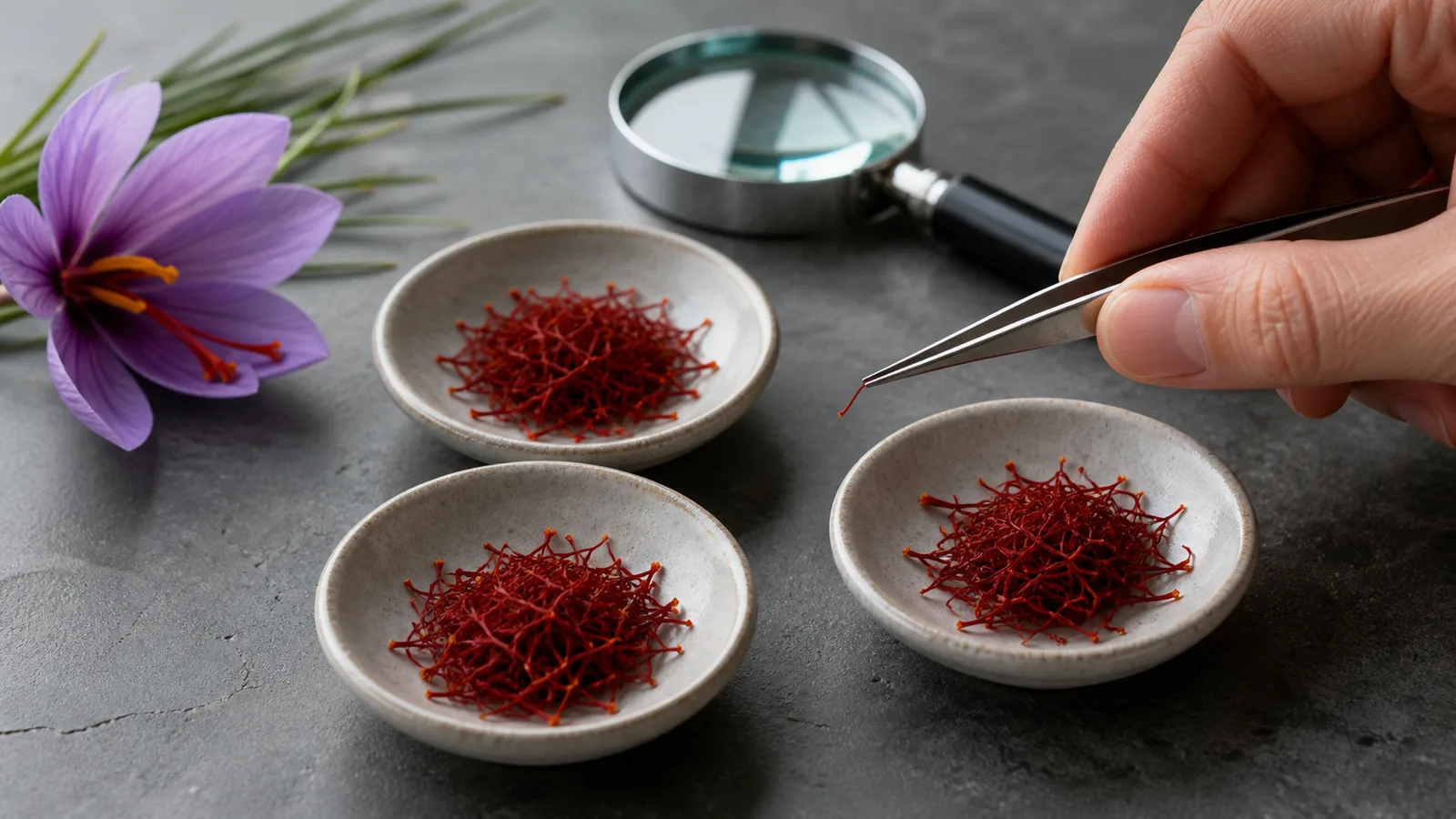
Choose whole threads when practical. Real saffron stigmas are fine but not uniformly machine-cut, and the tips often flare slightly. Deep red is desirable for an all-red cut, although a legitimate Pushal or bunch style will contain yellow or pale portions by design.
Aroma should be clear and complex, often described as floral, hay-like, honeyed or earthy. It should not smell musty. A very bright red powder, a perfume-like artificial scent or a price far below the normal market deserves scrutiny, but none of these clues alone proves fraud.
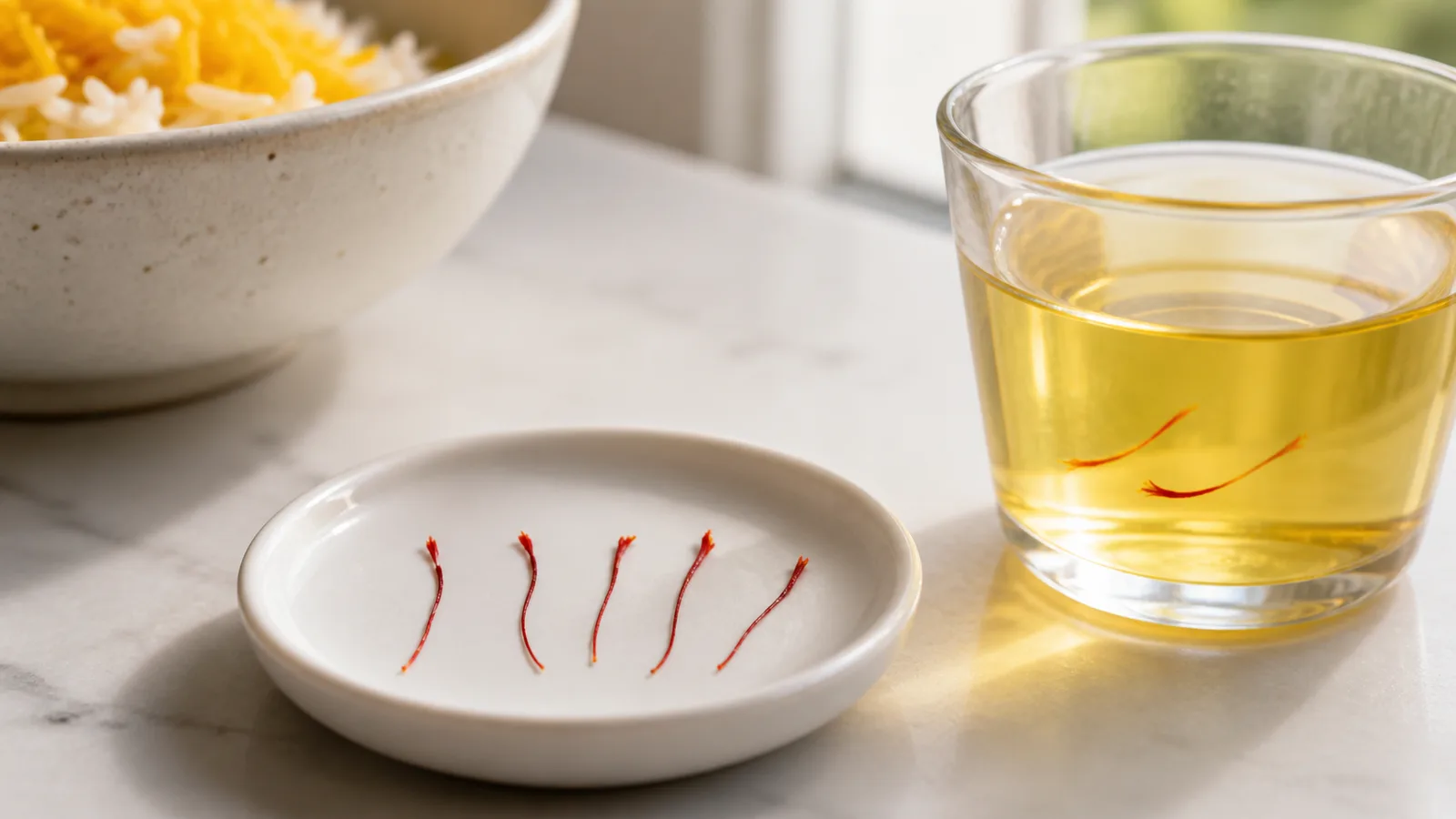
Water tests are screening observations, not certificates. Genuine threads release golden colour gradually and should retain recognisable form; adulterants and added dye do not all behave in one predictable way. If authenticity matters commercially, use documentation and laboratory analysis. Our home guide explains what saffron tests can and cannot tell you.
Which origin is best for cooking?
For Persian rice, stews and desserts, high-quality Iranian saffron is an obvious and versatile choice. For a dish tied to a protected regional tradition, authentic Kashmir saffron or Azafrán de La Mancha may add a provenance that matters to the cook. Good Afghan, Greek, Moroccan or Italian saffron can work beautifully in the same kitchen.
The better question is not “which country saffron is best?” in isolation. Ask which verified lot offers the aroma, colour strength, format, freshness and price you need. Use a small amount properly bloomed, and even a modest packet will serve several dishes.
The honest verdict
Where does the best saffron come from? Iran is the most dependable broad answer because of its scale, experience and range of high-quality cuts. Kashmir, La Mancha and Afghanistan also produce exceptional saffron with their own regional character.
Country narrows the search; the individual batch finishes it. Buy traceable Crocus sativus, prefer transparent grading and storage information, and judge bold “world’s best” claims by evidence rather than packaging.