You can grow saffron wherever Crocus sativus receives strong sun, free-draining soil, a comparatively dry summer rest and a cool growing season without prolonged waterlogging. Famous saffron regions meet those needs outdoors, but suitable sites also exist well beyond Iran, India, Spain and Morocco.
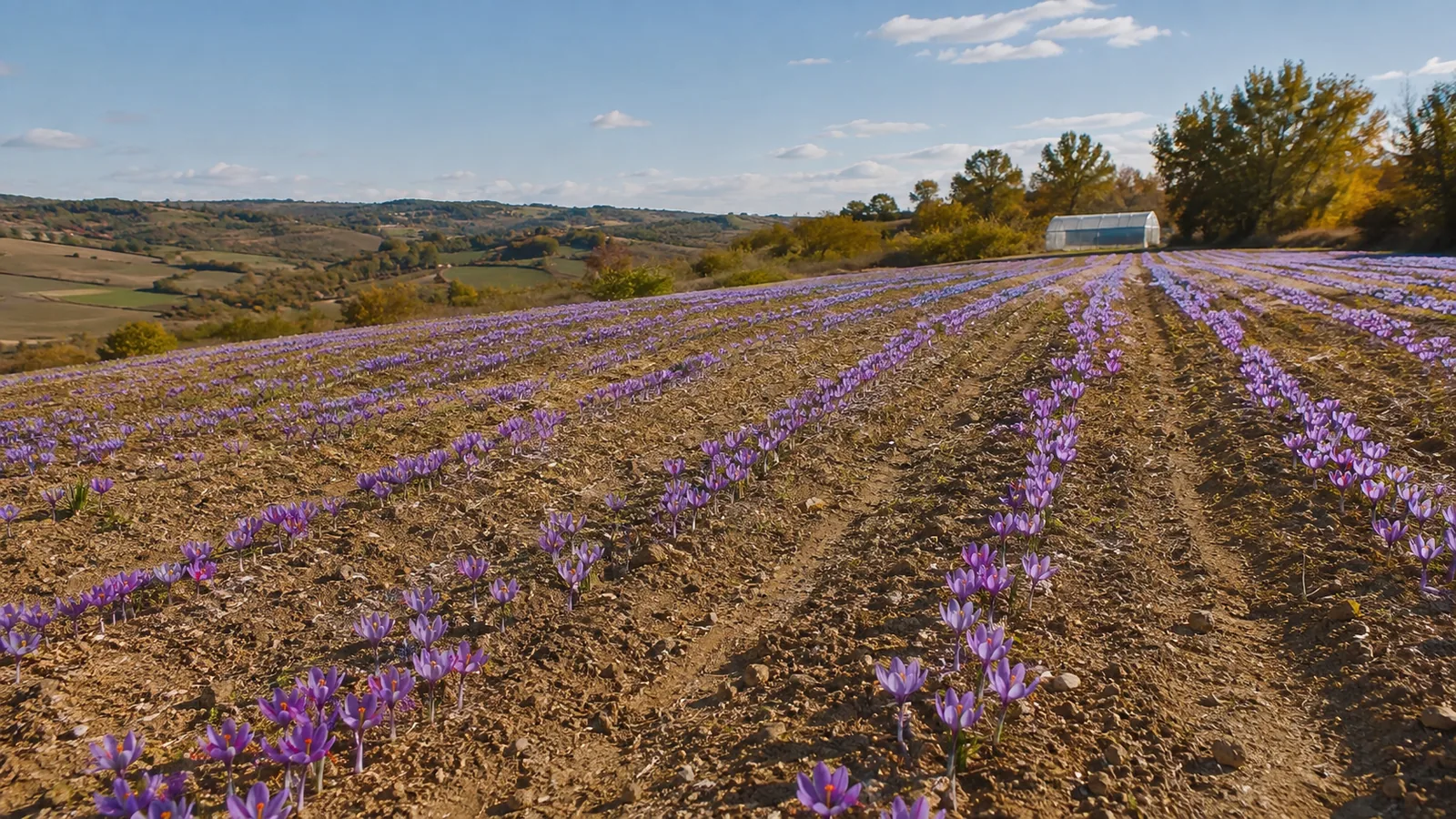
Where does saffron grow?
Saffron is cultivated across parts of western and central Asia, South Asia, the Mediterranean basin, North Africa, Europe and, on a smaller scale, the Americas and Oceania. Iran is the largest producer, while Kashmir, Spain, Greece, Afghanistan, Morocco and Italy have important regional traditions.
That list describes saffron growing countries, not the limits of the plant. Commercial output depends on far more than survival: growers need healthy corms, suitable land, enough harvest labour, reliable drying, quality control and a market. A home gardener can succeed in a place that would not support a competitive export industry.
What climate does saffron grow in?
Saffron is commonly associated with a Mediterranean pattern—dry summers and cooler, wetter months—but it also grows in continental climates. Its annual cycle matters more than a single average temperature. Corms are normally planted during dormancy, flowers emerge in autumn, foliage develops through the cooler season, and the plant returns to dormancy after the leaves die back.
The old advice that saffron must stay between exactly 60°F and 70°F (15–21°C) is too narrow. Temperatures change through the cycle, and successful outdoor plantings experience conditions outside that band. Likewise, frost does not automatically rule out saffron. The RHS profile for Crocus sativus gives it a hardy rating for UK conditions, although an exposed flower can still be damaged by severe weather and a waterlogged or uninsulated container is more vulnerable than a well-sited bed.
The best regions for saffron cultivation share a few site traits
The best regions for saffron cultivation are not simply the hottest or driest places. Productive sites tend to offer:
- plenty of direct light during active growth;
- soil that drains promptly after rain or irrigation;
- a summer period when dormant corms are not kept continually wet;
- enough cool-season moisture for roots and leaves without standing water;
- manageable weather during the short flowering and harvest period;
- labour and drying capacity ready when flowers open.
Altitude alone does not decide suitability. Neither does annual rainfall: its timing, the soil’s drainage and the grower’s water control can be more important than a yearly total.
Soil can make a promising climate fail
Saffron grows in sandy, loamy and some chalky soils, but persistent saturation is a serious problem. Dense clay can sometimes be improved with raised beds, organic matter and a deliberately free-draining root zone; merely adding a little sand to heavy soil may not repair its structure.
The University of Vermont’s saffron cultivation guide stresses good drainage and describes successful field, raised-bed, high-tunnel and lined-crate systems. Before committing a field, inspect it after heavy rain, test the soil and run a small trial through more than one season.
Which saffron growing zones are suitable?
People often ask for a single saffron grow zone, but hardiness-zone maps measure typical winter minimum temperatures, not drainage, summer moisture, harvest weather or soil. They are a useful first screen, not a planting guarantee.
For North American readers, the University of Vermont guide describes saffron as growable in USDA hardiness zones 4–8. That range reflects tested northern production and suitable management; it does not mean every location in those zones is equally good or that zone 9 automatically fails. In a cold site, planting depth, snow cover, drainage and protection affect corm survival. In a hot, humid site, summer wetness and disease pressure may be the larger concerns.
In other countries, use the local hardiness or climate system and compare the full seasonal pattern. A sunny slope with draining soil can behave very differently from a low, wet plot in the same mapped zone.
Where can saffron grow in the United States?
Saffron can be grown in many parts of the US, including regions with cold winters, when the site and system are appropriate. University trials in Vermont show that the crop is not limited to California-like weather. Growers also work in the Mid-Atlantic, Mountain West, Pacific Northwest and other areas, but the main production risk differs by location.
Cold-region growers may use deeper planting, raised beds, crates or high tunnels and watch winter drainage. Areas with wet summers need a way to keep dormant corms from staying saturated. Very warm regions need to confirm that local seasonal cues support reliable flowering. A small plot reveals more than a climate label alone.
Can you grow saffron outside Mediterranean regions?
Yes. The strongest evidence is the number of successful research and farm plantings outside the traditional belt. What cannot be copied blindly is a calendar written for another hemisphere or climate.
In the Northern Hemisphere, planting commonly occurs in late summer and flowering in autumn. Seasons reverse in the Southern Hemisphere, and local growers should time operations to dormancy and growth rather than following a European month by name. Mountain elevation, coastal influence and irrigation can also shift flowering within a region.
When protected cultivation helps
A high tunnel, unheated greenhouse or movable containers and crates can protect flowers from heavy rain, improve drainage control and make harvest work easier. These systems can also extend saffron cultivation into a marginal site. Protection should support the natural cycle, not turn the crop into a permanently warm houseplant.
Fully indoor production adds lighting, ventilation, temperature and moisture-management costs. For a home pot, our guide to growing saffron indoors explains the seasonal care in detail. A commercial controlled environment should be tested against actual dry-stigma yield and quality, not promoted from flower photographs alone.
How to evaluate your own location
Start with the field or container, not the country name. Ask:
- Does the site receive strong sun during the growing season?
- Where does water go after sustained rain or irrigation?
- Can dormant corms avoid prolonged summer saturation?
- Will harvest labour be available during a concentrated bloom?
- Can stigmas be separated and dried promptly and hygienically?
- Are rodents, corm diseases, extreme heat or exposed flowering weather manageable?
Plant a documented trial with known corm size and spacing. Record emergence, flower count, dry stigma weight, losses and corm survival for at least two cycles before projecting commercial yield. Our broader saffron cultivation tips follow the work from site preparation through storage.
Where to grow saffron successfully
The concise answer is: in a sunny, well-drained site that can provide a dry-enough dormancy and a cool-season growth period. Mediterranean regions are proven homes for the crop, but they are not the only possibilities. Parts of North America, northern Europe and other non-traditional areas can work with the right soil, seasonal timing and protection.
Country, climate and hardiness zone narrow the search. A well-run local trial decides whether a particular garden, field or protected structure is genuinely suitable.