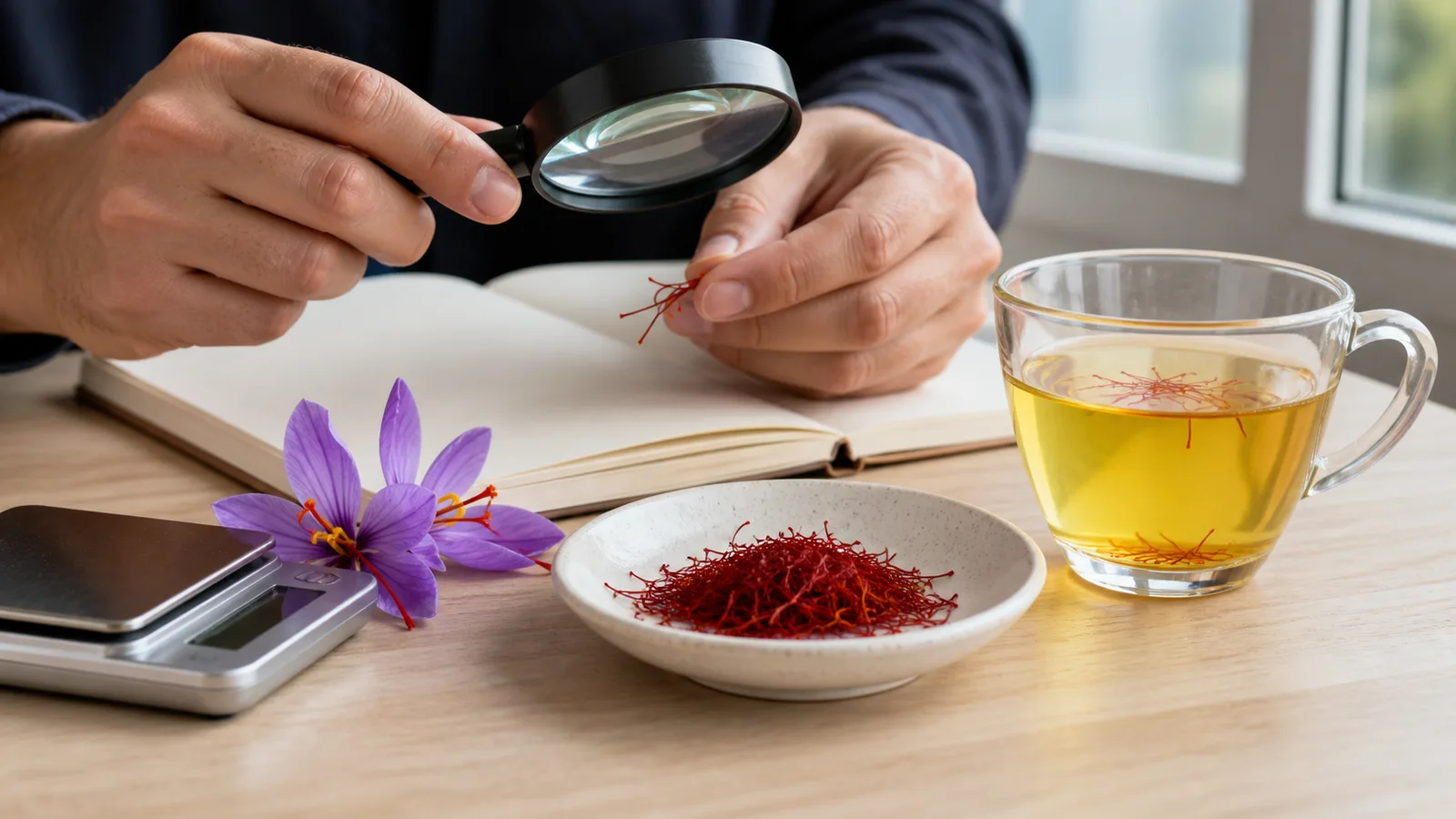
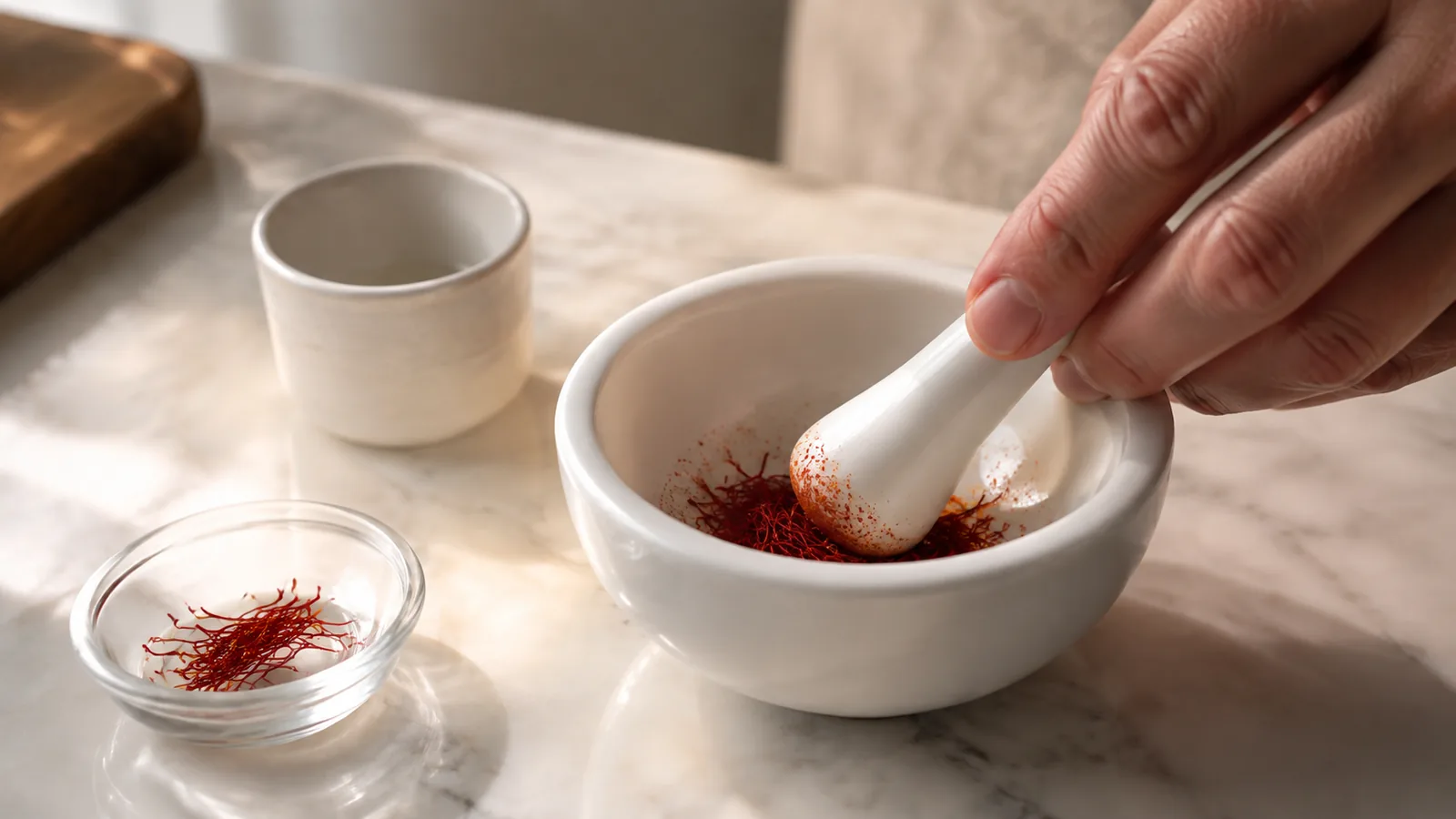
Greenhouse Saffron Cultivation, or saffron farming in a greenhouse, can make temperature, rain, airflow and crop access easier to manage, but a greenhouse is not a growing method by itself. Saffron can be planted in the ground, raised beds, soil-filled crates or a carefully designed soilless system inside the structure. The right choice depends on climate, corm-renewal plans, labour and whether the goal is spice production, daughter corms or a controlled trial.
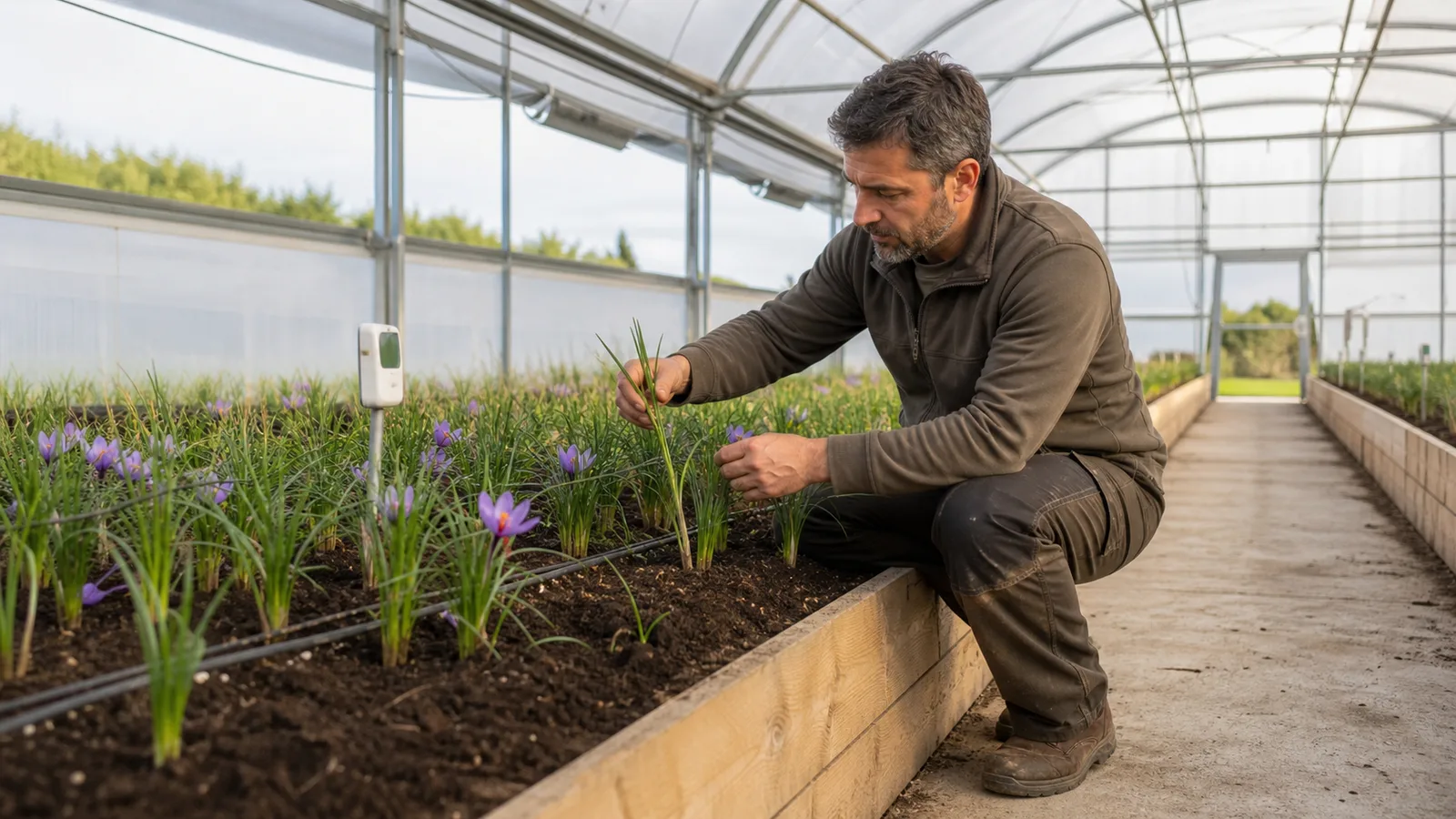
Can you grow saffron in a greenhouse? Yes. Start with a small monitored block, healthy Crocus sativus corms and a full-season plan. Flower forcing is only one part of the crop: after flowering, the leaves and roots must remain productive long enough to build the daughter corms that support a future harvest.
What a saffron greenhouse can control
A protected structure can shield flowers from heavy rain, reduce wind damage and give workers a cleaner route through the crop during the short harvest flush. Ventilation, shading and heating or cooling can also moderate conditions that would otherwise be unsuitable. These controls are useful only when they respond to measurements. A closed greenhouse can quickly become too warm or collect condensation around dense foliage and corms.
The structure does not remove biological limits. Saffron remains an autumn-flowering perennial that grows from a corm. It still needs drainage, appropriate seasonal temperature changes, a healthy root zone and months of leaf growth after the stigmas have been picked. A greenhouse also does not guarantee a higher yield, better spice or profit. Those outcomes have to be measured against the energy, equipment, labour and corm costs required to produce them.
Choose a system before buying equipment
There is no single greenhouse saffron method. University of Vermont trials and grower guidance describe protected cultivation in raised beds, milk crates and directly in the ground. Its saffron planting guide also treats depth, spacing and local climate as connected decisions rather than universal settings.
In-ground and raised-bed cultivation
Soil-based beds are usually the most familiar option. They support the entire cycle in one place, from autumn flowering through winter and spring leaf growth to summer dormancy. A raised bed can improve drainage and working height, while a high tunnel can protect the flowering crop from rain. Before planting, test the soil, correct drainage problems and plan for rodents, weeds and eventual lifting of crowded corms.
Crates and substrate containers
Crates or benches filled with a free-draining substrate can make lots easier to separate and move. They also concentrate risk: one blocked drain, poorly mixed substrate or irrigation error can affect many corms at once. Containers need enough root volume, stable support and a plan for the long leafy phase. They should not be treated as dry display trays that are discarded after bloom.
Hydroponic and aeroponic saffron
In hydroponic saffron farming, water and nutrients are supplied through a soilless root zone; aeroponic saffron keeps roots suspended and applies a nutrient mist. Hydroponic saffron cultivation and aeroponic cultivation are sometimes described loosely in sales material, so ask what happens during every crop stage. Some indoor systems merely force stored corms to flower, while a regenerative system also supports leaves, roots and replacement corms after harvest.
Controlled research shows that soilless production is possible, not that every commercial design works. One multilevel hydroponic study tested specific corms, preconditioning, lighting, temperature and ebb-and-drain irrigation in contained environments. A separate comparison of field and controlled systems found that production method affected both quantity and quality. These are useful findings for system design, but they do not support a blanket promise of 30% more yield or faster growth on another farm.
Aeroponics adds pumps, nozzles, filtration and fail-safe requirements. A misting interruption can dry exposed roots quickly, while poor sanitation can spread a problem through shared equipment. Hydroponics adds nutrient-solution management and water-quality questions. Both deserve a pilot with records before vertical racks are scaled.
Respect the corm’s annual cycle
A mature corm carries reserves that help initiate flowers. That can make a flower-forcing room look successful even when it has not produced a sustainable next generation of corms. After bloom, green leaves photosynthesise and feed daughter corm development. Removing the crop, starving the roots or cutting foliage too early borrows from the next season.
Build the system around four connected periods: warm dormancy and flower initiation; cooling and autumn emergence; flowering and daily harvest; then sustained leaf and root growth until natural senescence. Our guide to saffron bloom and harvest timing explains why a single calendar date cannot replace local observations.
Temperature, humidity and airflow
Do not apply a one-week “shock” below 13°C or hold relative humidity at 80% simply because a generic recipe says so. Controlled experiments found that flower formation responds to the corm’s earlier temperature history and that emergence follows cooler conditions. In one temperature study of saffron flowering, favourable flower formation occurred after sustained warm conditions around 23–27°C, followed by transfer toward 17°C for emergence. Local material and production history still matter.
Measure air temperature at crop height and root-zone temperature where the corms sit. Track minimums, maximums and time at each condition rather than relying on one midday reading. Humidity should be managed with airflow, irrigation timing and ventilation so leaves and flowers do not remain wet and condensation does not settle on the crop. Fans should circulate air gently without blowing substrate or drying one rack more than another.
Water, nutrients and the root zone
Saffron needs water during active growth but performs poorly in waterlogged, oxygen-starved conditions. In beds and containers, water deeply enough to reach the roots and allow the medium to drain before the next irrigation. In recirculating systems, monitor water temperature, pH, electrical conductivity, dissolved oxygen where relevant and the cleanliness of tanks and lines. Calibrate sensors and keep a manual response plan for pump or power failure.
Do not copy a nutrient recipe without testing the source water and substrate. A program designed for flower forcing may not support replacement corms, while unnecessary salts can accumulate in a closed system. Use crop observations and tissue or solution analysis when scale justifies it. The related guides to watering saffron plants and saffron fertilizer planning cover the principles in more detail.
Select and handle corms carefully
Buy true Crocus sativus corms from a traceable supplier. Inspect each lot for firmness, wounds, mould, insects and unusual odour, and keep lots separate until their performance is known. Larger mature corms often have greater flowering potential, but “15 grams” is not a universal pass mark. Size grade, cultivar material, storage history and health all influence the result.
Clean reusable trays and tools between lots with a method suitable for the material and production system. Do not assume a cheap treatment is harmless to corm tissue, workers or equipment. Quarantine questionable stock and record corm count, size grade, source, arrival condition and losses. Good traceability is more useful than discovering after bloom that several suppliers were mixed on one rack.
Flowering, harvest and drying
Begin checking the crop before its expected flowering window. Once flowers appear, harvest usable blooms daily rather than waiting until flowering is complete. Pick in clean, dry conditions, move flowers promptly to a hygienic work area and separate the three red stigmas from each true saffron flower.
Drying determines shelf stability and contributes to aroma development, so use a repeatable time, temperature, airflow and load depth. Keep each lot identified from corm batch through dried product. A greenhouse may produce excellent saffron, but quality should be judged from the finished spice with appropriate sensory, moisture and laboratory criteria—not assumed from whether it grew in soil, water or mist.
Saffron advantages and disadvantages in a greenhouse
The main advantages are shelter during flowering, closer environmental monitoring, cleaner access, easier separation of trials and the possibility of growing where outdoor autumn conditions are unreliable. Stacked systems may increase the number of corms held per floor area, although every tier still needs uniform temperature, light, airflow and worker access.
The disadvantages are equally practical. Structures, controls, energy and backup systems cost money. High density can make disease or irrigation errors spread quickly. Racks add lifting and inspection work. A system that produces flowers but weak daughter corms may require continual replacement stock. Greenhouse space also has an opportunity cost if another crop would use it more profitably.
Test profitability with a pilot block
“High-value crop” does not mean automatic income. Before expanding, record the full cost of corms, substrate, trays, greenhouse area, climate control, lighting, water treatment, sanitation, harvest labour, stigma separation, drying, packaging and crop losses. Measure flowers per corm, dry stigma weight, labour minutes per gram, daughter-corm number and size, energy use and saleable quality across at least a complete cycle.
Compare those figures with a soil or outdoor reference under the same local conditions. Our discussion of saffron cultivation profit provides a budget framework without treating a promotional yield as guaranteed revenue. Scale only after the pilot shows which control actually improved the result and what that improvement cost.
A practical saffron cultivation setup
For a home or commercial trial, start with one system rather than mixing several methods in the same crop record. Prepare:
- a well-drained bed, container substrate or engineered soilless root zone;
- traceable, healthy corm lots with a defined post-flowering plan;
- temperature and humidity sensors placed at crop level;
- ventilation and gentle air circulation that reach every bed or rack;
- an irrigation method that can be checked, cleaned and shut down safely;
- clean harvest, stigma-separation and drying areas; and
- a log for environment, irrigation, bloom, yield, labour, quality and daughter corms.
A greenhouse earns its place when it solves a real local constraint and the records confirm the benefit. Treat greenhouse saffron farming as a managed crop system—not a shortcut built around flowering alone—and the first trial will tell you far more than a universal recipe can.