


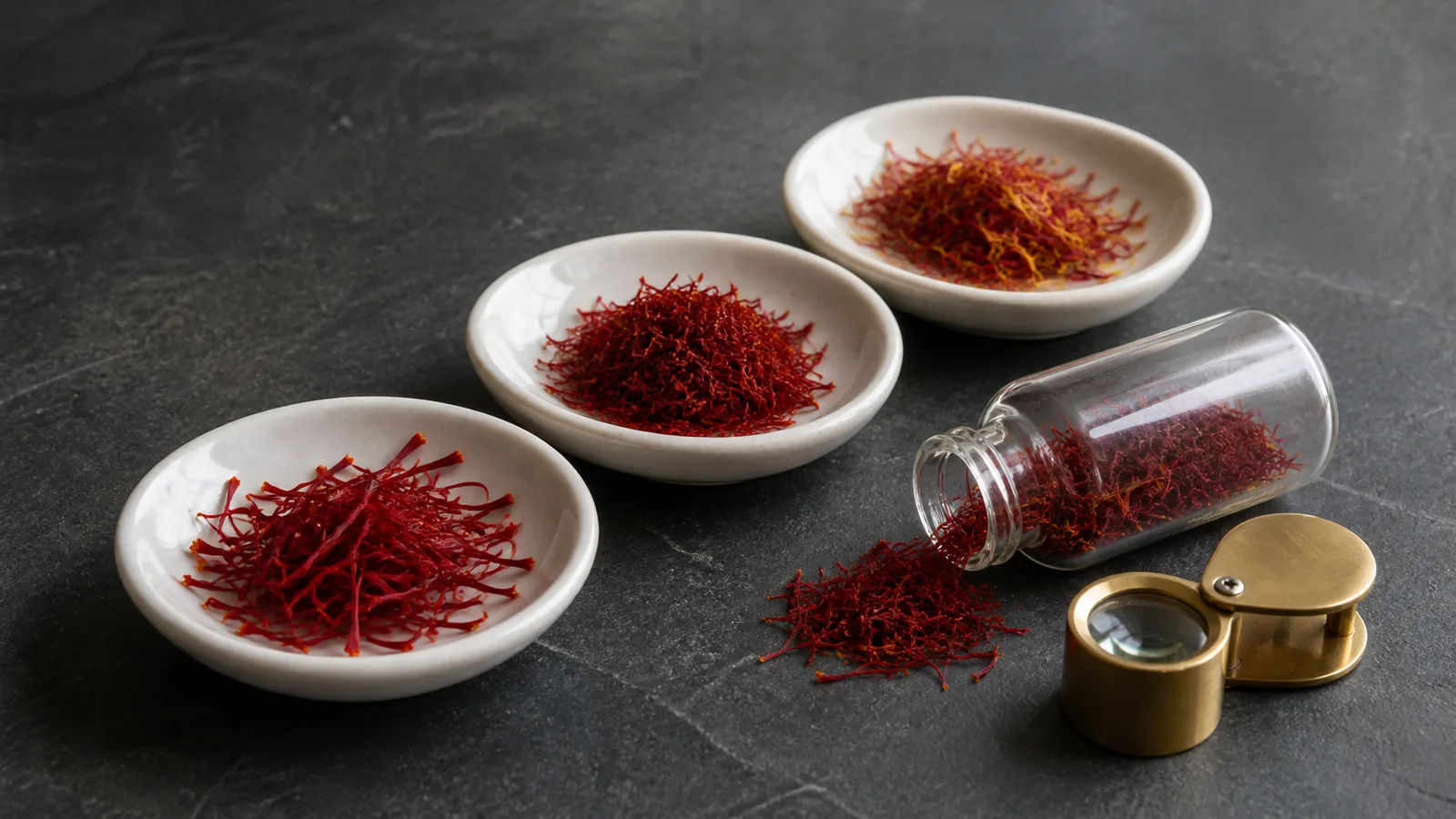
Among mainstream Iranian saffron grades, a well-sorted Super Negin lot is usually the most expensive per gram. Its long, thick, evenly red stigmas take careful handling and have the polished appearance expected in premium export packs. That is the useful short answer to “What is the most expensive type of saffron?”—but it is not a universal price law. An exceptional, traceable harvest from another region can cost more, and the words “Super Negin” alone do not prove quality.
Saffron prices make more sense once three ideas are separated: the plant, the trade grade and the individual batch. People often search for different types of saffron or saffron varieties, but those phrases can blur an important distinction. Nearly all culinary saffron comes from the same species, Crocus sativus. Names such as Negin, Sargol and Pushal generally describe how the dried stigma has been cut, sorted or presented. They are not different botanical varieties with fixed prices.
Is Super Negin always the most expensive saffron?
Super Negin sits at the top of the familiar Iranian presentation grades in many shops. Buyers pay for long, separated red threads, minimal yellow style, little breakage and consistent appearance. “Royal Super Negin” is also used by some sellers for an especially selective lot, although it is a commercial description rather than a separate category in the international saffron standard.
The distinction matters. The current ISO 3632-1 specification for saffron applies to filaments, cut filaments and powder, but it does not establish a worldwide price ladder called Royal, Super Negin, Negin and Sargol. A seller’s top label may therefore tell you how the product was sorted; it cannot replace testing, provenance or a fair comparison of like-for-like packs.
Nor is the highest-priced jar automatically the best purchase. A small gift tin can have a higher price per gram than a larger pack of equally good threads. A protected-origin or small-harvest saffron may command a premium for traceability. Freshness, laboratory results, retail market and packaging all affect the final number.
Expensive saffron types and trade grades
There is no single naming system used in every growing country. The following descriptions are a practical guide to common market terms, especially those used for Iranian saffron.
Super Negin and Negin
Negin means “jewel,” an apt name for its neat presentation. The red stigma strands are separated, with very little pale or yellow style visible. Super Negin is sorted for longer, thicker and more uniform threads, so it usually attracts the premium price among these Iranian cuts. It is often chosen when visual presentation matters, such as a clear gift pack or a dish where intact threads will be visible.
Appearance still cannot prove chemical strength. A Negin batch that has been poorly dried or stored for too long may be less satisfying than a fresher Sargol or Pushal batch. Published work on commercial samples has shown that products sold in the market can fall into different ISO quality categories even when they look plausible at purchase.
Sargol
Sargol consists of the red tips of the stigma. The threads are commonly shorter or more fragmented than Negin, but that does not make Sargol weak. With little style material included, a sound batch can deliver strong colour and aroma. It is a sensible choice for cooking when immaculate thread length is less important than genuine saffron character.
Pushal or Poushal
Pushal retains the red stigma with a small amount of the lighter style attached. It normally costs less than a highly sorted Super Negin pack because it is less uniform and contains some non-red material. For many cooks, good Pushal offers an appealing balance of visible whole strands, flavour and price. The attached style can also make the natural structure of the stigma easier to recognise, although it is not an authenticity guarantee by itself.
Dasteh, bunch and local names
Dasteh saffron is dried as a small bundle with more of the red stigma and pale style kept together. It may also be described as bunch saffron. Names such as Dokhtarpich, Narma, Dafta or Kesar can appear in local or vendor-specific descriptions, but their meanings are not consistent enough to place them on a universal price chart. Kesar, for example, is also simply a widely used word for saffron.
Kashmiri trade has its own familiar terms, including Mongra or Mogra for red stigma material and Lacha for threads with some style attached. These should be understood in their regional context rather than forced into an Iranian grading ladder. Origin and cut are two separate pieces of information.
For a closer visual explanation of these presentations, see our guide to saffron types and their quality.
What actually determines saffron quality?
The costly part of saffron production is familiar: each flower yields only three stigmas, and they are picked and processed by hand. Once the spice reaches a jar, however, value depends on more than labour or thread size.
- Colouring strength: crocin-related compounds are responsible for saffron’s colour. Laboratory methods assess this more reliably than the eye.
- Taste and aroma markers: picrocrocin is associated with saffron’s bitter taste, while safranal contributes strongly to its aroma. ISO test methods consider the characteristic absorbance associated with these quality components.
- Freshness and storage: heat, moisture, light and time can change a batch. An airtight container kept cool, dry and dark protects the spice better than a decorative clear jar left beside a cooker.
- Thread integrity: long, intact stigmas require more selective sorting and are easier to inspect than powder. They often cost more for presentation reasons.
- Purity and authenticity: added plant fibres, artificial colour or excess style material reduce value. A reputable supply chain and credible testing matter more than a dramatic adjective on the label.
- Origin and traceability: a documented farm, harvest or protected geographical origin may carry a premium. Country of origin alone does not guarantee that every batch has the same grade.
Research describing saffron quality assessment links commercial evaluation to crocin, picrocrocin and safranal-related measurements. Separate research on commercial saffron traceability and storage age also illustrates why a market name and a visual check cannot tell the whole story.
How to compare two saffron prices fairly
Start with the price per gram, not the pack price. Then compare whole threads with whole threads, bought in the same market at roughly the same time. A one-gram souvenir pack and a 25-gram food-service pack are different retail products even if the saffron inside began as the same grade.
Next, read the specific claims. Does the label give a harvest or packing date? Does it identify the origin and the net weight clearly? Is there a batch number or a meaningful test certificate? If a seller cites an ISO category, the claim should relate to results for that batch—not merely to the general fact that ISO has a saffron standard.
Inspect the threads under good light. Genuine saffron stigmas are not perfectly identical, but a premium Negin lot should look deliberately sorted rather than crushed or dusty. A few paler ends are normal in grades that retain part of the style. Powder is convenient, yet it is harder for a buyer to inspect, so provenance is especially important.
Finally, consider what you are cooking. Paying extra for exceptionally long threads makes sense when presentation is part of the pleasure. If the saffron will be ground and infused for rice, bread or dessert, a fresh, verified Sargol or Pushal may give better value than the most immaculate gift-grade strands.
Which saffron is best to buy?
Choose the batch, not just the grandest grade name. Super Negin is the usual answer when the question is strictly about the most expensive Iranian saffron type, because its sorting and appearance command a premium. It is not automatically stronger, fresher or more authentic than every less expensive grade.
For a gift or a dish that displays whole threads, clean Super Negin or Negin can justify the extra cost. For everyday cooking, a reputable Sargol or Pushal may be the smarter choice. In either case, buy whole threads from a seller that states the origin, net weight and batch details clearly, then store the saffron away from light, heat, air and moisture.
The shortest honest conclusion is this: Super Negin is often the highest-priced mainstream grade, but the best saffron is the batch whose identity, freshness and quality can be supported.

![Exporting Saffron to Turkey + Price Guide [Complete 0 to 100]](https://img.rowhanisaffron.com/20260827003933/saffron-export-turkey-quality-inspection.webp)



