


Saffron farming income potential can be attractive, but the crop is not automatically profitable because dried saffron sells for a high price. The honest calculation starts with saleable yield, the price a particular buyer will actually pay, and every cost required to produce, process and sell it. Corm establishment and hand labour can turn a promising gross-revenue figure into a weak cash-flow year.
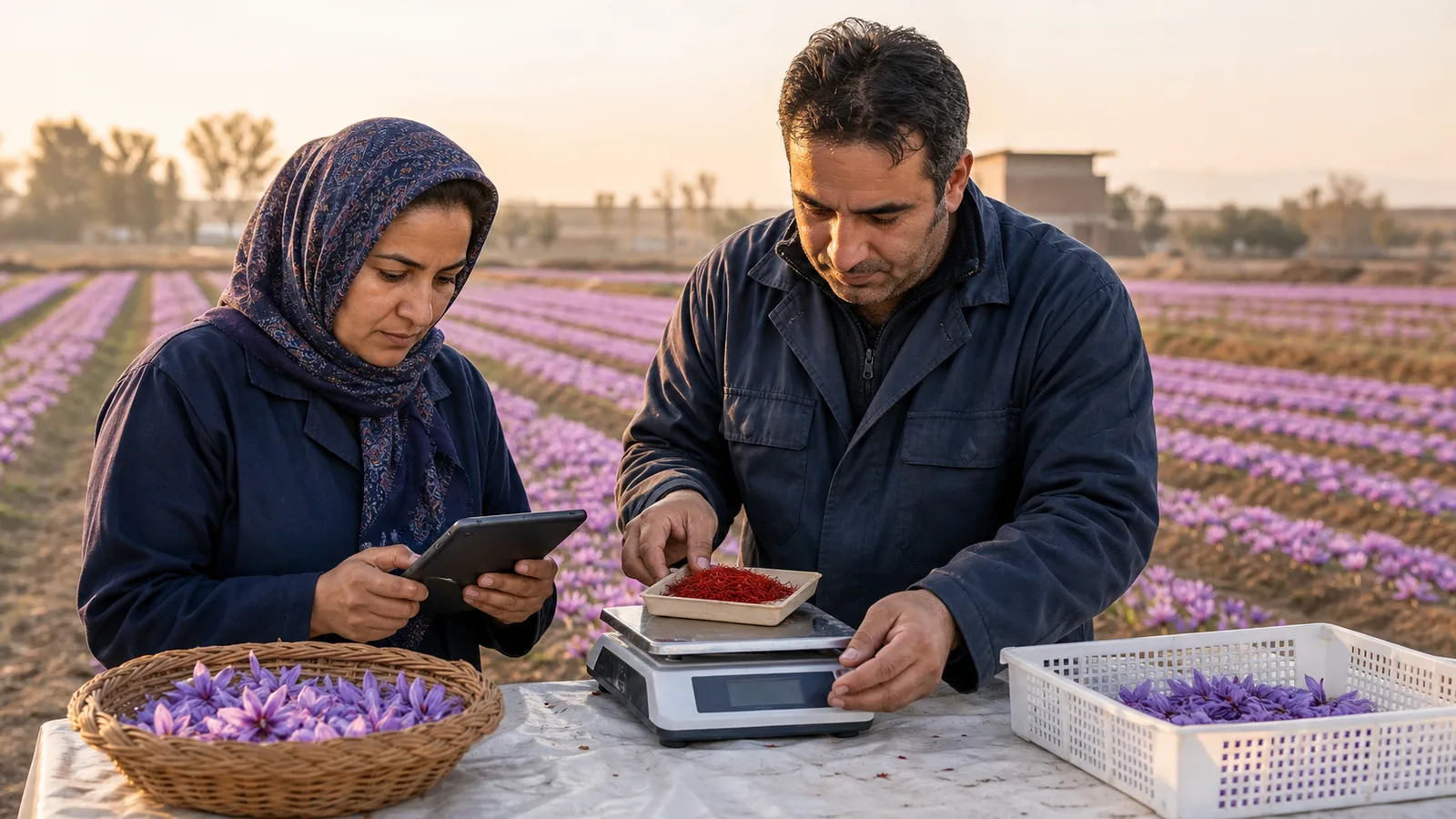
So, how profitable is saffron farming? It can work on suitable land with reliable labour and a verified market. It can also lose money when a plan assumes retail prices for a wholesale crop, uses an exceptional research yield as an average, or leaves the owner’s time out of the budget.
Is saffron farming profitable?
Profitability is local. Climate and soil determine whether the corms survive and flower; planting density affects the first corm bill; harvest speed and drying affect both labour cost and quality; and the selling channel determines how much of the final shelf price reaches the grower.
Kesar is another name for saffron. If you are asking whether kesar farming is profitable, the same farm-level yield, cost and buyer evidence is required.
Farm studies do show that saffron can produce positive returns under specific systems. A 2022 analysis of 70 farms in central Iran reported a benefit-to-cost ratio above one and modelled improvements from better input use. A recent long-term field study also found benefit-to-cost ratios above one in several mature seasons, but its most economical end year differed by planting method. These are examples of viable operations, not universal profit promises.
The practical answer to “can you make money growing saffron?” is therefore yes, after a pilot proves four things:
- the corms flower and multiply in the site’s real soil and weather;
- the farm can harvest and separate stigmas during the short bloom window;
- the dried crop consistently meets the buyer’s quality specification; and
- the buyer, price and payment terms exist before the area is expanded.
Average saffron yield per hectare
There is no single dependable average saffron yield per hectare. Published figures differ because they describe different climates, stand ages, corm sizes, planting densities, irrigation, flower counts, drying methods and definitions of saleable material.
The often-repeated range of 5 to 15 kilograms of dried saffron per hectare may describe some established fields, but it is too broad to use as a guaranteed budget. An older FAO regional overview used an approximate figure of 10 kg of dried saffron per hectare. By contrast, Penn State Extension says an acre produces about three pounds on average, equivalent to roughly 3.4 kg per hectare. Its saffron production overview also notes that yield can rise as corms mature and multiply in years two and three.
Those numbers are not contradictory instructions. They show why someone searching for “average saffron yield per hectare kg” needs a local range, not a global constant. Build the financial plan with three scenarios:
- Conservative: the pilot’s lower saleable yield after drying and grading losses.
- Expected: the multi-year average from comparable local farms or trials.
- Strong: a defensible upper result, used for capacity planning rather than loan repayment.
Record dried stigma weight, not only flower count. Keep each bed and season separate. A traditional saffron yield per hectare, a protected-culture result and an unusually successful research plot should not be blended into one forecast.
Saffron yield and profit per acre
One hectare equals about 2.47 acres, so divide a per-hectare yield by 2.47 to estimate the same yield per acre. For example, 5 kg/ha is about 2.0 kg/acre, while 10 kg/ha is about 4.0 kg/acre. The conversion is arithmetic; whether either yield is realistic still depends on the farm.
Do not calculate saffron farming profit per acre by multiplying yield by an online retail price. Use this sequence:
- Gross crop revenue = saleable dried saffron × the farm’s realised price after discounts and rejected lots.
- Other gross revenue = corms or genuinely marketable by-products, counted only when a buyer and harvestable surplus exist.
- Operating margin = total revenue minus current-season cash costs.
- Net farm return = operating margin minus annualised establishment costs, equipment depreciation, land charge, owner labour, finance, tax and marketing overhead.
The break-even yield is equally useful: subtract dependable other revenue from total annual cost, then divide by the net price per kilogram. If that yield is above what the pilot has produced, the business is not yet bankable.
What belongs in a saffron farm budget?
Establishment costs
Corms are often the largest first-year purchase. Add shipping, inspection, losses, bed preparation, drainage, irrigation, fencing or rodent protection, tools, drying equipment and suitable storage. If the stand will remain for several seasons, spread appropriate establishment costs across the planned cycle instead of pretending the first year and a mature year are identical.
Annual field costs
Count irrigation water and energy, soil and tissue tests, compost or fertilizer actually required, weeding, pest and disease monitoring, replacement corms, records and insurance. Our guides to watering saffron plants, fertilizer planning and saffron pest control explain why copying a universal input schedule can waste money or damage the stand.
Harvest and post-harvest labour
Saffron flowers arrive in a concentrated window and each flower carries only three stigmas. Budget picking, same-day transport, stigma separation, controlled drying, grading, packaging and cleaning. Family labour still has an economic cost: if those hours are treated as free, the result measures cash left over, not the true return to the farm.
Selling costs
Add testing, food-business registration, compliant labels, packaging, marketplace or payment fees, samples, photography, fulfilment, customer service, storage loss and unsold inventory. Wholesale is simpler but pays less per gram; direct retail can earn more but turns the grower into a packer, marketer and retailer.
Price, quality and the route to market
Saffron price varies by origin, grade, colour strength, aroma, moisture, purity, certification, package size, contract volume and sales channel. A high advertised shop price is not evidence that a new farm can sell its whole harvest at that figure.
Before planting commercially, ask potential buyers for:
- the specification and test results they require;
- minimum and maximum lot sizes;
- sample approval and rejection rules;
- price basis, currency, delivery terms and payment timing; and
- whether packaging, certification or traceability changes the offer.
Use at least one realistic wholesale offer in the conservative budget, even if the preferred plan is direct retail. That protects the farm from building its entire forecast around customers who have not yet been acquired.
Why first-year income can be misleading
A saffron stand changes over time. Large planting corms may flower in the first season, daughter corms can raise later production, crowding can eventually reduce performance, and the stand may need lifting and replanting. Weather, rodents, rot and labour availability can change the curve.
A University of Vermont agrivoltaic pilot illustrates the danger of quoting one annual number. Its three-year one-acre estimate modelled a large loss in year one, positive later years and very different totals depending on whether surplus corms were sold. The assumptions included a $35-per-gram retail price and corm sales; they are transparent, but they are not a promise for another farm.
Prepare a cash-flow statement for every year in the planned planting cycle. Include the timing of corm purchases and sales, the month labour is paid, when buyers pay invoices, and the cost of replanting. A project can show a positive multi-year return and still run out of cash during establishment or harvest.
Small-scale saffron farming profitability
Small plots can be a sensible way to learn because the owner can test corm survival, labour minutes per gram, drying loss and buyer response without risking a full acre. Small scale also makes direct sales possible, but packaging and customer acquisition consume time that a hectare-level spreadsheet may overlook.
Measure the pilot as if it were already a business. Log paid and unpaid hours, every input, fresh flowers, dried stigma, rejected material, package yield, sale price, fees and unsold stock. Then ask whether the margin survives when labour is paid and production is scaled.
Growing saffron indoors for profit
Indoor or controlled-environment production should have its own model. A room can manage temperature, humidity and flower handling, but it adds trays, shelving, sensors, sanitation, ventilation, energy, building cost and disease risk. Flowering corms also need a credible plan for leaf growth and daughter-corm recovery; a one-cycle bloom display is not automatically a renewable farming system.
Do not convert a room’s shelf area into “acres” and apply an open-field yield figure. Use flowers and dry stigma per tray, usable rack level, cycle and square metre of actual production area. Then subtract corm replacement, failed corms, electricity, climate control, cleaning and labour. A pilot should prove biological repeatability before an indoor profit claim is used to sell equipment or attract investment.
How to grow saffron for profit without chasing yield
Higher saleable yield helps only when the extra output is worth more than the extra cost and does not lower quality. The strongest plan usually concentrates on avoidable losses:
- buy healthy, correctly identified corms and inspect them before planting;
- use well-drained soil and irrigation suited to the local life cycle;
- test nutrients rather than buying a long product list;
- schedule enough trained labour for the peak flowering days;
- standardise drying and protect the crop from moisture, light and contamination;
- grade honestly and keep traceable lots; and
- secure more than one sales route before harvest.
Invest in saffron only after a local pilot, a multi-year budget and buyer conversations agree. The crop’s high value per kilogram is real. So are its low physical yield, concentrated hand labour, delayed corm cycle and market risk. Saffron farming profitability comes from managing all five, not from the “red gold” nickname.

![Exporting Saffron to Turkey + Price Guide [Complete 0 to 100]](https://img.rowhanisaffron.com/20260827003933/saffron-export-turkey-quality-inspection.webp)



