


When does saffron bloom? In the Northern Hemisphere, Crocus sativus usually flowers in autumn, often during October and November. The exact saffron blooming time moves with location, weather, planting date, corm condition and soil temperature. In the Southern Hemisphere the calendar is reversed, so growers should follow local autumn conditions rather than copy a Northern Hemisphere month.
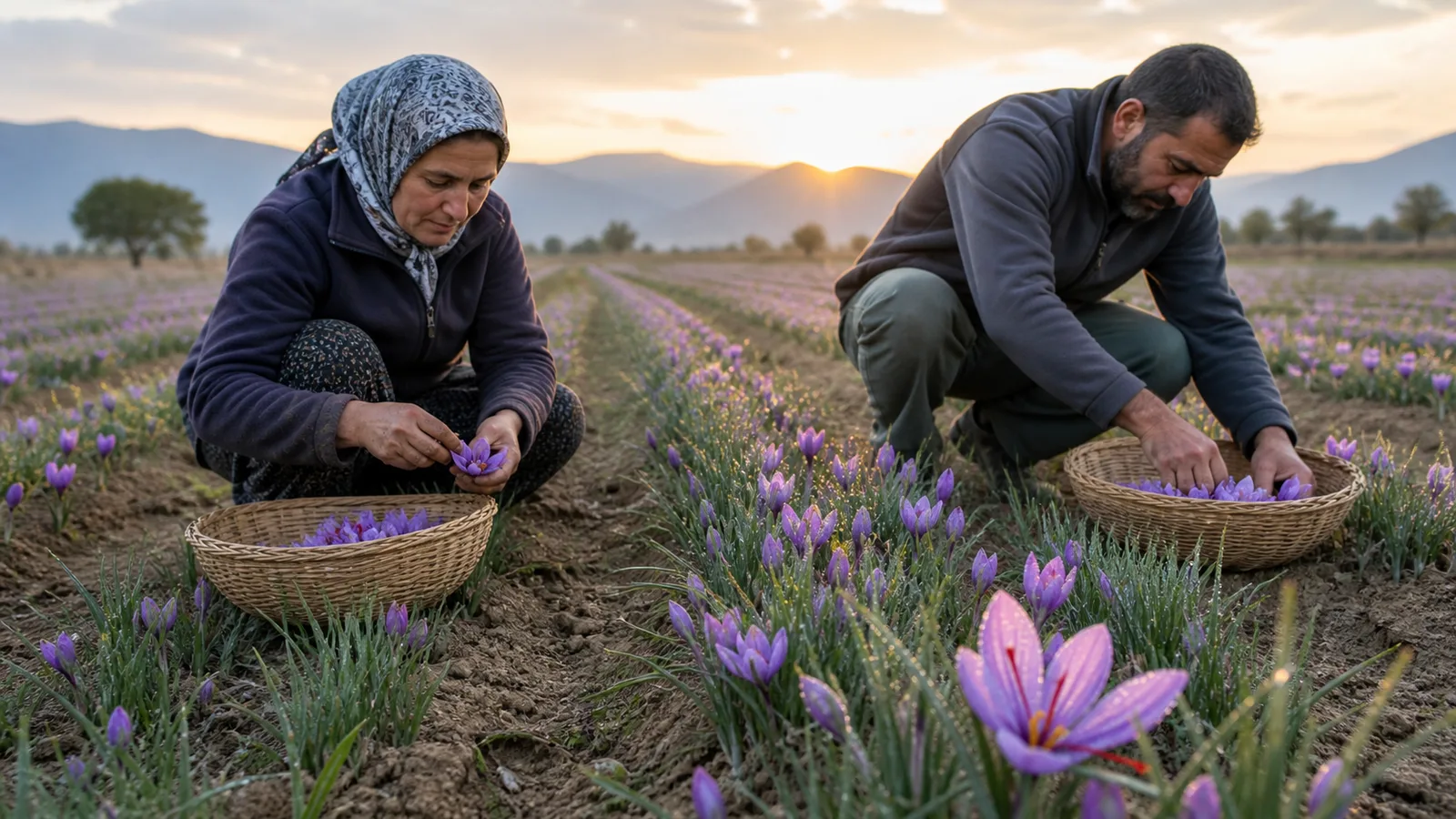
The best time for saffron flower harvest is not two or three weeks after the first flower. Harvest begins as soon as usable flowers appear. Pick through the field every day during the flowering flush, preferably in dry early-morning conditions while blooms are still closed or only beginning to open, then separate and dry the stigmas promptly.
In which season is saffron flowering observed?
Saffron is an autumn-flowering crocus. In established Northern Hemisphere production areas, the saffron flowering season commonly falls from October into November. Iran’s Khorasan harvest, for example, is associated with this autumn window. A University of Vermont production-cycle guide also places flowering, harvesting and drying in October and November in its climate.
That calendar is a guide, not a trigger. A warm autumn can delay emergence; an earlier cooling pattern can bring it forward. High-tunnel, container and indoor systems can shift conditions further. Record the first bud, first flower, peak flower day and final flower each season so next year’s labour plan is based on the field itself.
How temperature affects saffron bloom time
Saffron corms form flower structures during their warm dormant period, then emergence follows a marked cooling. Controlled research found that flower formation was most favourable after sustained conditions around 23–27°C and that emergence followed transfer toward 17°C. The temperature study also found that timing differed widely by location.
This is why “flowers appear at an average daily temperature of 8°C” is not a dependable universal rule. Air temperature, soil temperature, the corm’s earlier heat exposure, moisture and local cultivar material all interact. Do not force irrigation from one thermometer reading. Watch the corm cycle and use the local field’s response.
How often does saffron bloom?
A saffron planting has one seasonal flowering period each year. In that sense, the answer to “how many times does saffron bloom in a year?” is once. That does not mean every flower opens on the same day or that each corm produces only one flower.
New buds emerge in waves during the seasonal flush, so a grower may harvest the field daily for several weeks. University of Vermont trials reported flowering beginning 30–40 days after planting and continuing for five to six weeks, but those figures came from a particular Vermont system. Other production areas often report a more concentrated main harvest. Corm size, stand age, density and weather affect both the number of flowers and the length of the window.
You therefore harvest saffron once per year as a crop season, but pick it many times within that season. Asking “how often can you harvest saffron?” is really a labour question: inspect the field each morning while new flowers are emerging.
The Crocus sativus life cycle
Saffron grows from a corm, not true seed. Its annual cycle has five practical stages:
- Dormancy: leaves die back and the corm rests through the warmer dry period.
- Flower initiation inside the corm: this happens before the bloom is visible above ground.
- Autumn sprouting and flowering: buds and leaves emerge as conditions cool.
- Winter and spring leaf growth: green leaves feed the developing daughter corms.
- Senescence and daughter-corm maturity: leaves yellow naturally before the next dormancy.
The leaves after flowering are next year’s production system. Do not cut healthy green foliage just because the harvest has ended. The University of Vermont’s saffron life-cycle guide notes that daughter corms develop while leaves remain green for months.
What is the approximate duration of a saffron crop in the field? A bed may remain for several years—UVM describes a four-to-six-year cycle—but crowding, disease, declining flower count and the local rotation plan determine when corms should be lifted and replanted. “How many days to grow saffron?” has no single answer: first bloom can follow autumn planting within weeks in one trial, while a commercial stand and its corm multiplication span years.
When to pick saffron flowers
Saffron harvest time begins with the first usable flowers, not after the whole field has bloomed. When to harvest saffron is decided flower by flower: collect each day’s closed or just-opening blooms rather than leaving them for a later weekly round.
Walk the field early and pick on a dry day, ideally before flowers are fully open. University of Vermont Extension recommends early- to midmorning harvest. Closed or just-opening flowers are easier to protect from soil, rain, sun and handling damage than blooms left open in the field.
Do not wait for the entire bed to peak. Individual saffron flowers are short-lived, and new flowers can appear overnight. During the main flush:
- inspect every planted area each day;
- lift or pinch the flower cleanly without pulling up the corm or damaging leaves;
- keep flowers loose in clean, shallow, breathable containers;
- protect them from rain, direct sun, soil, fuel and crushing; and
- move them to a clean separation area promptly.
“Within three weeks of blooming” is too slow as an instruction for an individual flower. The overall saffron harvest season may last weeks, but each day’s flowers should be collected and processed without unnecessary delay.
Separating and drying the stigmas
Each true saffron flower has three red stigmas. Handle flowers on a clean food-contact surface and separate the stigmas without adding yellow style material if the intended grade excludes it. Keep lots traceable by field and date; that makes it easier to connect quality or moisture problems with weather and handling.
Drying is not an afterthought. It lowers moisture and develops the aroma profile, but the result depends on temperature, time, airflow, load depth and the starting moisture. Research on saffron drying shows that different conditions change volatile compounds. Use a validated method and a clean, controllable dryer rather than guessing from colour alone. Cool the dried saffron, package it in a moisture- and light-protective container, and store it away from odours.
Manual saffron harvesting
Manual picking remains the reference method because workers can select flowers while protecting narrow leaves and uneven beds. Its main weakness is labour concentration: a large share of the crop may appear over a few mornings, and delayed picking can expose flowers to opening, weather and contamination.
Plan people, not only hectares. Time a pilot crew, measure flowers or grams per worker-hour, include walking and container changes, and allow for stigma separation after field work. Raised beds, clear paths, low rolling seats and well-spaced rows may improve ergonomics without changing how the flower is detached.
Can saffron flowers be harvested by machine?
Mechanical and robotic saffron harvesters are still an active engineering field. Prototype backpack devices use a cutting head and suction to collect flowers, while vision systems aim to distinguish harvestable buds. A published low-cost semi-automatic design was conceived as a battery-powered backpack system and underwent preliminary experimental validation.
That evidence does not support a generic claim that a gasoline backpack machine is ready for every irregular field, or that a one-operator cart will reliably harvest 5,000 square metres. Before buying or building equipment, require field data for:
- flowers collected per hour under the farm’s density and terrain;
- missed, cut or damaged flowers and leaves;
- soil and foreign-material pickup;
- cleaning time, battery or fuel demand and repair support; and
- final stigma quality compared with the manual method.
A machine can reduce bending or increase speed and still lose money if it lowers collection rate at peak bloom, contaminates flowers or creates more sorting work. Structured planting and level paths may help a device, but they should be designed around verified equipment rather than a promotional capacity figure.
A practical harvest plan
Two to three weeks before the expected saffron blooming season, prepare clean baskets, separation tables, lighting, drying equipment, storage containers, lot labels and backup labour. Begin scouting before the historic first-bloom date. During flowering, record weather, daily flower count, fresh weight, dry stigma weight, worker-hours and drying settings.
After the final bloom, review where flowers emerged early or late and whether water, drainage, corm density or disease explains the pattern. Keep the green leaves intact and continue the crop’s appropriate winter and spring care. Our guides to watering saffron plants and saffron fertilizer planning cover those decisions without relying on a fixed calendar.
The short answer remains simple: saffron generally blooms once each autumn, with many flowers emerging across a brief seasonal flush. The quality-focused answer is operational—watch the field daily, pick dry flowers before they fully open, and move the three stigmas through clean separation and controlled drying as soon as practical.

![Exporting Saffron to Turkey + Price Guide [Complete 0 to 100]](https://img.rowhanisaffron.com/20260827003933/saffron-export-turkey-quality-inspection.webp)



