


The saffron cultivation process starts with healthy Crocus sativus corms in free-draining soil and ends with a very short autumn harvest, when each flower is picked and its three red stigmas are separated and dried. The outline is simple. Doing each job at the right point in the plant’s unusual annual cycle is what makes growing saffron demanding.
How is saffron grown from planting to harvest?
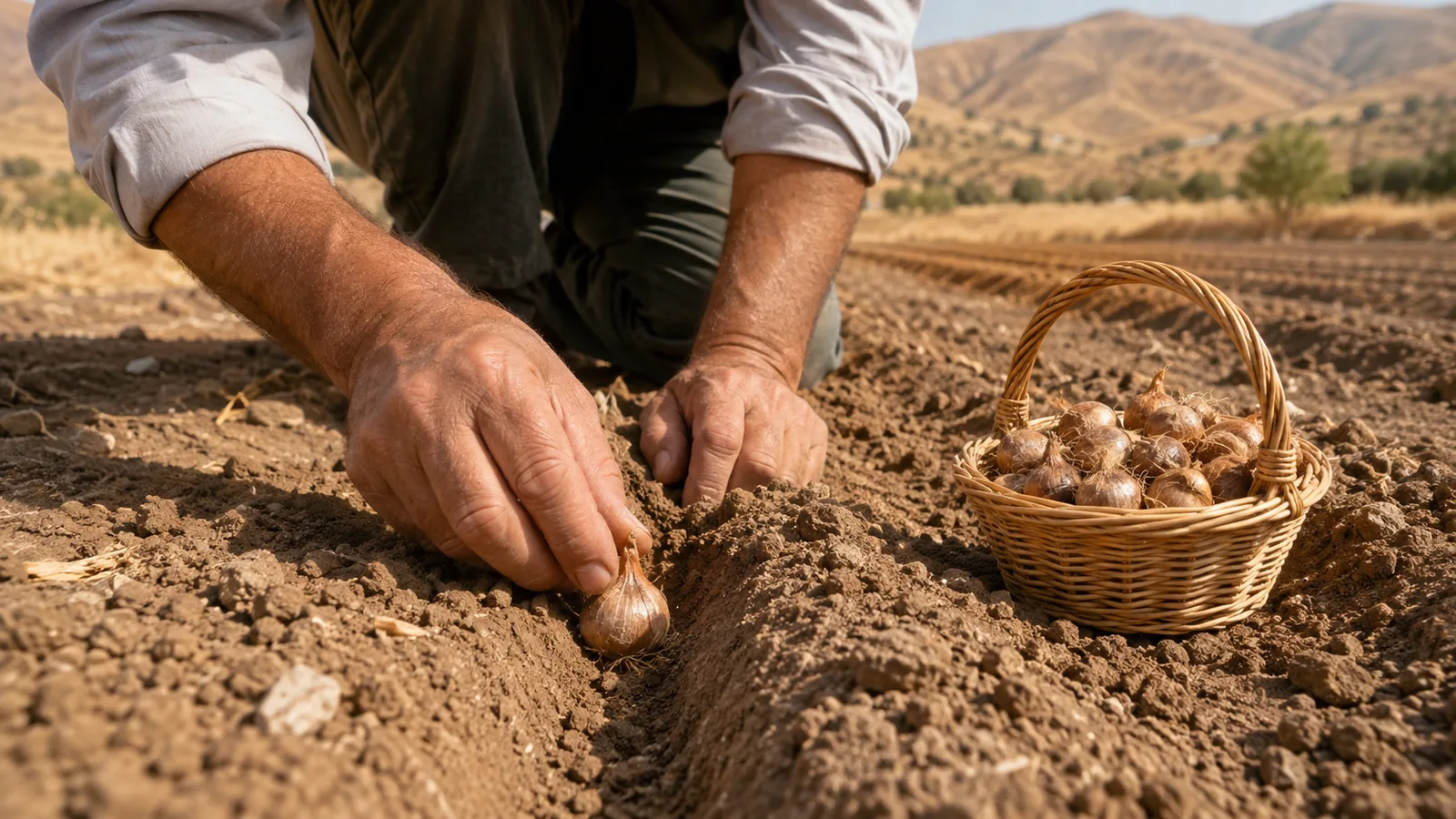
Saffron is grown from corms rather than seed. A corm is a solid underground stem that stores the plant’s energy. After planting, roots and shoots develop, flowers usually appear in autumn, and narrow leaves continue growing through the cooler months. Those leaves feed new daughter corms before they yellow and die back. The plant then rests underground during summer dormancy and begins the cycle again.
In practical terms, the cultivation of saffron follows these stages:
- Assess the climate, drainage, soil and irrigation supply.
- Buy firm, healthy corms from a traceable supplier.
- Prepare the bed and plant at a depth and spacing suited to the local system.
- Manage water, weeds, nutrition, pests and disease through the growing season.
- Pick flowers promptly during the brief bloom.
- Separate the red stigmas, dry them evenly and store the finished saffron correctly.
- Let the foliage finish naturally, then lift and divide crowded corms during dormancy when necessary.
That full sequence is the saffron production process. Growing the flowers is only half the work; harvest timing and post-harvest handling have a direct effect on the spice that reaches the jar.
Start with the saffron plant, not a packet of seed
Crocus sativus is a sterile triploid plant, so ordinary saffron production does not begin with viable seed. It is propagated vegetatively: each planted corm can produce daughter corms, which become future planting material. Listings for “saffron seeds” are therefore a warning sign. They may refer to another crocus, safflower, or a completely unrelated plant.
A good corm feels firm and looks intact. Reject stock that is soft, mouldy, badly cut or shrivelled. Size matters because a well-developed corm holds more reserves and is generally more likely to flower than a very small one, although size alone cannot compensate for disease or poor storage. Our guide to choosing and handling saffron corms goes further into propagation and corm health.
What climate does saffron need?
Saffron is a cool-season perennial with a warm-season dormancy. Many successful regions have warm, relatively dry summers, an autumn change in temperature and moisture that supports flowering, and winters that allow the leaves to remain active. Full sun is generally helpful, but drainage and the timing of moisture matter as much as a simple temperature label.
Hardiness advice varies because a dry, sheltered bed and a saturated exposed field behave differently even at the same winter temperature. The University of Vermont’s saffron guidance for home gardeners reports successful production in USDA zones 4–8 and stresses that standing water can rot the corms. Treat a zone number as a starting point, then judge the actual site, summer rainfall, freeze-thaw pattern and soil.
Can saffron grow in a tropical climate?
Saffron does not naturally thrive in a uniformly hot, wet tropical climate. Persistent warmth and saturated soil during the plant’s resting period raise the risk of corm rot, while the seasonal signals for flowering may be weak. That does not make every tropical location impossible: a dry-season production window, suitable elevation, protected cultivation or careful container management can create a workable microclimate. A trial plot is wiser than assuming the crop will suit an entire region.
Choose soil for drainage first
The best soil for saffron cultivation drains promptly while holding enough moisture for active growth. Sandy loam is often recommended, though another texture can work if its structure is sound and water never sits around the corms. Raised beds can help on a damp site. Heavy soil that puddles after rain needs more than a handful of sand; drainage, bed height and soil structure must be corrected as a system.
A soil test should guide pH and nutrient decisions. Broad advice such as “add phosphorus and potassium” can waste money or create an imbalance when the soil already contains enough. Incorporate mature compost only at an appropriate rate, and avoid placing fresh manure or concentrated fertiliser directly against the corm. Commercial growers should use local soil and tissue analysis rather than copy a feeding programme from a different soil and climate.
When and how should saffron corms be planted?
Plant during dormancy, before the corms begin active autumn growth. In much of the Northern Hemisphere this means late summer to early autumn, but a local grower or extension service should set the calendar. Corms held too long may sprout in storage and lose condition.
Place each corm with its growing point upward. Planting depth and density are management choices, not universal constants. Home-garden recommendations commonly place corms several inches deep and a few inches apart. Iranian field systems may plant more deeply or group corms in holes, while intensive beds use closer rows. Deeper planting can buffer temperature and discourage some animals, but it also changes emergence and daughter-corm behaviour. Shallow planting can make lifting easier but leaves corms more exposed.
For a first bed, use one consistent depth, label the planting date and record the corm size and source. That modest record is far more useful next season than trying to remember why one row flowered better.
Watering and feeding after planting
Water the bed in after planting if the soil is dry, then respond to actual soil moisture and weather. The old rule that every saffron row must be watered at two- or three-day intervals is unsafe: in a cool or slow-draining field, that frequency can keep corms wet enough to rot. Outdoor home beds may need little extra water where autumn rainfall is reliable. Arid commercial systems need planned irrigation, but the schedule differs with soil, temperature, root activity and water quality.
Moisture before flowering can help initiate autumn growth in dry regions. Later water supports leaves and daughter-corm development. During summer dormancy, unnecessary irrigation is usually avoided. For the seasonal logic behind each application, use the detailed saffron irrigation timing guide and adjust it to field measurements rather than the calendar alone.
How long does saffron take to grow?
Healthy corms planted at the right time may flower in their first autumn, sometimes within several weeks, but there is no dependable single number of days. Planting date, corm size, temperature and prior storage all influence emergence. Small or stressed corms may make leaves without producing a useful first-year bloom.
Saffron is perennial, so a bed should also be judged across seasons. Leaves remain after flowering and should not be cut while green; they are replenishing the corms. They yellow naturally in spring or early summer, signalling dormancy. Daughter corms can increase the stand, but crowding eventually reduces space and makes flowering uneven. Depending on the system, growers lift, sort and replant during dormancy after several years.
Field care during the growing season
Weeds compete for light, water and nutrients and make a fast flower harvest harder. Control them before they set seed, but work shallowly around active corms. A hard surface crust may need careful loosening after irrigation in some field soils; aggressive cultivation can damage shoots and roots.
Watch for soft or discoloured corms, patchy emergence and foliage that collapses before its normal dormancy. Waterlogging, fungal disease, rodents and physical damage can all produce gaps. Remove suspect material with clean tools and ask a local plant-disease service for a diagnosis before applying a treatment. Good drainage, clean planting stock, sensible rotation and sanitation are more reliable than routine chemical use without knowing the cause.
How saffron is harvested
The saffron harvesting process is compressed into a short flowering season. Fields may need to be picked every day because open flowers deteriorate quickly and the stigmas are easier to protect before they are exposed to rain, dust and strong sun. Pick on a dry morning after surface moisture has lifted, handle flowers gently and move them into a clean, shaded work area.
Inside each normal flower are three red stigmas. Separate those from the yellow stamens and purple petals without mixing in soil or damaged plant material. This work is still largely manual. A field can flower unevenly, so labour has to be available when the crop is ready rather than when it is convenient.
How saffron is made after the flowers are picked
Fresh stigmas are not yet shelf-stable saffron. They must be dried soon after separation with controlled, even heat and clean airflow. Too little drying leaves excess moisture and storage risk; too much heat can scorch the threads and flatten their aroma. Equipment, batch thickness and humidity change the time, so appearance alone is not a dependable endpoint for a commercial lot.
Cool the dried threads before sealing them in a clean, airtight container. Store the container away from light, heat and moisture, and avoid repeated opening. Small home batches and commercial lots need different controls; our comparison of saffron drying methods explains the practical options. A producer selling the crop should also follow the applicable hygiene, moisture, labelling and traceability rules in the destination market.
What saffron cultivation looks like in Iran
Saffron cultivation in Iran is concentrated particularly in the Khorasan provinces, where growers have generations of experience with field selection, corm multiplication, irrigation, flower picking and drying. Iran is also the world’s largest saffron producer. The UN Food and Agriculture Organization describes the qanat-based saffron farming system in Gonabad as operating under severe water scarcity and supplying irrigation through historic underground channels.
That example explains why saffron is associated with dry regions, but it should not be simplified into “saffron needs no water.” Root growth, flowering and daughter-corm development still depend on moisture at the right time. It also does not mean one Iranian field method transfers unchanged to a raised bed in Vermont or a container in Britain. Climate, soil, machinery, labour and the intended life of the planting all affect the method.
For the distinction between producing regions, exports and re-exports, see our current saffron production statistics. Any figure for hectares, yield or national share needs a crop year and a named source; it should not be treated as permanent.
Common saffron-growing mistakes
- Buying “seed” instead of true corms: culinary saffron is propagated from Crocus sativus corms.
- Choosing a wet site: a valuable corm is still vulnerable to rot in standing water.
- Following a fixed watering interval: moisture should be checked in the root zone.
- Expecting every corm to flower immediately: size, health and planting time affect the first crop.
- Cutting green leaves after harvest: those leaves are feeding next year’s corms.
- Waiting to process a large flower pile: stigmas should be separated and dried promptly.
- Planning commercial acreage before a trial: yield and labour assumptions should be tested locally.
Is growing saffron commercially straightforward?
The crop uses little land for a high-value product, but saffron farming is not passive income. Corms are a material up-front cost. Flowering is brief, picking and separation are labour-intensive, and saleable quality depends on drying, hygiene, grading, storage and access to honest buyers. Yield can change sharply with corm size, planting age, weather and management.
Begin with a measured trial. Record planted corms, flower count, fresh and dry weights, labour hours, losses and selling costs. Confirm that enough trained hands are available for peak bloom. Only then can a grower estimate whether scaling the saffron plantation makes sense under local conditions.
The cultivation process in one sentence
To grow and produce saffron well, plant healthy corms in sunny, free-draining ground before autumn growth, give them measured seasonal care, harvest the flowers promptly, dry the three red stigmas cleanly and allow the foliage to rebuild the next generation of corms. The crop rewards close observation; rigid advice copied from another climate does not.

![Exporting Saffron to Turkey + Price Guide [Complete 0 to 100]](https://img.rowhanisaffron.com/20260827003933/saffron-export-turkey-quality-inspection.webp)



