


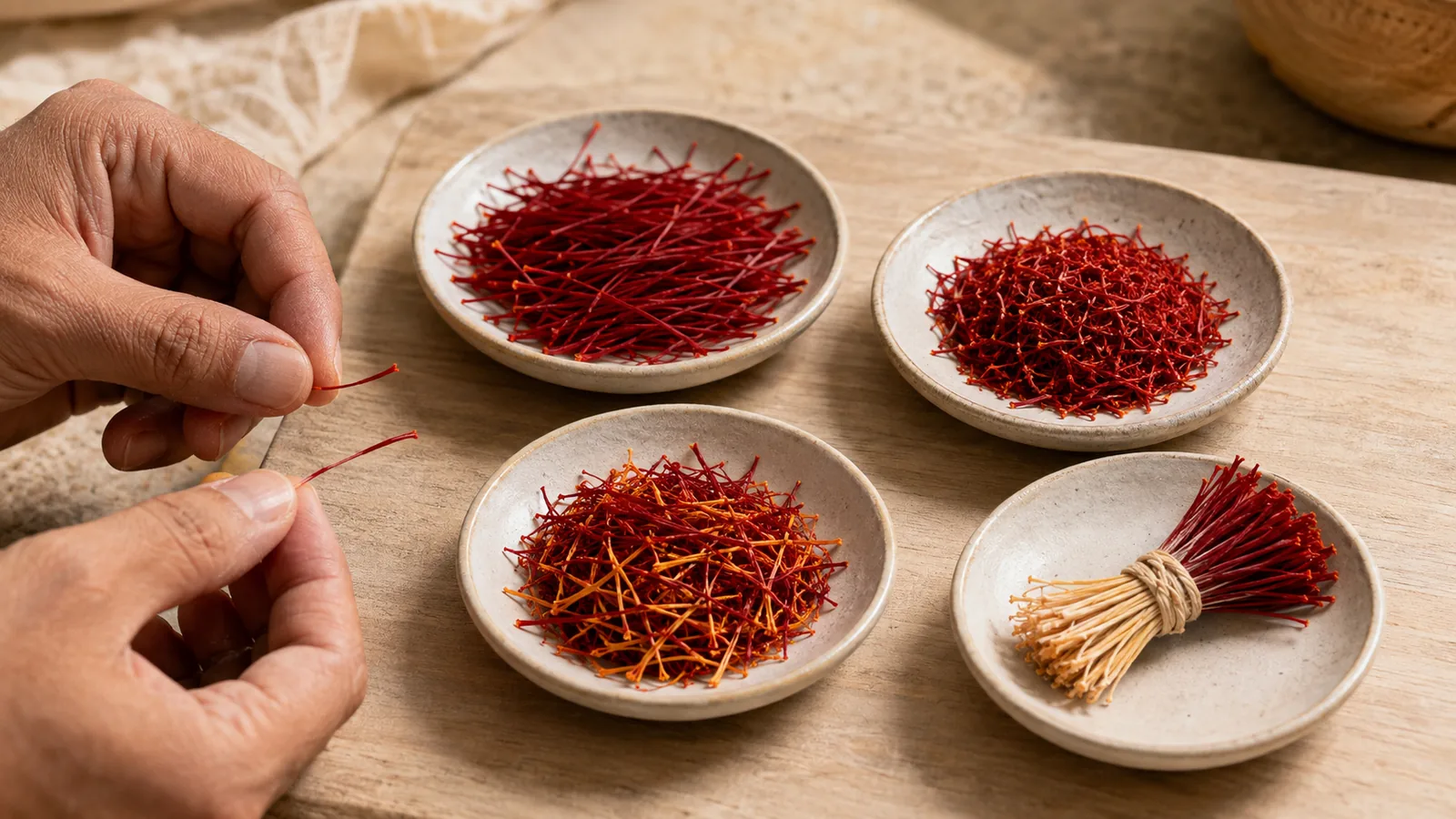
The best-known types of saffron are Sargol, Pushal, Negin and Bunch, names used particularly in the Iranian trade. They describe how the red stigmas and paler style are separated and presented after harvest; they are not four different saffron plants. That distinction makes it much easier to compare packs without assuming that an impressive trade name guarantees strength or freshness.
Why saffron is one of the most valuable spices in the world
Every Crocus sativus flower produces only three red stigmas. The flowers open during a short autumn season and are commonly picked by hand, then the delicate stigmas are separated and dried. A large amount of careful work produces a small weight of spice. That combination of limited material, concentrated labour and demanding post-harvest handling helps explain saffron’s value.
The price of one pack, however, does not prove it is the best. Origin, cut, harvest, moisture, purity, storage, packaging and laboratory results can all affect value. A buyer needs to know what a type name actually describes before comparing prices.
Why saffron types, grades, origins and forms differ
People use “saffron type” to mean several different things. Keeping the terms separate prevents most confusion:
- Commercial cut or style describes how much of the red stigma and yellow-to-orange style remains. Sargol, Pushal, Negin and Bunch belong here.
- Grade is a quality classification based on a specification, test result or seller’s own system. The basis must be named.
- Origin is where the saffron was grown, such as Iran, Kashmir, Spain, Greece or Afghanistan. An origin is not automatically a cut or grade.
- Physical form means whole or cut filaments versus powder.
- Botanical identity means genuine culinary saffron from Crocus sativus, not safflower, turmeric or another crocus.
Most retail comparisons are really about commercial cuts. The different types of saffron on a shop shelf may therefore describe a cut, an origin or a physical form. There is no single worldwide list that makes every regional and seller term interchangeable.
How many types of saffron are there?
Four names dominate many Iranian catalogues, but “four” is not a universal scientific answer. Producers can sort threads more finely, use regional terms, sell powder, or create named subgrades. The useful question is not only how many types of saffron there are, but what plant material each pack contains and how its quality was verified.
Sargol saffron
Sargol consists of separated red stigma portions with the pale style removed. The threads are often shorter than carefully selected Negin because the emphasis is on red material rather than long, aligned appearance. Clean Sargol can deliver strong colour and aroma, which is why cooks and food businesses value it.
“All red” does not make every Sargol batch equal. Broken red threads can still be old, damp, poorly dried or adulterated. Colouring strength and aroma should be judged from the actual lot, not inferred from the name alone.
Pushal saffron
Pushal saffron keeps the red stigma attached to a short section of yellow or orange style. That connection can make the natural structure of the pistil easier to see. Because part of each piece is pale style rather than red stigma, a gram may contain a lower proportion of the colour-bearing red tissue than an all-red cut.
It is too simple to call Pushal “low quality.” A fresh, clean, well-dried Pushal can be a better purchase than a badly stored product with a more prestigious label. It suits buyers who want visible connected threads and understand that appearance and measured performance are separate questions.
Negin saffron
Negin is selected for long, thick, separated red stigmas with little or no pale style. Careful alignment and minimal breakage give it a striking presentation, especially in a clear gift pack. Super Negin is a commercial selection generally used for particularly long, straight, uniform red threads.
The boundary between Negin and Super Negin is not enforced by one worldwide retail definition. A seller should state the sorting specification rather than use “super” as proof. Long threads may command a presentation premium, but the longest batch is not automatically the most aromatic or the strongest in a laboratory test.
Bunch or Dasteh saffron
Bunch saffron, also called Dasteh, preserves red stigmas with a longer section of style and traditionally aligns or ties them in a small bundle. It is closer to the harvested pistil than the heavily trimmed red cuts. It does not contain the full flower: the purple petals and yellow stamens are not what defines Bunch saffron.
The visible transition from red to orange, yellow and pale style can help a buyer understand the plant’s structure. On the other hand, more style means less red stigma per gram. Bunch is therefore a distinct presentation with its own cultural and practical appeal, not simply the “worst” type. Our Bunch saffron page shows this traditional form in more detail.
Whole threads versus powdered saffron
Whole or cut filaments allow the buyer to inspect thread shape, colour distribution and foreign material. They can be ground immediately before cooking, which gives the cook more control. Powder disperses quickly and can be convenient for a commercial recipe, but its identity is harder to judge by eye and its greater surface area makes protection from air, light and moisture especially important.
Powder is not inherently fake. It should come from a traceable batch of genuine saffron and be packed by a supplier with appropriate controls. Be cautious when a bright red powder is unusually cheap, has no batch information or makes a very intense colour without a characteristic saffron aroma.
Are saffron varieties different from one country to another?
Iranian, Kashmiri, Spanish, Greek and Afghan saffron refer primarily to origin and regional production traditions. Climate, soils, harvest practice and drying can shape a batch, while protected geographical names may define additional rules. Those labels should not be presented as separate plant species: culinary saffron remains Crocus sativus.
One country may also use several commercial cuts. Iranian saffron can be offered as Negin, Sargol, Pushal or Bunch; naming a country does not tell you which is in the pack. Conversely, a familiar cut name on a package does not prove the declared origin. Traceability has to support both claims.
What do “types of kesar” mean in India?
Kesar is a common South Asian name for saffron. In Indian and Kashmiri trade, buyers may encounter terms such as Mongra, Lacha or Lachha, and Guchhi. These regional names are not always exact one-to-one translations of Iranian Sargol, Pushal, Negin and Dasteh. Spelling and seller definitions also vary.
When comparing types of kesar, ask the same concrete questions: Are the threads all red or attached to style? Are they loose or bundled? Is the origin traceable? Is there a current test report for the lot? A clear physical description is more useful than forcing two regional naming systems into a false match.
What official standards call the different forms
The FAO/WHO Codex Alimentarius standard for dried saffron, CXS 351-2022, uses broader international styles. It describes filaments as dried stigmas with part of the style, cut filaments as dried stigmas with the styles removed and the pieces detached, and powder as crushed particles. It also allows another distinctly different style when it is labelled accordingly.
The current ISO specification, ISO 3632-1:2025, likewise applies to filaments, cut filaments and powder. ISO 3632-2 provides test methods. A laboratory report should identify the standard, method, sample and date; the phrase “ISO quality” on its own is not a result.
Does Negin always have the highest quality?
No. Negin often has the most visually impressive long red threads, and careful selection can justify a higher price. Yet quality is multidimensional. A shorter Sargol lot can have excellent colouring strength, while a beautiful Negin lot can lose aroma through age, heat or a poor seal.
The familiar compounds discussed in saffron testing include crocin-related colouring strength, picrocrocin-related flavour and safranal-related aroma. Moisture and foreign matter matter too. These characteristics are measured under defined methods; they cannot be ranked reliably from thread length or a product photograph.
How to compare a pack before buying
- Read the exact description: look for form, net weight, origin, responsible business and batch identification.
- Inspect whole threads: genuine stigmas have a characteristic shape and should not be padded with obvious petals, fibres or unrelated plant material.
- Smell carefully: saffron has a distinctive complex aroma; mustiness or a flat old smell is a warning.
- Ask what the grade means: request the named specification and recent lot result behind a numerical or “premium” claim.
- Check the package: it should protect against moisture, heat, light and odour transfer.
- Compare like with like: price per gram is useful only after form, origin, freshness and evidence are considered.
No kitchen test is conclusive on its own. If a purchase is important, combine sensory inspection, supplier traceability and credible testing. Our saffron identification guidelines explain what simple observations can and cannot prove.
Which type of saffron is best for cooking?
For most home dishes, fresh, genuine Sargol, Negin or another all-red cut is easy to measure and bloom. Long Negin threads make an attractive gift or garnish, while Sargol can be practical when the threads will be ground. Pushal and Bunch can also flavour food, but the attached style changes how much red stigma is present in the same total weight.
Use a scale for costly batches or repeatable recipes rather than counting threads, since thread size varies. Grind only what is needed, steep it according to the recipe, and judge the result before adding more. A trade label cannot replace good technique.
Storage can erase the difference between types
Even excellent saffron declines when left beside a cooker, displayed in direct sun or repeatedly exposed to humid air. Keep it tightly closed in a food-safe container, away from light, heat and strong odours. Avoid moving it in and out of a refrigerator if condensation may reach the threads.
Buy a quantity that can be used while it remains lively rather than choosing a large pack only because the unit price is lower. For container and location choices, see our guide to storing saffron without sacrificing quality.
A simple way to choose
Choose Negin when long, uniform presentation matters; Sargol when you want an all-red cut that will often be ground; Pushal when you prefer connected stigma and style; and Bunch when you value the traditional, minimally trimmed arrangement. Then look beyond the type. Freshness, purity, traceable origin, careful drying and storage determine whether that particular saffron deserves its price.

![Exporting Saffron to Turkey + Price Guide [Complete 0 to 100]](https://img.rowhanisaffron.com/20260827003933/saffron-export-turkey-quality-inspection.webp)



