


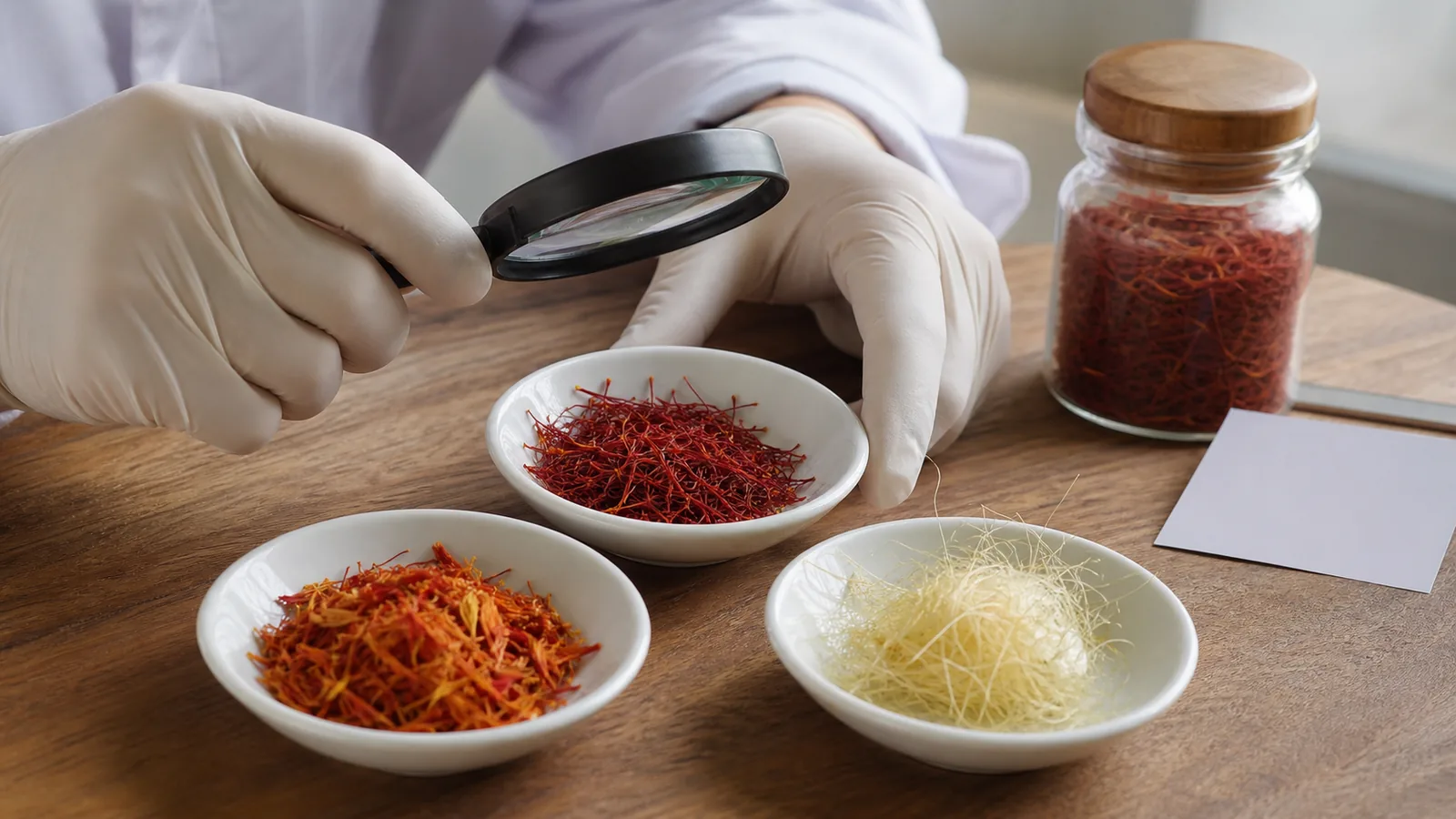
You can screen whole saffron for obvious problems by checking the threads, package, aroma, and how a small sample behaves in water, but no home test can certify authenticity. Powder removes the flower’s visible structure, sophisticated dyes can imitate color release, and genuine saffron can be mixed with cheaper plant material. When the answer matters, use traceable packaging and an appropriate laboratory.
The older version of this guide offered visual, taste, flame, and paper tests as if each could diagnose saffron. Some are useful warning signs; others are unsafe or unsupported. This updated guide separates screening from proof.
Common ways saffron can be adulterated
Genuine culinary saffron consists of dried stigmas from Crocus sativus. Its high value creates an incentive to substitute, dilute, color, or misrepresent it. Reported practices include:
- mixing in safflower or calendula petals, dyed corn silk, other plant fibers, or saffron stamens and styles;
- coloring low-grade material or substitutes with natural or synthetic dyes;
- adding sugar, salt, moisture, oil, or other weight-increasing material;
- selling underweight packs or misrepresenting origin, grade, harvest, or purity;
- grinding a mixture so its components cannot be recognized by eye.
A scientific review of saffron quality control describes physical, microscopic, chromatographic, spectroscopic, DNA-based, and sensor-based authentication methods. That range exists because one observation cannot detect every kind of fraud.
Start with whole threads, not powder
A whole saffron stigma is a slender red thread that generally broadens or flares at one end and narrows toward the other. Threads are naturally irregular; they should not all look like machine-cut strips. A small yellow or orange style portion can be genuine, although a large proportion lowers coloring strength and commercial grade.
Safflower petals tend to be flatter and more petal-like. Dyed corn silk and other fibers may remain uniformly thin instead of showing the stigma’s characteristic form. A magnifier and side-by-side reference can expose crude substitution.
Appearance is still only a screen. Cut genuine threads can lose their obvious shape, and a mixture may contain enough real stigmas to look convincing. Do not reject or certify an expensive batch from one thread.
Powdered saffron cannot be authenticated by sight
The assigned source correctly adds a limitation missing from the destination: once saffron is powdered, morphology is gone. Color alone cannot reveal whether the powder contains genuine stigma, style, safflower, turmeric, starch, dye, or a blend.
Buy powder only when the producer and batch are traceable, preferably with a relevant certificate of analysis. For valuable, commercial, or disputed lots, laboratory testing is the appropriate route. Buying whole threads and grinding them immediately before use gives an ordinary customer more information and usually preserves aroma better.
What aroma and taste can—and cannot—tell you
Saffron’s aroma is complex rather than merely sweet, and its taste is characteristically bitter. Picrocrocin contributes bitterness, while safranal is important to aroma. A clearly sugary or salty sample can indicate added material.
That is not a safe authentication test. Old saffron may have weak aroma, individual perception varies, and adulterants can be mixed with enough real saffron to retain bitterness. Do not taste an unknown or suspicious product to determine whether it contains an unauthorized dye or contaminant.
Use sensory checks only after the product has come from a credible food source, and treat an unusual taste or odor as a reason to stop using it—not as a way to identify the substance.
A water check is a screen, not a verdict
Place a few whole threads in clear warm water and observe rather than boiling them immediately. Genuine saffron usually releases a yellow-to-golden color over time while the threads remain visibly structured. An instant cloud of harsh red dye, painted streaks, or fibers that quickly lose a surface coating are warning signs.
This check cannot prove purity. Extraction speed changes with water temperature, thread size, age, storage, and whether the saffron was broken. Some colorants are designed to mimic saffron, while a genuine but damp or poorly stored sample may behave unusually.
Do not mistake coloring strength for authenticity. Grade and authenticity are related but separate questions; our guide to saffron grades explains what quality categories do and do not show.
Do not use the flame test
The old destination advised putting saffron on a gas flame and said pure material would turn purple or orange because of potassium, while counterfeit material would turn yellow. No reliable source is supplied for that chemistry, and the result is not a recognized proof of saffron identity.
Burning an unknown food sample can produce smoke or fumes from dyes, coatings, pesticides, packaging fibers, or other contaminants. Flame color also depends on many compounds and on the burner itself. The test is both unsafe and diagnostically weak, so it should not be used.
The paper test has a very narrow use
The previous guide suggested pressing threads between paper and treating a grease mark as evidence of fake saffron. A visible oily residue can indeed be a reason for concern because plain dried stigmas should not be coated in oil.
However, no grease mark does not rule out plant substitution, dyes, salt, sugar, excess style, or underweight packaging. Paper type, pressure, moisture, and natural compounds can also affect the mark. This is at most a check for an oily coating, not an authenticity test.
Read the package and trace the seller
The source adds a more useful purchase checklist. For saffron packed under Iranian regulation, check the applicable Ministry of Health production and operation licence details, the producer or factory name and address, production or packing date, expiry or best-before information, batch or lot code, net weight, and an intact seal.
Rules and symbols differ by country. Outside Iran, use the responsible food authority and importer information for that market rather than looking for an Iranian mark. A logo alone is not enough: licence numbers should be verifiable, and the business named on the package should be reachable.
Prefer a seller who can state origin, product form, grade method, harvest or packing period, storage conditions, and refund process. An implausibly low price is a risk signal, not proof by itself. Our high-quality saffron buying guide covers the broader supplier and batch questions.
What a laboratory can test
Laboratories choose methods according to the suspected problem. Microscopy can identify foreign plant structures. Gravimetric and chemical measurements can assess moisture, ash, and soluble material. UV–visible spectrophotometry is used for important saffron quality characteristics. Chromatography and spectroscopy can look for characteristic compounds, dyes, or unusual fingerprints, while DNA methods can identify plant species.
No method answers every question. A study of commercial samples found that ISO 3632 measurements, microscopy, and DNA barcoding complemented one another: the ISO approach could assess color and aroma but not establish genetic origin, microscopy could screen morphology without quantifying purity, and DNA could identify biological origin while missing some forms of self-adulteration.
FAO’s current saffron-authenticity work likewise notes that routine ISO 3632 testing has limits and is developing high-resolution NMR fingerprinting alongside post-harvest guidance. A credible report should therefore name the method, sample, result, and laboratory rather than simply saying “tested.”
Store saffron so genuine quality is not mistaken for fraud
Authentic saffron can lose aroma, color, and flavor when exposed to light, heat, humidity, oxygen, or repeated opening. Store it in a clean, airtight food-grade container in a cool, dry, dark place. Keep it away from steam and strong odors.
Whole threads generally retain their identity and quality better than pre-ground saffron because grinding increases exposed surface area. Do not add moisture before storage, and do not rely on a decorative clear jar left in sunlight.
For container choice and practical shelf-life considerations, see our guide to storing saffron without sacrificing quality.
A practical decision sequence
- Choose whole threads from a traceable, licensed food business.
- Check the seal, lot, dates, net weight, producer or importer, and applicable licence details.
- Inspect multiple threads for plausible stigma structure and foreign material.
- Use aroma and a warm-water observation only as screens.
- Do not burn the sample or taste a suspicious unknown substance.
- Stop using and retain the package if color, odor, residue, or labeling raises concern.
- For commercial value, health concern, or a dispute, use an accredited laboratory and report suspected food fraud to the relevant authority.
The most reliable way to identify real saffron is not a dramatic kitchen trick. It is the combination of recognizable whole stigmas, a documented supply chain, appropriate packaging, and laboratory evidence when the risk or value justifies it.

![Exporting Saffron to Turkey + Price Guide [Complete 0 to 100]](https://img.rowhanisaffron.com/20260827003933/saffron-export-turkey-quality-inspection.webp)



