


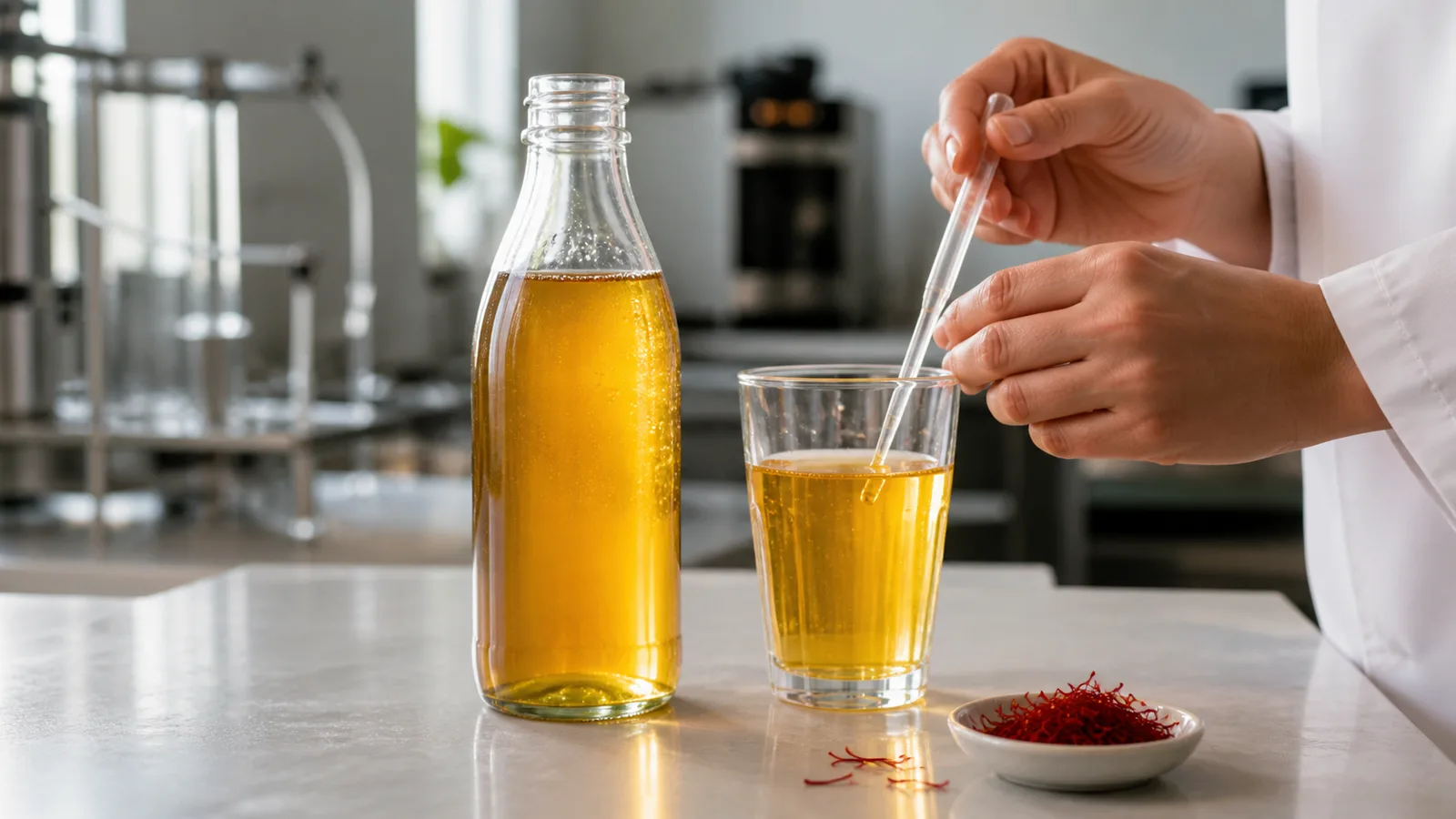
Energy drink organic production of saffron was the subject of an Iranian product-development report about a caffeine-free saffron beverage. The original account attributed the work to inventor Ehsan Lotfi and described it as the first organic saffron energy drink. Those are historical claims, however, not enough on their own to establish that a finished drink was caffeine-free, certified organic or first in the world.
The idea remains interesting. Saffron can give a drink a distinctive golden-red colour, a dry floral aroma and a recognisable Iranian identity. Whether that drink is safe, genuinely organic and useful to consumers depends on the entire formula, laboratory results, production controls and certification—not on saffron alone.
What the original saffron energy drink report said
The short report, first published on this site in 2016 and later migrated to its present date record, referred to an interview with the Khorasan branch of the Iranian Students News Agency (ISNA). Lotfi said the research had begun after Nowruz in the Iranian year 1393, corresponding to 2014–15. He also referred to collaboration with academic staff at Islamic Azad University of Torbat-e Jam.
Part of the archived English translation is damaged. It appears to contain the names of collaborators, but it does not preserve them reliably enough to repeat. Guessing those names would turn a translation problem into a factual error, so only the affiliation that remains clear is retained here.
A surviving secondary patent index supports the basic chronology. It lists Ehsan Lotfi as owner and inventor of a “saffron organic energy drink,” with an application dated 29 Shahrivar 1393 and registration number 87321 dated 7 Azar 1394. This helps corroborate that a documented invention existed, but a patent record is not a nutritional analysis, an organic certificate or proof of worldwide priority.
Why the word “first” needs qualification
The archived article called the product the first organic saffron energy drink. That phrasing is best understood as the inventor’s statement at the time. Establishing a genuine “first” would require a wider search of earlier patents, products, trade records and publications across different countries. The material currently available does not provide that comparison.
It is therefore accurate to say that Lotfi developed and registered a saffron beverage invention in Iran. It is not accurate to turn the old interview wording into an independently verified global record.
Does caffeine-free mean healthier?
Lotfi presented the drink as an alternative to caffeinated products, mentioning Coca-Cola and Pepsi in the original interview. The brands are relevant to that historical comparison; they are not an endorsement or a claim that all of their drinks have the same formula.
A caffeine-free recipe may suit people who choose to avoid stimulants, but caffeine is not automatically harmful at every level. The US Food and Drug Administration’s current caffeine guidance says that caffeine can be part of a healthy diet for most adults, while excessive intake and individual sensitivity can cause problems. The FDA also notes that products sold as energy drinks vary greatly in caffeine content.
For this particular drink, “caffeine-free” would need to be demonstrated from the complete ingredient list and, ideally, a validated laboratory test on the final product. A formula containing tea, coffee, cocoa, guarana or another caffeine-bearing ingredient could not be assessed from the saffron content alone. The archived report provides no full recipe or test certificate, so it cannot verify the claim.
Organic saffron does not make the whole drink organic
The old article reasoned that a drink derived from saffron and made without caffeine was organic. These are separate ideas. “Organic” describes an audited production and handling system; it does not mean natural, herbal or caffeine-free.
For example, the European Commission’s organic rules cover each stage from agricultural production to the processed food. A processed product generally needs at least 95% organic agricultural ingredients, along with compliant processing and labelling, to be sold as organic under the EU system. The USDA organic-labelling framework likewise distinguishes “100 percent organic,” “organic,” “made with organic” and products that merely identify particular organic ingredients.
That means a commercial drink would need evidence for its water treatment, sweetener, saffron, flavourings and every other agricultural ingredient, as well as the processor’s certification. Even certified organic saffron production would support only the saffron ingredient unless the finished beverage and its handling chain also met the applicable standard.
What saffron contributes to a beverage
Saffron is powerful in small quantities. Properly infused threads can produce colour and aroma without the bitterness that comes from using too much. That makes it a plausible ingredient for a distinctive soft drink or botanical beverage.
It does not, by itself, establish an “energy” effect. In ordinary food quantities, saffron is used primarily for flavour, colour and identity. Any claim about calories, alertness, physical performance or another physiological effect must be based on the final formulation and evidence appropriate to the market where the drink is sold.
Readers who want a household drink rather than a commercial product can use a simple saffron drink preparation method. A home infusion should not be confused with the patented formulation discussed in this report, whose complete recipe was not published here.
Evidence a finished product should provide
A buyer, distributor or investor evaluating a saffron beverage should be able to review more than the concept. At minimum, the product file should include:
- a complete ingredient list, with ingredients named in descending order where the target market requires it;
- the amount and specification of saffron used in each serving;
- laboratory results supporting a caffeine-free claim and checking relevant contaminants;
- nutrition information, including serving size, calories, total sugar and added sugar;
- microbiological and shelf-life validation for the packaged drink;
- details of any preservatives, acidity controls and food-contact packaging;
- an organic certificate covering the finished product if “organic” appears in its name or marketing; and
- the registrations, label review and manufacturing controls required in each sales market.
This information matters because “caffeine-free,” “organic” and “energy drink” answer different questions. One concerns a measurable compound, one concerns certified production, and one is a product category. None proves the other two.
Sugar and the meaning of energy
A caffeine-free drink can still contain substantial added sugar. The archived interview does not disclose the sweetener or nutrition profile, so there is no basis for calling the product low-sugar or nutritionally superior to a cola. The FDA’s added-sugars guidance explains why packaged food and drink labels identify added sugar per serving: consumers need that information to compare products.
If calories from sugar provide the drink’s energy, the label should make that plain. If “energy” refers only to branding or refreshment, the presentation should avoid implying a demonstrated performance benefit. Clear wording is more useful than replacing one broad marketing claim with another.
From invention to a dependable drink
The original report ended with Lotfi saying he was ready to cooperate with investors. That was a statement about commercial development at the time, not a current investment solicitation from Rowhani Saffron.
The strongest part of the concept is straightforward: use Iranian saffron to create a recognisable caffeine-free beverage. The unresolved parts are just as important. A dependable commercial version would need a stable formula, sensory testing, food-safety controls, honest nutrition information, evidence for the caffeine claim and valid certification before it could be presented as organic.
Seen in that light, the historical saffron energy drink is more than a broken news fragment, but less than a fully verified product specification. It records an Iranian invention and a useful direction for saffron-based beverage development while leaving the decisive product evidence to be supplied.
Sources reviewed
- Secondary archive of the Iranian patent listing, including application and registration details for Ehsan Lotfi’s saffron beverage invention.
- US Food and Drug Administration: caffeine and energy drinks.
- European Commission: organic production and processed-food requirements.
- USDA: organic product labelling categories.
- US Food and Drug Administration: added sugars on beverage labels.

![Exporting Saffron to Turkey + Price Guide [Complete 0 to 100]](https://img.rowhanisaffron.com/20260827003933/saffron-export-turkey-quality-inspection.webp)



