Yes, hydroponic saffron can be grown without field soil, but it is not as simple as leaving a saffron corm in a jar of water. The most manageable home method supports the corm in a free-draining inert substrate, supplies a measured nutrient solution, keeps oxygen around the roots, and follows the plant’s natural flowering, leaf-growth, and dormancy cycle.
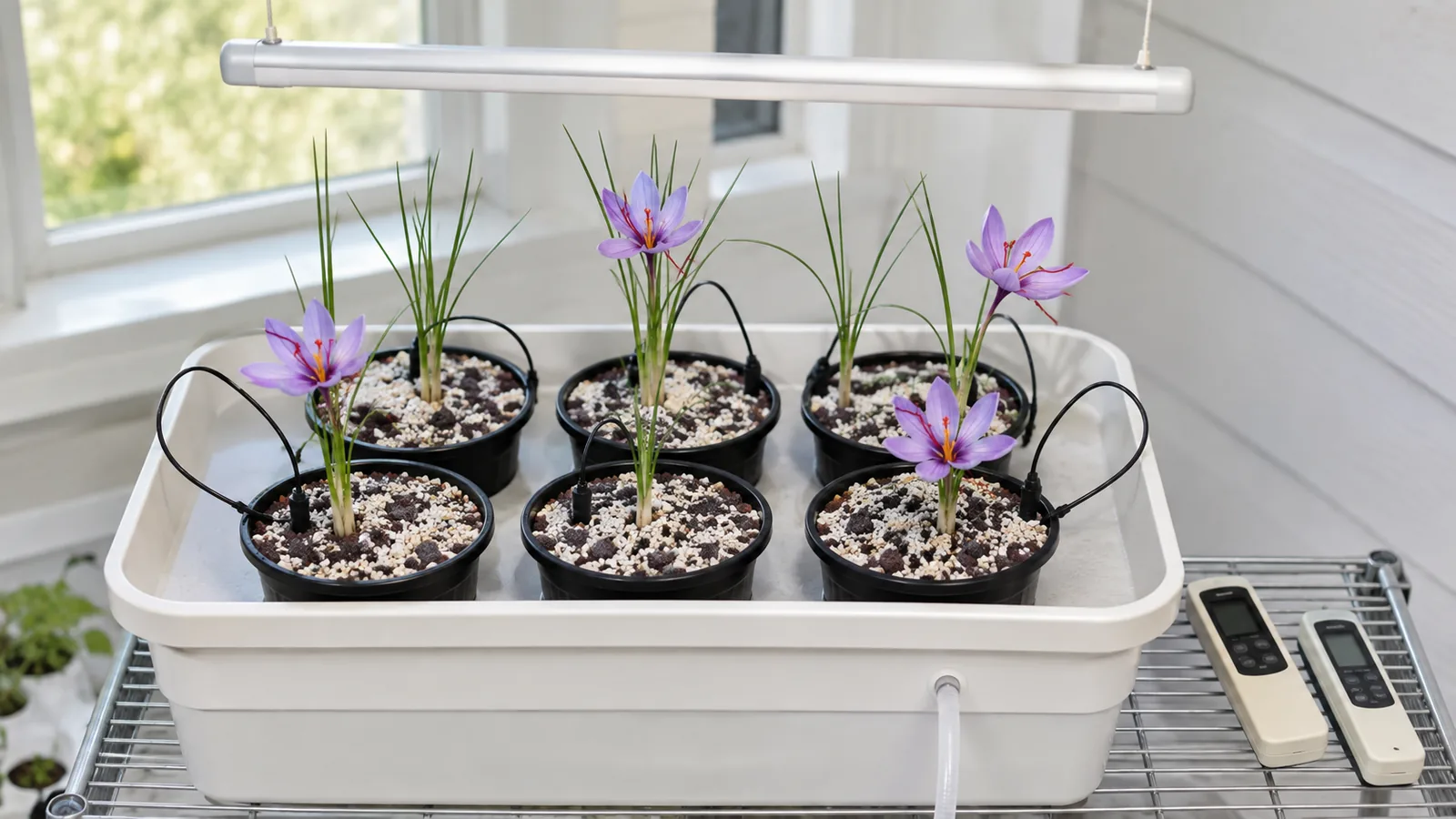
What growing saffron without soil actually means
Hydroponics means that mineral nutrition is delivered in water rather than being supplied by field soil. The plant may still sit in a solid material such as perlite, volcanic rock, or a suitable coir-based mix. That material supports the corm and holds some moisture while leaving air spaces around the roots.
In practice, the label saffron hydroponics covers several different systems. Hydroponic saffron cultivation may use substrate culture with drip irrigation, ebb-and-flow benches, continuous-immersion designs, aeroponics, or multilevel controlled environments. They are not interchangeable. A nutrient concentration, watering schedule, or corm position that worked in one experiment should not be copied into a different system without measurement.
A 2024 peer-reviewed study on saffron cormlets in soilless cultivation notes that practical information is still limited and tests substrate composition, irrigation volume, and individual nutrients as interacting variables. That is a good reason to start with a small trial rather than promise a universal recipe.
Can saffron be grown hydroponically at home?
It can, if the grower can control light, temperature, irrigation, drainage or aeration, and nutrient strength. For a home gardener, growing saffron hydroponically in a simple substrate-supported system is easier to observe than using a dense vertical installation. It also gives a beginner more warning before the root zone becomes waterlogged.
Use firm, healthy, flowering-size Crocus sativus corms. Small corms may produce leaves without flowers. In one peer-reviewed hydroponic trial, corms 22–25 mm in diameter did not bloom, while the highest stigma and cormlet yields came from mother corms at least 32 mm in diameter. The study, published in HortTechnology, is evidence that starting size matters, not a guarantee that every large corm will flower.
For the plant’s general seasonal needs, the Royal Horticultural Society’s saffron growing guide remains useful: saffron is planted in late summer, flowers in autumn, grows leaves through its active season, and dies back in late spring.
A cautious home setup
1. Choose a drainable system
For a first attempt, use individual net pots or a shallow grow tray filled with clean inert medium. Feed from a reservoir through drip irrigation or a timed flood-and-drain cycle, then allow the solution to leave the root zone. The corm should be supported securely with its growing point above the wettest part of the medium.
Perlite and volcanic rock were both used as substrates in the HortTechnology trial. Coconut coir can hold much more water, so a coir-heavy mix needs different irrigation from coarse mineral media. Do not assume that the same timer setting suits both.
2. Start with clean water and a complete nutrient
Use a complete hydroponic fertiliser intended for food crops and mix it with water of known quality. Measure electrical conductivity (EC) and pH with calibrated meters instead of judging the solution by colour. Record what is added and how the plants respond.
Do not copy a strong tomato or leafy-green formula merely because it is available. A peer-reviewed study of nutrient-solution strength in soilless saffron found that solution concentration affected nutrient uptake and the size distribution of new corms. The authors present their values as a research starting point, not a universal home recipe.
3. Give the roots both moisture and oxygen
Roots need water, but they also need oxygen. In a drain-to-waste or recirculating drip system, use enough flow to wet the root zone and enough drainage time for air to return. In a recirculating system, keep the reservoir clean, aerated, covered from light, and within the equipment maker’s safe operating range.
Inspect corms and roots regularly. A sour smell, slime, persistent softness, or dark collapsing tissue is a reason to isolate the plant and correct the root-zone problem. Adding more fertiliser will not cure poor oxygen or disease.
4. Provide useful light and seasonal conditions
Saffron is not an evergreen indoor herb. It flowers in autumn, then relies on its leaves to build replacement corms before summer dormancy. Use direct sun in a suitable protected space or a horticultural grow light sized for the actual growing area. Follow the fixture maker’s distance guidance rather than guessing from brightness to the eye.
A controlled-environment study of multilevel hydroponic saffron production used programmed lighting, temperature, photoperiod, and irrigation recipes. Its results show that controlled flowering is technically possible; they do not show that a warm shelf with a household lamp will perform the same way.
5. Keep the full cycle going after harvest
After the flowers are picked, leave healthy foliage under good light. Continue measured nutrition and irrigation during active leaf growth, then reduce water as the leaves yellow naturally. Clean and store dormant corms according to the selected production plan rather than keeping them continuously wet through summer.
Is deep water culture suitable for saffron?
Deep water culture appears in saffron search results and research, but it should not be interpreted as submerging the whole corm indefinitely. A designed DWC or continuous-immersion system controls which tissue contacts solution, keeps the solution oxygenated, monitors pH and EC, and manages temperature and hygiene.
The HortTechnology experiment compared ebb-and-flow with continuous immersion while supporting saffron in perlite or volcanic rock. Continuous immersion performed well in that specific controlled trial. That does not make an unaerated bucket of water equivalent.
For most home growers, substrate-supported drip or ebb-and-flow is a clearer starting point because irrigation and drainage are visible. If you choose deep water culture, use a published saffron design and monitor dissolved oxygen as well as nutrient strength; do not let the corm itself sit submerged without evidence that the setup is intended for it.
How to manage the nutrient solution
There is no single validated household formula for every saffron stage, water source, and substrate. Build a record around the system you actually have:
- measure source-water pH and EC before adding nutrients;
- mix a complete solution accurately and never combine concentrated salts directly around roots;
- record reservoir volume, pH, EC, solution changes, irrigation events, and plant symptoms;
- keep light out of the reservoir to limit algae;
- clean equipment between cycles and remove decaying plant material;
- change one variable at a time when troubleshooting.
A rising EC can mean that water is disappearing faster than mineral salts; a falling EC can mean rapid nutrient uptake or dilution. The reading is a clue, not a diagnosis by itself. Check meter calibration, water temperature, plant stage, reservoir volume, and root condition together.
When will hydroponic saffron flower?
Flowering depends strongly on corm maturity and the temperature history before and after planting. Research facilities sometimes precondition corms and then alter air temperature to trigger bloom. Home growers should not promise a fixed day from planting unless they are reproducing a tested protocol with comparable corms and controls.
Once flowers open, each one supplies three red stigmas. Harvest and dry them promptly, then keep the leaves growing. If your aim is a small culinary batch, our article on making saffron at home follows the flower-to-jar process. The detailed home saffron harvest guide covers identification, picking, drying, and storage.
Common reasons a soilless crop fails
- The corm stays saturated: irrigation, support height, or drainage does not leave enough oxygen around living tissue.
- The nutrient solution is guessed: unmeasured concentrate, pH, or EC makes diagnosis difficult and can damage roots.
- The corms are too small: leaves can grow even when stored reserves are insufficient for flowering.
- Light is too weak: foliage stretches and cannot rebuild strong replacement corms.
- The seasonal cycle is ignored: constant warmth and watering replace the cues and dormancy the plant normally experiences.
- The system is overcrowded: poor airflow and hidden root problems spread before they are noticed.
- Harvest ends the project: removing or neglecting green leaves sacrifices the next corm cycle.
Is hydroponic saffron automatically sustainable?
Not automatically. A recirculating system may use water and space efficiently, but pumps, grow lights, cooling, replacement media, fertiliser manufacture, sanitation, and discarded solution also have environmental costs. Sustainable saffron production has to be assessed against the local field alternative and the actual energy and water sources.
A small, measured experiment is more responsible than claiming that hydroponic saffron farming always saves money or resources. Track water, electricity, inputs, corm survival, flowers, dry stigma weight, and cormlet quality across the full season before expanding.
Should a home gardener try it?
Try growing saffron without soil if you enjoy monitoring a controlled system and can accept that the first cycle is an experiment. Choose substrate-supported culture, a small number of healthy corms, calibrated meters, strong light, and conservative irrigation. Keep a few corms in a conventional drained container as a comparison if space permits.
If the main goal is simply to grow saffron indoors, a drained pot is easier and our indoor saffron guide explains that route. For ready-to-use culinary threads, visit our saffron shop; for a product question, use the contact page.