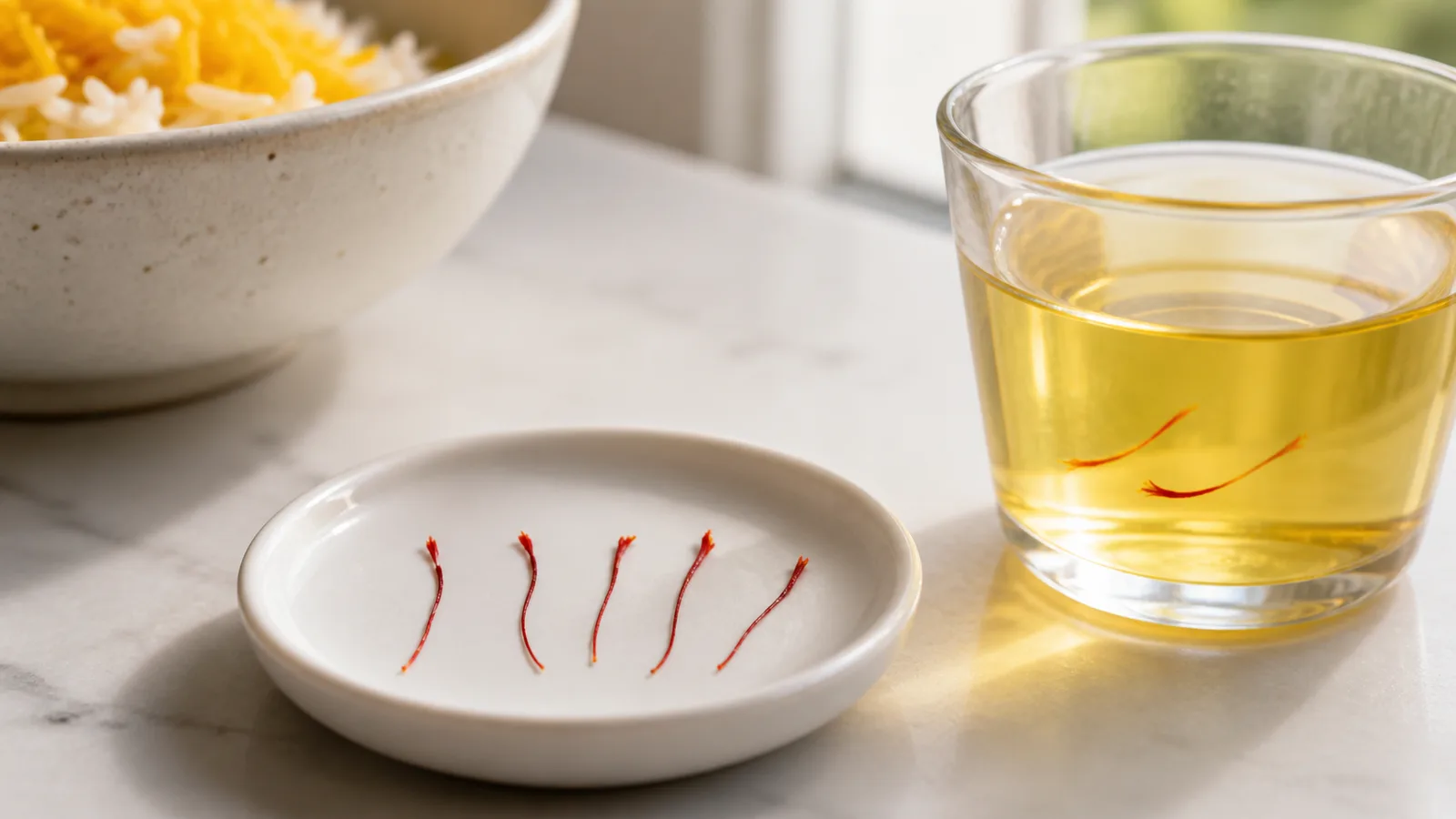
Saffron yield per flower is tiny: one Crocus sativus bloom normally carries three red stigmas, and those stigmas together produce roughly 0.006 grams of dry saffron. In practical terms, a grower usually needs about 150 to 170 flowers for one gram. The exact result changes with the flowers, separation and drying, so larger conversions should be treated as working estimates rather than guaranteed harvests.
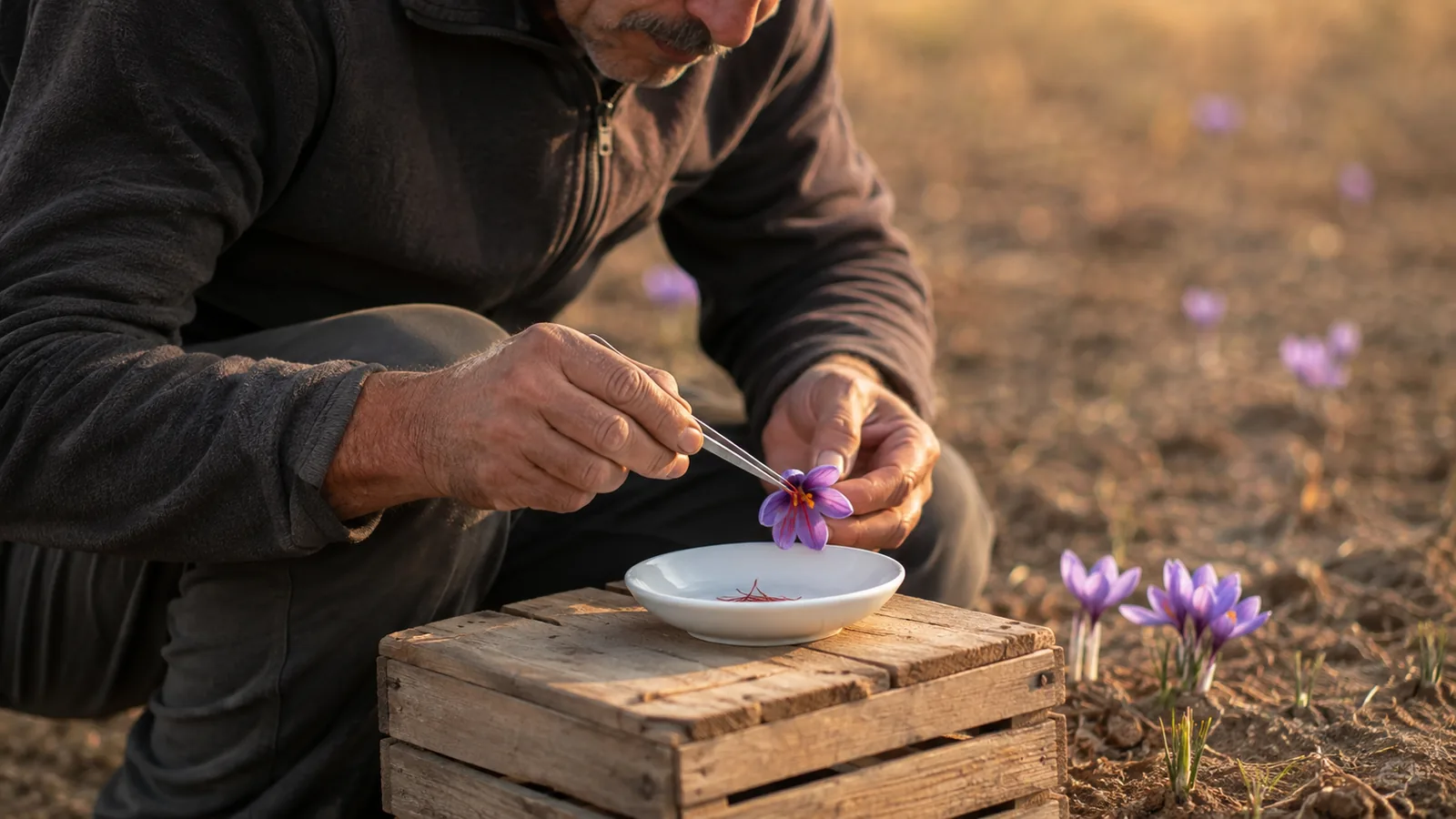
How much saffron can you get from one flower?
One flower gives three usable red stigmas. After they are removed and dried, their combined weight is commonly around six milligrams, or 0.006 grams. The University of Vermont’s Saffron by the Numbers grower sheet uses that figure and estimates about 167 flowers per gram.
The Royal Horticultural Society gives a rounded estimate of about 150 flowers for one gram of dry saffron. Neither figure contradicts the other. Stigmas are not identical, and the final weight depends partly on how completely and consistently they are dried.
That is the short answer. It is also why counting three visible threads in a flower does not tell you the finished weight with laboratory precision. Because each bloom contributes so little, finished saffron remains relatively rare beside spices harvested from an entire fruit, seed or leaf.
The spice comes from the stigmas, not the whole flower
A saffron bloom contains purple petals, yellow pollen-bearing stamens and three red stigmas. Only those red stigmas become the familiar culinary spice. The petals and yellow parts add bulk to a fresh flower but do not count as all-red saffron.
Freshly separated stigmas still contain moisture. Their saleable weight is measured after drying, when they have become stable saffron threads. That distinction matters: flower weight, fresh stigma weight and dry stigma weight are three different measurements.
Careful separation also affects the result. Leaving yellow style material attached may make a sample look heavier, but it changes its composition. Conversely, rough handling can leave part of a stigma behind. A meaningful yield figure therefore specifies clean, dry stigmas rather than simply weighing everything taken from the flower.
How many saffron flowers make a gram, ounce, pound or kilogram?
Using the practical range of 150 to 170 flowers per dry gram gives sensible planning figures:
- One gram: about 150 to 170 flowers.
- One ounce: roughly 4,250 to 4,800 flowers. University of Vermont Extension rounds this to about 4,000 flowers.
- One pound: roughly 68,000 to 77,000 flowers. The often-quoted figure of about 75,000 flowers falls inside this range.
- One kilogram: about 150,000 to 170,000 flowers.
These are conversions, not crop forecasts. If a particular harvest has lighter stigmas, it will take more flowers to reach the target weight. If the dried stigmas are unusually substantial, it may take fewer. Our separate explanation of how many flowers are needed for one kilogram of saffron looks more closely at the largest of these estimates.
How much saffron does one plant produce?
“Per plant” is less precise than “per flower.” Saffron grows from a corm, not from seed, and a newly planted corm may produce no bloom, one bloom or several. Corm size, planting date, age of the bed and growing conditions all affect the flower count.
In its Vermont guidance, the North American Center for Saffron Research and Development reports that only about half of newly planted corms flowered in the first year in its local conditions. It also notes that a large corm may produce two to four flowers in later years when conditions are right. That would correspond to roughly 0.012 to 0.024 grams of dry saffron at the six-milligram-per-flower estimate, but it should not be treated as a promise for every corm.
The corm itself also changes. It forms daughter corms, and flower production can rise as a bed establishes. Later, crowding may reduce yield unless the corms are lifted and replanted. For a home grower, the honest answer is to count flowers over a full season rather than multiply the number of planted corms by a fixed yield.
Flower count and yield per hectare are different questions
A field’s dry yield depends on much more than the weight from one flower. Planting density, the share of corms that flower, blooms per flowering corm, weather, bed age, disease, harvest losses, separation and drying all contribute. This is why a figure for saffron yield per hectare needs a place, season and production method attached to it.
A University of Vermont high-tunnel trial measured 0.88 to 1.39 grams of dry stigmas per square metre in its first year. That is an arithmetic equivalent of 8.8 to 13.9 kilograms per hectare, but it came from a specific small research system and is not a universal commercial average. The same report cites approximate field figures of 0.34 grams per square metre for Iran and 0.6 grams per square metre for Spain, equivalent to about 3.4 and 6 kilograms per hectare.
Those differences make a useful point: a grower should not build a business plan from a single headline yield. A modest trial bed, measured through several flowering seasons, gives better local evidence. Our guide to the challenges of growing saffron explains why commercial consistency is harder than producing a few successful flowers at home.
Why the yield changes from one harvest to another
The three-stigma structure is consistent, but stigma size and dry weight vary. University of Vermont specifically notes differences in stigma length and density. Harvest condition and postharvest work add another layer of variation.
At field level, climate, soil, watering techniques and the timing of the harvest can alter how many usable flowers reach the drying stage. They do not change the basic fact that a normal flower carries three stigmas, but they can change the season’s total dry yield.
Flowers are best collected promptly while they are in good condition. Delayed collection can make separation messier, while careless handling loses fragile material. Drying then has to remove enough moisture for stable storage without scorching the threads. Comparing a damp batch with a properly dried one produces a misleading result even if both began with the same number of flowers.
Growing conditions often affect the total harvest by changing how many corms flower and how many flowers the bed produces. Healthy planting material, suitable planting depth, drainage and the seasonal water pattern matter. Anyone establishing a bed can use the saffron planting guide as a starting sequence, then adjust it to local extension advice and actual site conditions.
How to measure your own saffron yield accurately
A grower does not need a hectare to learn something useful. Start with one clearly labelled bed and keep a simple harvest record.
- Count every flower collected from the measured area.
- Separate only the red stigmas using clean hands or tools.
- Dry the batch with one consistent method.
- Weigh it on a scale that can reliably measure hundredths or, preferably, thousandths of a gram.
- Divide the dry weight by the flower count to find the average yield per flower.
For example, if 500 flowers produce 3 grams of dry saffron, the measured yield is 0.006 grams per flower. Recording the bed, date and drying method makes that number useful when comparing another season. Mixing flowers from several beds may hide a drainage, corm-size or disease problem in one location.
Do not estimate dry yield by counting loose threads in a jar. Threads vary in length, can split during handling and are not necessarily one whole stigma each. Weight from a clean, dry batch is the more useful measure.
Why such a small yield affects saffron’s price
Three stigmas do not weigh much, yet each flower still has to be collected and opened or handled for separation. The flowers are harvested by hand, and the work arrives in a short blooming period, so a large field requires trained people at the right moment. The stigmas then need controlled drying, grading, packing and dry storage.
University of Vermont Extension’s overview of why saffron is such an expensive spice connects its price directly to this individual flower and stigma work. The small saffron yield per flower is therefore only part of the cost; concentrated labour and postharvest care are just as important.
Low yield does not automatically prove high quality. Clean separation, correct drying, storage and authenticity still matter. A poorly handled batch does not become premium merely because it came from many flowers.
What the number means when you buy saffron
A gram may represent the harvest from roughly 150 to 170 flowers, but shoppers do not need to count threads. Look for a declared net weight, intact red stigmas, appropriate packaging and a seller that can explain the product. Very low pricing or unexplained yellow material deserves more scrutiny than a difference in thread length.
For finished spice, the original all-red saffron selection remains the relevant route. For growers, the useful lesson is simpler: measure flowers and dry weight in your own conditions. Three stigmas per bloom is dependable biology; the exact number of blooms needed for a gram is naturally a range.