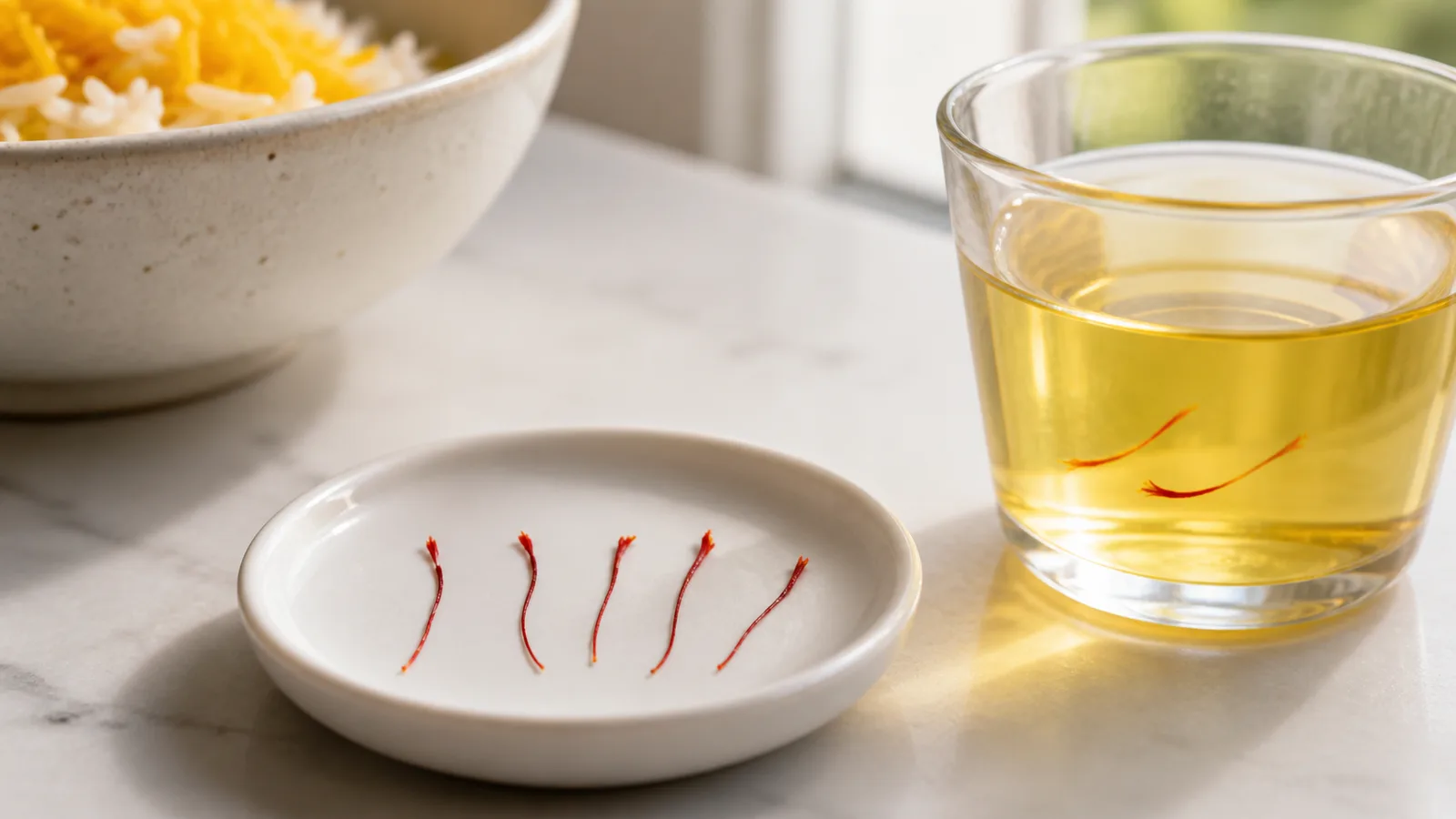
One gram of saffron in our current five-gram range is worth about €4.33–€6.82 before tax and shipping. At the European Central Bank reference rate for 4 September 2026, that converts to roughly $5.03–$7.93. This is a dated retail replacement value, not a permanent market price or a promise that an opened gram can be resold for the same amount.
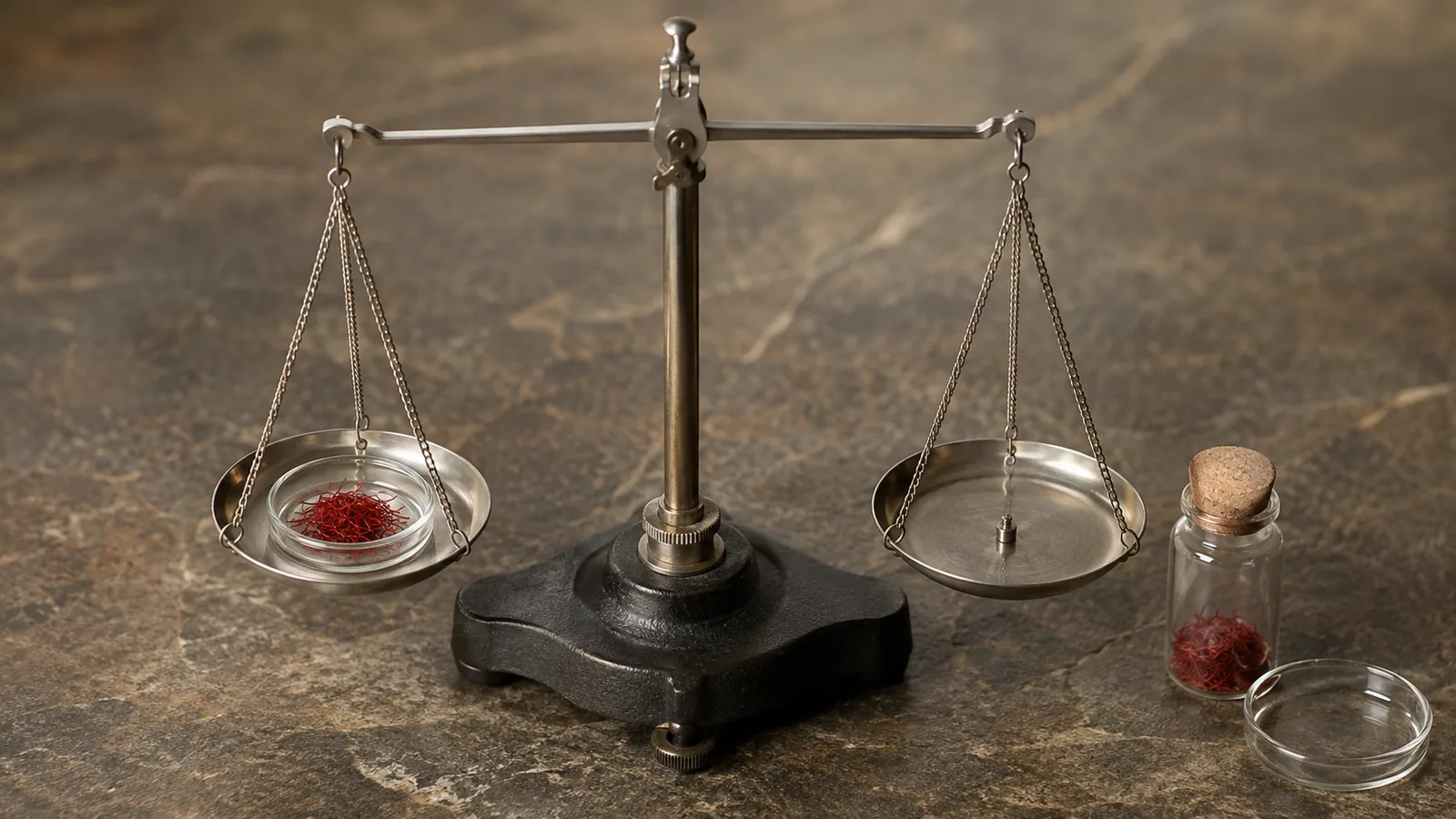
How Much Is 1g of Saffron Worth?
The current saffron price per gram depends on what “worth” means. A shopper asking “How much does 1 gram of saffron cost?” usually wants the cost of replacing it with a comparable product. A grower may be thinking about wholesale value, while someone holding an old unlabelled jar may be asking what it could be sold for. Those are different valuations.
For a transparent retail example, the five-gram culinary packs available in our shop on 5 September 2026 ranged from €21.63 for Bunch saffron to €34.11 for Super Negin A. Dividing each pack by five produces the €4.33–€6.82 per-gram range above. The live product range should be used for a purchase because prices, stock, tax and delivery can change after this article is checked.
The dollar conversion uses the ECB euro–US dollar reference rate of €1 = $1.1622 on 4 September 2026. It is not a quoted US checkout price. A card provider’s rate, local tax, import costs and delivery may lead to a different final amount.
Price, Cost and Worth Are Not Always the Same
Retail Replacement Value
This is the simplest answer for a household buyer: find a current offer for the same thread style, origin, pack size and quality evidence, then calculate its unit price. If the pack contains five grams and costs €25 before delivery, its listed replacement value is €5 per gram.
Wholesale or Farm-Gate Value
A bulk lot is not worth the retail unit price multiplied by every gram. Wholesale transactions can involve larger quantities, different packaging, moisture or quality specifications, laboratory documents, insurance, payment terms and transport. The amount paid to a grower is a different point in the chain again.
Resale Value of an Opened Jar
An opened household jar does not automatically retain a published retail value. A buyer cannot easily verify its net weight, origin, storage, age or handling. Unless it has professional traceability and a suitable sales channel, its practical worth is usually culinary use rather than resale.
How to Value One Gram Step by Step
- Confirm what the product is. Whole Crocus sativus threads, cut threads and powder should not be compared as though they provide the same visual evidence.
- Check the actual net weight. Use the stated net contents on a sealed pack. For loose material, a scale capable of reliably resolving hundredths of a gram is more useful than a kitchen scale that rounds to whole grams.
- Match the thread style and origin. Compare Bunch with Bunch, Sargol with Sargol, or Negin with a genuinely similar Negin offer. A famous country name does not make unlike products equivalent.
- Check condition and traceability. Age, moisture, faded cooking performance, a broken seal or missing lot information can reduce useful value.
- Calculate the price per gram. Divide the product price by its net grams before comparing packs.
- Put all offers on the same basis. Use one currency and state whether tax and shipping are included.
Our guide to buying high-quality saffron explains what visual checks and documentation can establish. The separate one-gram cost guide answers how much 1 gram of saffron costs with a fuller breakdown of current packs and weight conversions.
What Makes One Gram More or Less Valuable?
Thread Cut and Stigma Content
Bunch saffron retains red stigma and more of the lighter style. Pushal, Sargol and Negin describe different cuts or presentations with more emphasis on red material. The names are trade descriptions; they do not make every seller’s lot identical. “Super Negin” should not be treated as a universal laboratory category that overrides the actual batch.
Colour, Aroma and Taste Performance
A strong, clean batch can be worth more to a cook because a small measured amount gives satisfying colour, aroma and flavour. Yet a photograph of deep-red threads is not enough to prove strength. Lighting can mislead, and added colour can make a poor product look convincing.
The current ISO 3632-1:2025 saffron specification covers dried saffron in filament, cut-filament and powder forms. A seller referring to an ISO category should be able to connect the claim to the lot tested, not merely display the standard number in general marketing.
Origin, Harvest and Processing
Iran is the dominant producing country, while Kashmir, Spain, Greece, Afghanistan, Morocco and Italy also have established growing regions. Origin can affect scarcity, tradition and buyer demand, but careful picking, stigma separation, drying and storage still determine the condition of the finished threads.
Authenticity and Evidence
Adulteration can turn a low price into poor value. In 2025, the UN Food and Agriculture Organization highlighted authenticity testing and post-harvest handling as important safeguards for the saffron value chain. A traceable seller, intact pack, lot information and relevant testing carry more weight than an unexplained “premium” claim.
How Much Is Iranian Saffron Worth per Gram in 2026?
There is no single Iranian saffron price per gram for an entire year. Anyone checking an Iranian saffron price per gram in 2026 needs the date and trade level as well as the number. Retail, wholesale and farm-gate prices answer different questions, and grade, pack size, currency and delivery basis all change the result. For the retail products used in this dated example, Iranian culinary saffron worked out to €4.33–€6.82 per gram before tax and shipping.
The phrase zafran 1 gram price refers to the same spice in many markets; the language does not create a separate grade. Likewise, a local price in the Philippines, United States or another country must account for the seller, currency, taxes and landed cost. Converting a euro price can provide a reference, but it does not replace a real local offer.
What Do Larger Weights Work Out To?
At the same €4.33–€6.82 retail unit range, the arithmetic equivalents are:
- 5 grams: €21.63–€34.11, matching the current packs used here;
- 1 ounce (28.35 grams): about €122.64–€193.40;
- 1 kilogram: about €4,326–€6,822.
Only the five-gram amounts are actual listed pack prices. The ounce and kilogram figures are multiplication examples. A real large order should be quoted on its own specifications rather than valued by extending a small retail pack price.
Why Can a Gram Cost So Much?
Saffron comes from three stigmas in each flower, followed by time-sensitive picking, separation and drying. The University of Vermont’s saffron programme estimates about 167 flowers for one gram of dried saffron. Yield varies, but that scale explains why genuine saffron is one of the most expensive spices by weight.
Expense does not make saffron an investment product, and a retail price does not show a grower’s profit. Labour, planting material, land, crop loss, processing, tests, packaging, selling costs and unsold stock all sit between the field and the final gram.
The Short Answer
How much is 1 gram of saffron worth? As a current retail replacement example, about €4.33–€6.82 per gram before tax and shipping, or roughly $5.03–$7.93 at the ECB’s 4 September 2026 reference rate. For an opened jar, wholesale lot or local-market purchase, value it from comparable evidence rather than assuming the same number. The broader saffron price page is the best place to check the latest site pricing.