


Buying saffron is easier when you separate appearance from evidence. Look for clearly identified whole threads, traceable packaging, a seller who will answer specific questions and, for a significant purchase, a recent laboratory report. Colour tests and dramatic “burn tests” are not substitutes for a reliable supply chain.
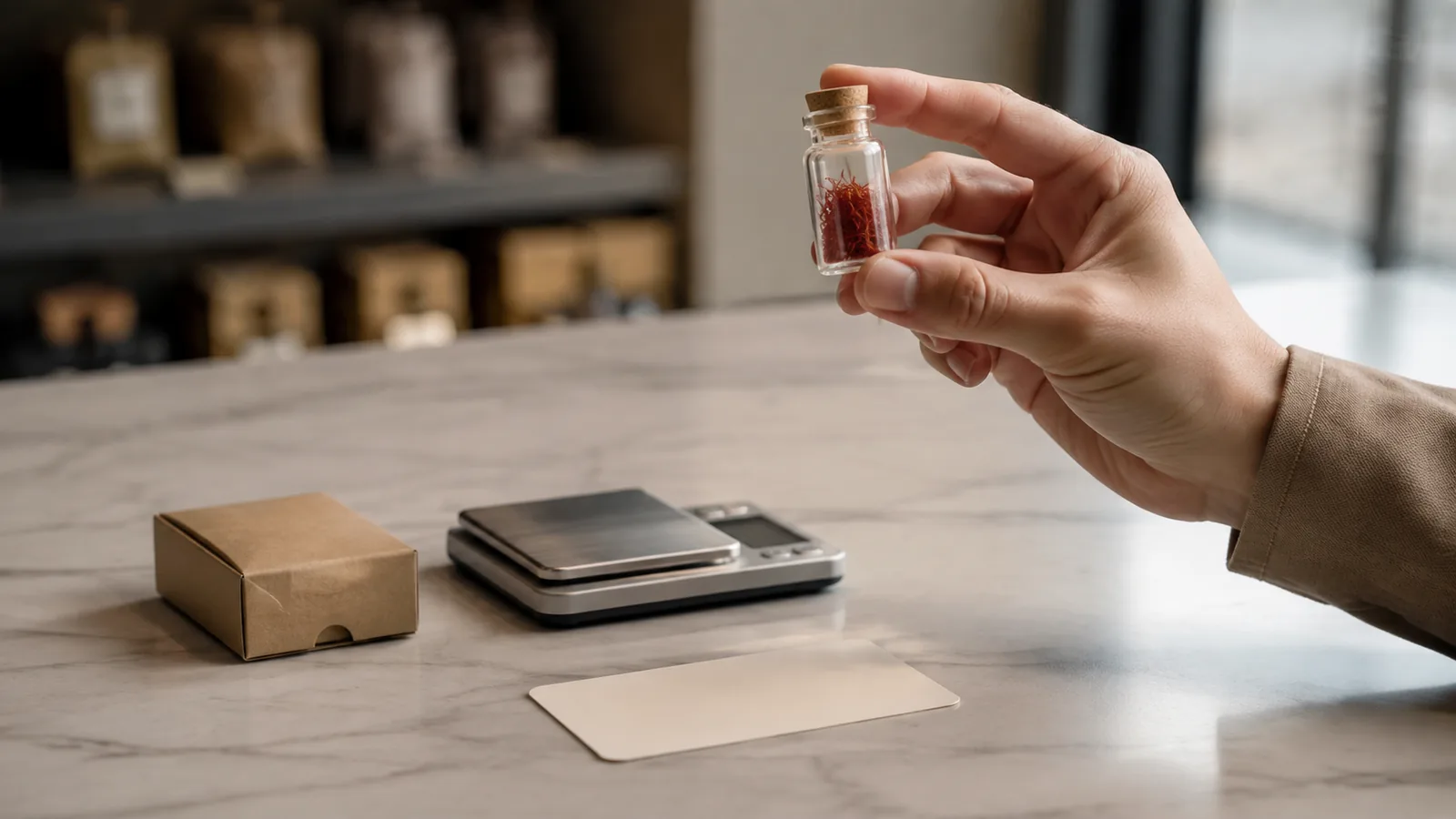
What exactly are you buying?
Culinary saffron is made from the dried stigmas of Crocus sativus. Each flower carries only three stigma branches, and separating them is largely manual work. That low yield and labour help explain the price, but a high price by itself does not prove that a jar is authentic or high quality.
Saffron may be sold as whole filaments, cut filaments or powder. Whole threads are the easiest form for a buyer to inspect and generally the best first purchase. Powder is convenient, but it gives you less visual evidence and exposes more surface to air and light.
How to buy saffron: the short checklist
- Choose whole threads unless a tested powder is required for production.
- Read the net weight, origin claim, packer or seller identity, lot code and best-before information.
- Look for a sealed, food-safe pack that protects the saffron from moisture and light.
- Ask whether the grade name describes cut style, laboratory quality, or both.
- For larger orders, request a current certificate of analysis tied to the lot.
- Compare price per gram, not package price.
- Buy a small trial quantity before committing to a bulk lot.
Understand Negin, Sargol, Pushal and Dasteh saffron
These familiar Iranian trade terms mainly describe which parts of the stigma and style remain and how the threads are selected. They are useful, but they are not a universal guarantee of chemical quality.
Negin saffron
Negin is selected for long, relatively straight red stigma branches with little or no pale style attached. “Super Negin” is a commercial appearance term used for especially uniform, thick-looking filaments. Sellers do not all apply the label in exactly the same way, so ask for a photograph of the actual lot and laboratory information when strength matters.
Sargol saffron
Sargol consists largely of separated red stigma tips. The pieces may be shorter or more broken than Negin, but a good Sargol can still colour and flavour food very effectively. Appearance and performance need to be considered together.
Pushal saffron
Pushal retains the red stigma with a small amount of yellow or orange style. That visible transition can make the botanical structure easier to recognise, although it also adds material with less colouring strength than the red portion.
Bunch saffron (Dasteh)
Bunch saffron, or Dasteh, keeps the stigma and style together in tied bundles. It is close to the traditional whole presentation. Because it includes more pale style, its colour strength per gram may be lower than a red-only cut even when it is genuine.
What sellers call saffron root
The pale part is commonly marketed as “saffron root,” but it is the style, not a root from the plant. It may retain some aroma and can be used where strong colour is unimportant. It should not be priced or represented as equivalent to red stigma.
What a laboratory report can tell you
The current ISO 3632-1:2025 saffron specification covers dried saffron in filament, cut-filament and powder forms. The related test methods evaluate defined characteristics under controlled conditions. When a seller cites an ISO category or test result, ask for the actual report, laboratory, date, lot number and units rather than relying on a badge.
A certificate is most useful when it is recent, comes from a competent independent laboratory and matches the lot you will receive. A report for another harvest or a generic sample does not verify every package in stock.
How high-quality saffron should look and smell
Whole saffron is made of fine, irregular red stigma branches that broaden slightly at one end. Natural variation is normal. A jar of perfectly identical pieces deserves closer inspection, but broken genuine threads can also be perfectly suitable for cooking.
The aroma is complex and difficult to reduce to one comparison. People describe dry hay, honey, warm earth and floral or metallic notes. A description cannot authenticate a sample, especially when the buyer has little reference experience.
Good saffron tastes bitter and aromatic in a very dilute infusion; it should not taste sugary. Never chew a large amount to test it. Sensory checks can identify an obvious problem, but they do not measure purity, contamination or strength.
Why home saffron tests are limited
The water test
Genuine threads release colour into warm water while retaining some red colour themselves. Speed varies with grinding, water temperature, thread condition and strength. Dyed material may colour water quickly, but genuine crushed saffron can also release quickly. Treat this as an observation, not a verdict.
The taste and smell tests
Sweetness can reveal added sugar, and a flat or musty smell can indicate poor storage. Neither check rules out more sophisticated adulteration. Packaging odours and age can also mislead the nose.
Do not use a burn test
Setting saffron on fire is unsafe, destroys the product and does not provide a dependable authentication result. Flame colour depends on moisture, contaminants and the ignition source. A seller or article claiming that one flame colour proves genuine saffron is offering false certainty.
Buying saffron online
An online saffron buying guide should begin with the seller, not the photograph. Look for a real business identity, physical contact information, clear shipping and return terms, secure payment and product pages that state net weight and origin without exaggerated medical claims.
Ask these questions before a meaningful order:
- Is the photograph from the current lot?
- What cut or trade type is being supplied?
- When was it harvested or packed?
- Can the lot code be matched to a certificate of analysis?
- How has it been stored?
- What happens if the seal is damaged or the product differs from the description?
A polished website is not proof, and a marketplace review is not a laboratory result. Use several signals together. Our overview of how to identify real saffron provides a closer visual and practical inspection guide.
Does origin guarantee quality?
Iran is closely associated with saffron production, and regional names can communicate tradition and supply history. Origin alone does not tell you how the flowers were handled, how quickly the stigmas were dried, whether the pack stayed dry or whether the label is truthful.
Buy the lot, not only the story. Traceability, condition, sensory quality and appropriate testing matter more than a broad country claim. If a geographic claim is commercially important, ask how the seller verifies it.
How much saffron should you buy?
For home cooking, a small sealed pack is often better value than a large jar that will be open for years. Estimate how many rice dishes, drinks or desserts you actually make, then choose a quantity you can use while the aroma remains lively.
Restaurants and manufacturers should test a sample from the offered lot in their own recipe before scaling up. Colour strength, flavour balance and required dose affect the real cost per serving more than the cheapest price per gram.
How to store saffron after purchase
Keep saffron airtight, dry and away from light and heat. A small glass container inside a dark cupboard works well. Avoid opening it over a steaming pot, and use a dry spoon or clean dry fingers.
Whole threads usually make storage and inspection easier than powder. Do not move the jar repeatedly between a cold refrigerator and humid air; condensation can introduce moisture when it is opened.
Red flags when buying saffron
- No net weight, lot information or identifiable seller
- A grade name with no explanation of what it means
- Powder sold without traceability or testing
- An implausibly low price combined with pressure to buy in bulk
- Guaranteed cures or medicinal promises attached to an ordinary food product
- A certificate that does not match the lot, date or supplier
- Moist, musty or visibly mouldy threads
- Instructions to burn the saffron as the main authenticity test
A practical final decision
When buying saffron, prefer a small sealed pack of identifiable whole threads from a transparent seller. Understand whether Negin, Sargol, Pushal or Dasteh describes the cut you want, then look beyond the label to lot-level evidence. For everyday cooking, sound aroma, dry condition and traceable packaging matter; for high-value trade, add independent laboratory testing.

![Exporting Saffron to Turkey + Price Guide [Complete 0 to 100]](https://img.rowhanisaffron.com/20260827003933/saffron-export-turkey-quality-inspection.webp)



