

A mature saffron corm can produce flowers roughly six to eight weeks after late-summer planting—about one and a half to two months. The full saffron growth period is longer: leaves and replacement corms continue developing for months after the autumn harvest.
How many months does saffron take to grow?
The honest answer depends on what you mean by “grow.” There are three useful milestones:
- Planting to first flowers: often about 1.5–2 months for a mature, well-timed corm.
- Planting through one complete seasonal cycle: roughly a year, including flowering, leafy growth, corm development, dieback, and dormancy.
- Planting to a stronger established yield: commonly two or three growing seasons rather than a fixed number of months.
These are planning ranges, not deadlines. Corm size, planting date, climate, drainage, light, and the age of the bed can all change the result.
Why “six to eight months” is misleading
A statement that saffron always takes six to eight months from planting to harvest confuses flowering with the rest of the plant’s annual development. Penn State Extension reports in its home saffron production guide that corms planted in early September can flower in six to eight weeks.
The plant does remain active after those flowers are picked. Its leaves grow through the cooler season and feed daughter corms, then the foliage dies back before summer dormancy. If “fully grow” means completing that entire cycle, the answer is closer to ten to twelve months.
A month-by-month saffron growing calendar
The calendar below uses planting as month zero, so it can be adapted to different climates. The named seasons are more reliable than copying one country’s date.
Month 0: plant mature corms
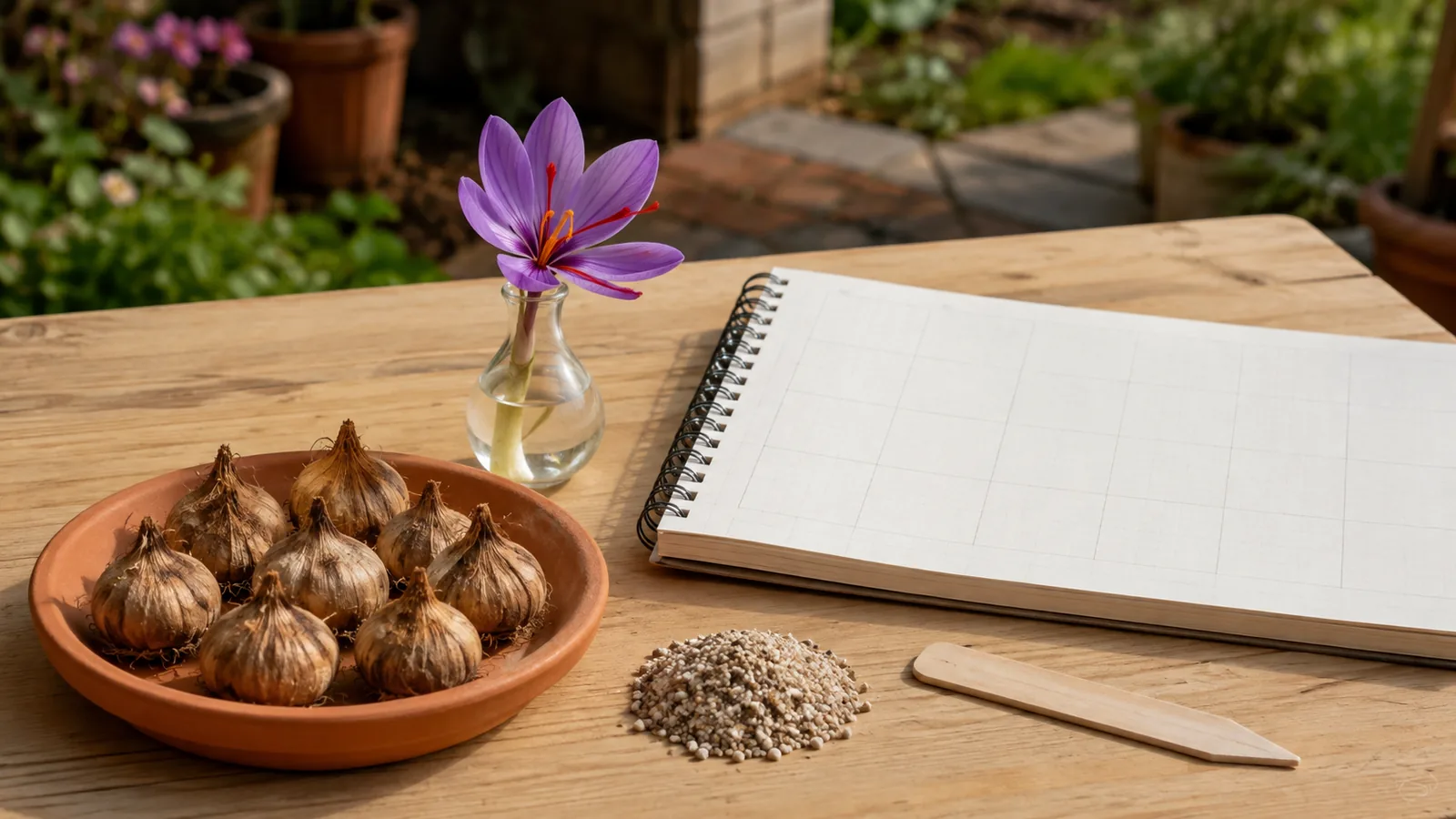
Plant firm Crocus sativus corms in late summer, often August or September in temperate Northern Hemisphere gardens. Choose a sunny place with free-draining soil. Gardeners often call them saffron bulbs, but corm is the correct botanical term.
The Royal Horticultural Society’s saffron growing guide recommends planting at least 10–15 cm (4–6 in) deep and spacing corms about 10 cm (4 in) apart. Water them in, then avoid keeping the soil saturated.
Months 1–2: roots, shoots, and possible flowers
Roots and shoots develop first. A flowering-size corm planted on time may then produce purple blooms in October or November. Each flower carries three red stigmas, which are picked and dried as saffron.
Do not panic if a late-planted or smaller corm produces only leaves. The first season can be delayed, and small daughter corms may need more time before flowering. The condition of the corm matters more than a promise printed on a calendar.
Months 2–7: cool-season leaf growth
The harvest may be over, but the plant is not finished. Narrow green leaves continue to photosynthesise through winter and early spring. They supply energy for new corms developing below the surface.
Leave this foliage intact while it remains green. Cutting it for a tidy bed can reduce future flowering. Water in response to actual soil moisture and rainfall; the corm needs drainage, not a fixed weekly dose.
Months 7–9: daughter-corm development and dieback
As the weather warms, replacement corms mature and the leaves begin to yellow. Allow the foliage to dry naturally before clearing it. A bed that looks untidy for a few weeks is completing useful underground work.
The University of Vermont’s saffron production-cycle guide places daughter-corm development in spring, after the winter vegetative phase and before summer dormancy. Exact months shift with hemisphere and local weather.
Months 9–12: summer dormancy
Once the foliage is fully dead, the corms rest. Keep the site relatively dry and, above all, free from standing water. Dormancy is not failure; it is the normal stage before the next autumn growth cycle.
An established planting can stay in the ground for several years. Lift and divide crowded clumps during dormancy when flower numbers fall or the bed becomes congested, rather than replacing healthy corms automatically.
When is the first saffron harvest?
The first harvest may arrive in the same autumn as planting, sometimes within that six-to-eight-week window. Flowers open over a short season, so check the planting daily once buds appear. Pick clean flowers promptly and separate the three red stigmas for drying.
Saffron normally gives one bloom season each year. Several picking mornings within that period are not separate crops. The North Carolina Extension Crocus sativus profile describes a one-to-two-week flowering period in its conditions.
Why first-year yield may be small
A corm can flower quickly without producing a large harvest. One bloom supplies just three stigmas, and a new bed may have only one flower from each flowering corm. Penn State notes that years two and three can bring substantially more blooms as corms establish and multiply.
This is why “time to first flower” and “time to full production” should never be treated as the same number. A gardener may taste a tiny home harvest after two months and still wait two or three seasons for the bed’s stronger potential.
What changes the saffron growth period?
Corm size and health
Large, firm, flowering-size corms are more likely to bloom in the first season than very small cormlets. Softness, mould, physical damage, or poor storage can delay growth or prevent it altogether.
Planting date
A late corm has less time to establish before its normal flowering window. Planting months after the recommended period does not simply move every stage by the same amount; it may mean leaves without first-year flowers.
Drainage and summer moisture
Persistent wet soil can rot corms during active growth or dormancy. A raised bed, sloping site, or freely draining container can help where garden soil is heavy or summer rain is frequent.
Light and temperature
Saffron needs strong light and a seasonal environment. Deep shade weakens growth, while a constantly warm, dim room can disrupt indoor container performance. Local climate changes calendar dates, so observe growth rather than relying only on the month name.
Crowding
Daughter corms multiply. That supports later harvests at first, but a dense clump eventually competes for room and resources. Divide during dormancy when performance declines.
Can you shorten the growing time?
You cannot compress the plant’s biology into a few days, but you can avoid preventable delay. Buy mature true Crocus sativus corms, plant at the right season and depth, provide sun and drainage, leave post-flowering foliage alone, and protect dormant corms from excess water.
Be wary of “saffron seeds.” Cultivated Crocus sativus is sterile and is propagated by dividing corms. A seed listing may describe another crocus or an unrelated plant, and it will not follow the same saffron growth period.
The answer in months
For a mature corm planted on time, allow roughly one and a half to two months to possible first flowers. Allow about ten to twelve months to see the whole annual cycle, and two to three years for a new planting to develop stronger yields. Those different answers describe different milestones, not a contradiction.
For a broader explanation of first bloom, annual regrowth, and mature-bed timing, read our complete saffron growing-time guide. Our separate saffron regrowth guide explains how the corm returns in later years.
If you want culinary saffron rather than planting corms, you can compare the formats in our saffron shop.