Saffron health benefits are often presented as a long list of certainties. The human evidence is more interesting—and more limited. Clinical trials have found encouraging signals for mood, sleep and several cardiometabolic measurements, but the studies are usually small, short and based on standardised supplements rather than the few threads used in cooking.
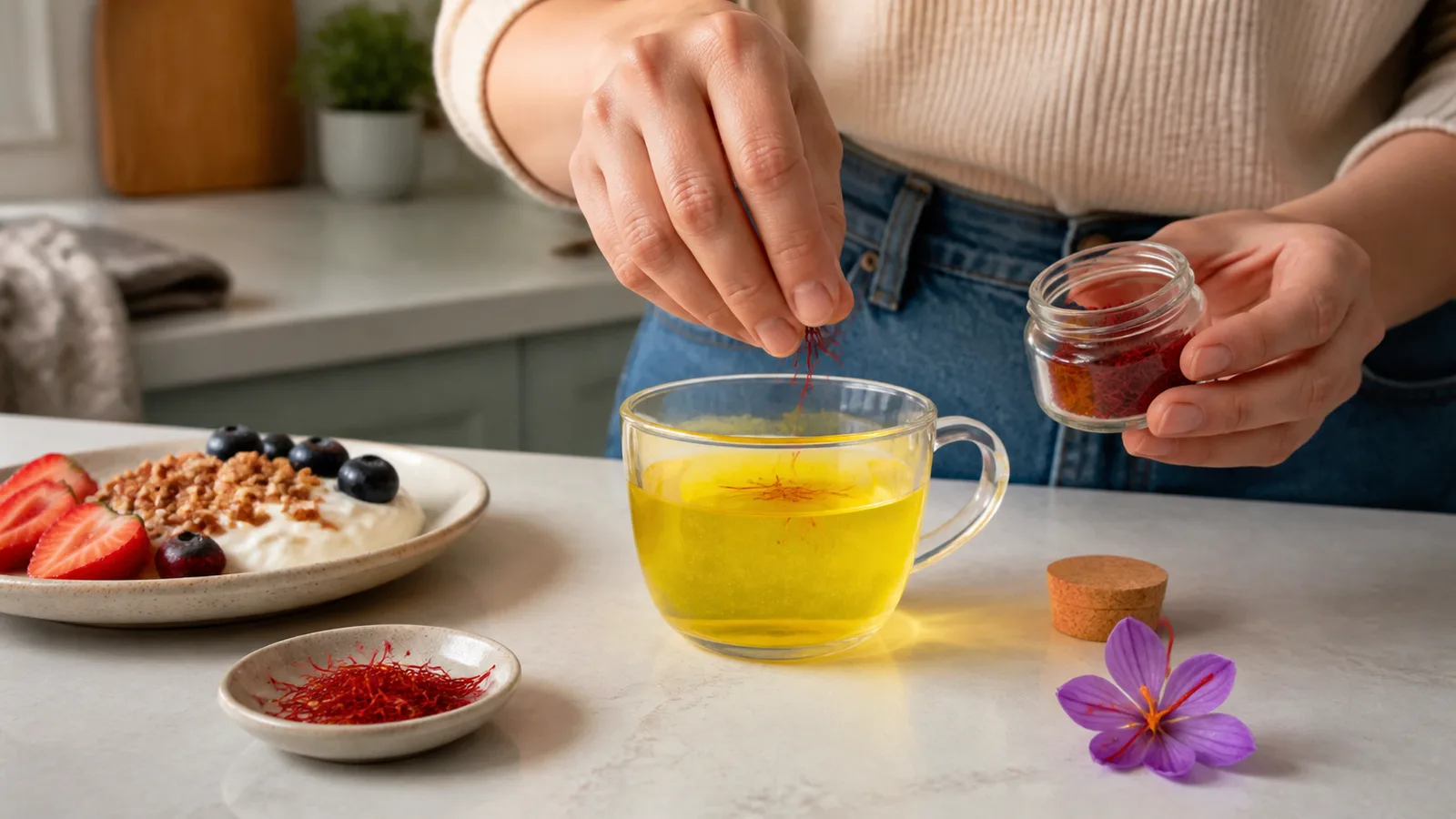
This guide looks at 20 common benefit claims and tells you what each one actually means. Some are supported by several randomised trials. Others rest on mixed results, laboratory work or an idea that has not yet translated into a health outcome for people.
How to read saffron health research
A change in a questionnaire score or blood marker is not the same as preventing a disease, and a statistically significant result is not always large enough to matter in daily life. Results from an extract also cannot automatically be applied to every powder, tea or retail supplement.
A broad evidence map of saffron meta-analyses found promising results across several outcomes, while also judging that the methodological quality of the reviews needed improvement. That combination—real signals with genuine uncertainty—is the right frame for the list below.
20 saffron benefit claims, checked against human evidence
1. Depressive symptoms
Mood is one of the better-studied areas. A 2026 review of 34 randomised trials found improvements in self-reported depression scores, although clinician-rated scales did not show the same clear effect and results varied considerably between studies. The authors rated the overall evidence as moderate, not definitive.
That makes saffron a possible complementary option to discuss with a clinician, not a reason to stop counselling or prescribed treatment. Our focused guide to saffron and depression explains those limits in more detail.
2. Anxiety symptoms
The same GRADE-assessed mood review found lower self-reported anxiety scores in pooled trials, but clinician-rated anxiety did not improve consistently. The high variation between studies means the average result will not describe every person or product.
3. Everyday mood and stress
Some trials have enrolled people without a diagnosed mood disorder and measured stress, wellbeing or general mood. The wider neurological and psychiatric literature includes positive findings, but populations, extracts and scales differ. It is reasonable to call this promising; it is too early to promise a reliable mood lift for a healthy person.
4. Sleep quality
A systematic review of five randomised trials, involving 379 participants across three countries, reported initial support for better sleep quality or duration. Five trials are a useful beginning, not a settled treatment standard. Larger independent studies are still needed.
Sleep problems can also come from pain, medication, breathing disorders, anxiety or an irregular schedule. A spice or supplement should not postpone an assessment of the cause. See our separate review of saffron and sleep quality for the practical context.
5. Cognition in mild cognitive impairment or dementia
Small trials in mild cognitive impairment and Alzheimer’s disease have reported better cognitive scores than placebo and results similar to comparison medicines. Yet a systematic review found only five eligible trials with 325 people and warned about possible high risk of bias.
The cognition review describes the evidence as promising. It does not justify substituting saffron for a diagnosis, a clinician’s care plan or approved medication.
6. Memory in healthy adults
Evidence from patients with cognitive impairment is sometimes turned into a general claim that saffron “boosts memory.” That jump is not supported. The cognition review found far less information for cognitively healthy people, so a dependable memory benefit in healthy adults remains unproven.
7. Visual function
Several small clinical studies have examined saffron in age-related macular degeneration, glaucoma or diabetic maculopathy. A systematic review of ocular research found encouraging clinical signals, alongside a larger body of cell and animal work. The authors called for further clinical confirmation.
Eye conditions are time-sensitive. Saffron should never replace an examination or prescribed eye treatment, especially when vision changes suddenly.
8. Premenstrual syndrome
A 2026 systematic review pooled randomised trials of premenstrual syndrome and found lower symptom scores with saffron. The result supports further study, but it does not show that every formulation or dose works, or that another cause of symptoms can be ignored.
9. Menstrual pain
The same PMS and dysmenorrhoea meta-analysis reported a smaller reduction in menstrual-pain scores. The confidence interval was close to no effect, so this finding is less secure than a casual “relieves cramps” claim suggests.
10. Sexual function
A meta-analysis found improved sexual-function scores across five studies, but the total sample was only 173 people and the results differed between studies and subscales. Some research involved medication-related sexual dysfunction rather than the general population. This is an early clinical signal, not an aphrodisiac guarantee.
The sexual-function review itself calls for additional studies. Persistent changes in sexual function deserve medical assessment because medicines and underlying conditions are common contributors.
11. Fasting blood glucose
Recent pooled trials in people with metabolic syndrome, diabetes or related conditions found a small average reduction in fasting glucose. Earlier reviews were less consistent. Differences in participants and background treatment matter, and the result does not mean saffron prevents or treats diabetes by itself.
12. HbA1c
A 2025 meta-analysis of 25 trials found a modest reduction in HbA1c, a marker of longer-term glucose control. The change was small and came from supplementation studies in people who often had an existing metabolic disorder. Nobody using glucose-lowering medicine should adjust it on the strength of this finding.
13. Cholesterol and triglycerides
Reviews do not give one uniform answer. A broad 2023 analysis reported small reductions in total cholesterol, LDL and triglycerides, while another recent metabolic-syndrome review found a change in total cholesterol but not triglycerides, LDL or HDL. These are risk markers, not evidence that saffron prevents heart attacks.
14. Blood pressure
Pooled studies have reported small reductions in systolic or diastolic pressure, depending on the review. The average changes were only a few millimetres of mercury and results varied by population. That is not a basis for replacing prescribed blood-pressure medicine, and anyone who already has low blood pressure should be cautious with medicinal use.
The cardiovascular-risk meta-analysis is useful precisely because it reports the size of the changes rather than simply calling saffron “heart healthy.”
15. Appetite, weight and waist circumference
Some trials have measured snacking, appetite, weight or waist circumference. Meta-analyses have occasionally found a small reduction in waist size, but more recent pooled work found no significant change in body mass index or waist circumference. Saffron is not a demonstrated weight-loss treatment.
16. Oxidative-stress markers
Crocin and other saffron compounds have antioxidant chemistry, and pooled trials have found changes in markers such as malondialdehyde and total antioxidant capacity. A 2023 meta-analysis also noted that studies were concentrated in Iran and differed in participants and design.
A biomarker shift does not prove that a person will avoid a particular disease or live longer. “Contains compounds with antioxidant activity” is more accurate than “detoxes the body.”
17. Inflammatory markers
The overall evidence is mixed. A systematic review of eight randomised trials found no significant average change in CRP, TNF-α or IL-6, although some subgroups appeared to respond. Later reviews in people with type 2 diabetes have reported changes in selected markers but not others.
The inflammatory-biomarker review is a useful reminder that anti-inflammatory effects in a laboratory do not automatically become a clinically meaningful benefit.
18. Liver markers
Some pooled trials have found small changes in ALT or AST, particularly in people with diabetes. These enzymes are measurements, not a diagnosis or a direct measure that liver disease has been reversed. Evidence in specific liver conditions is sparse, so “cleanses the liver” is not an evidence-based claim.
19. Kidney function
Trials have measured creatinine and blood urea nitrogen, but recent reviews have not shown a dependable improvement. Saffron should not be described as a kidney treatment. People with kidney disease also need professional advice before using concentrated supplements.
20. Cancer prevention or treatment
Laboratory and animal studies of crocin, crocetin and other compounds are frequently turned into statements that saffron “fights cancer.” That wording overreaches the human evidence. Cell experiments can help researchers choose a pathway to study, but they do not establish that eating saffron prevents cancer or that an extract treats it in a person.
No one should delay screening or cancer care for saffron. This is the clearest example of why a mechanistic possibility is not yet a health benefit.
Food use and supplement research are not interchangeable
A culinary dish may contain a small pinch shared by several people. Clinical studies usually use a measured amount of stigma, extract or isolated constituent every day for a defined period. Extraction, standardisation and storage can change what the participant receives.
That means a trial does not provide a universal home dose. Nor does a label that says “saffron” prove that a supplement matches the product studied. If you simply enjoy the spice, bloom a modest pinch for flavour and colour; our saffron tea recipe shows a culinary preparation without presenting it as medicine.
Safety deserves a place beside the benefits
A 2026 systematic review of adverse events found that saffron was generally well tolerated in trials, but side effects did occur. Gastrointestinal complaints were the most frequently reported and were usually mild. The review recommends clinical monitoring for higher-dose or prolonged medicinal use because some potentially important events have been reported.
Pregnancy calls for particular care. A recent review of saffron use in pregnancy found that safety evidence remains limited and inconclusive, with concern around higher exposure and uterine effects. A pregnant or breastfeeding person should not start a concentrated saffron product without guidance from their clinician.
It is also sensible to ask a pharmacist or doctor before supplementation if you take prescription medicine, have a bleeding or blood-pressure concern, are preparing for surgery, or are being treated for a mental-health, metabolic, eye, liver or kidney condition. “Natural” does not tell you whether a concentrated product is appropriate for your situation.
What can fairly be said about saffron’s benefits?
The fairest summary is that saffron has credible but still developing human research. Mood has the broadest trial base. Sleep, selected menstrual symptoms and several metabolic measurements have encouraging pooled results. Cognition, eye health and sexual function have smaller bodies of clinical evidence. Weight loss, kidney support and cancer claims are not established.
For most readers, saffron remains first a fragrant culinary spice. Its colour and aroma are benefits you can experience in a meal without turning dinner into treatment. Anyone considering it for a health condition should take the research—and the uncertainty—to a qualified clinician who knows their medicines and medical history.