Yes, saffron expires in the sense that its colour, aroma and flavour weaken with time. Properly dried threads do not suddenly become useless on the date printed on the pack, but their best culinary quality is finite. A practical saffron shelf life is about two to three years for well-stored whole threads, while ground saffron usually fades sooner.
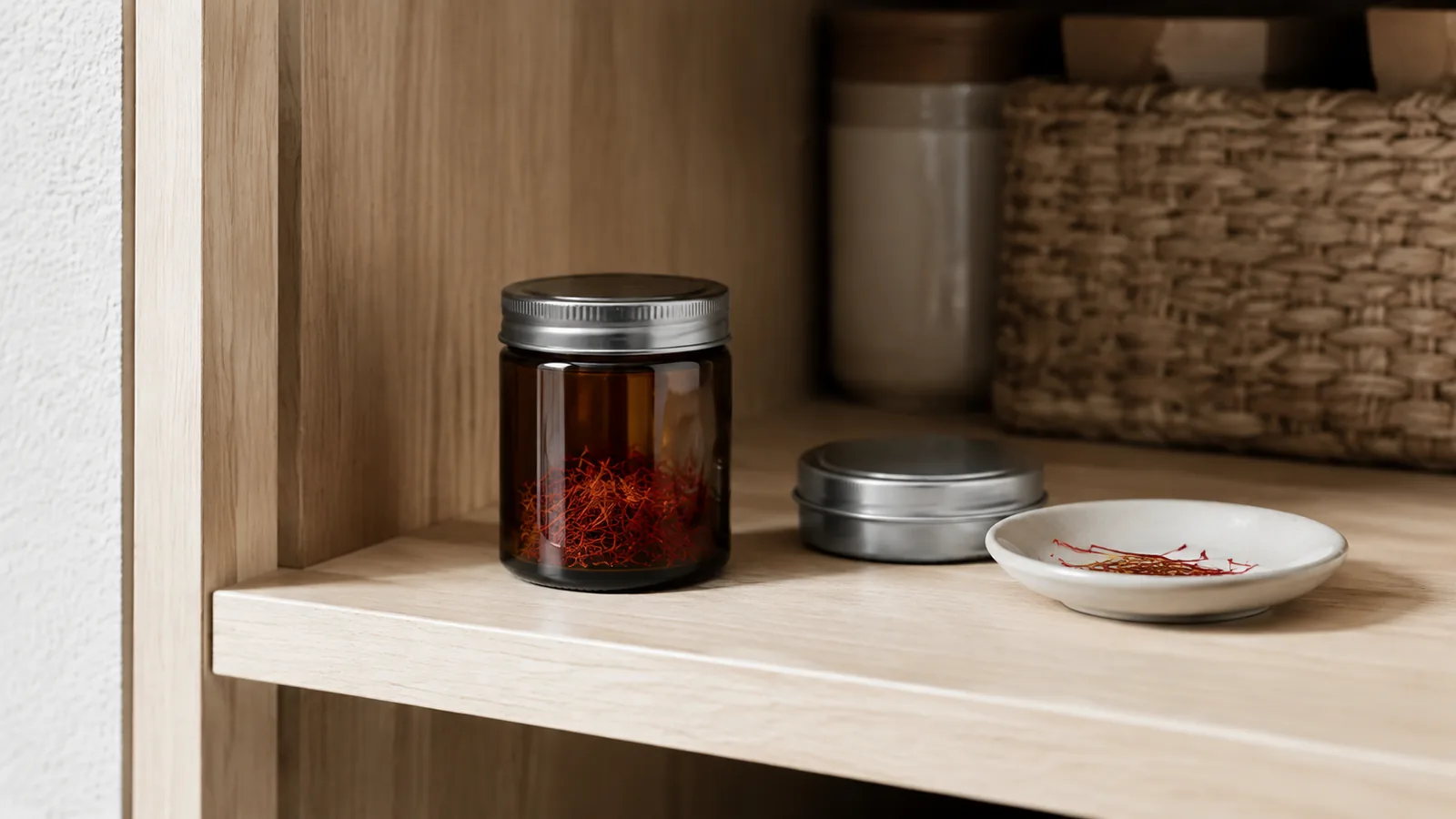
Does saffron have an expiry date?
A sealed commercial pack may carry a best-before or expiry date set by the producer. Follow that label, especially if it gives storage instructions. For a dry spice, the date commonly marks the period in which the maker expects the product to retain its intended quality; it is not permission to ignore moisture, mould, pests or damaged packaging before that date.
After opening, the calendar is only part of the answer. How often the container is opened, where it sits and whether a damp utensil enters it can matter more than a few weeks on either side of the printed date.
How long do saffron threads last?
Whole threads kept airtight, dark, dry and reasonably cool can remain useful for several years. For the best balance of aroma, flavour and colouring strength, aim to use them within two to three years and sooner after opening if the container is frequently exposed to air.
Research on saffron compounds and commercial quality reports that merchants often consider three to four years under suitable dark storage, while also documenting the decline in colouring strength over time. That wider range is not a promise for every kitchen jar. Initial quality, drying, packaging and temperature vary.
If you are asking how long you can keep saffron threads, use the printed date as the first guide and your storage history as the second. A batch left beside a hot cooker in a clear jar may deteriorate faster than one kept sealed in a dark cupboard.
Ground saffron has a shorter useful life
Grinding exposes much more surface area to oxygen, light and moisture. It also makes changes in the original thread structure impossible to see. As a practical household rule, use ground saffron within one to two years when the maker does not give a shorter date, and keep it in the smallest airtight, opaque container that holds it comfortably.
Do not grind a large supply simply for convenience. Keeping most of it as whole threads and grinding a measured portion when needed usually protects quality and makes the product easier to inspect.
What changes as saffron ages?
Saffron does not age along one simple line. Crocins contribute its golden colour, picrocrocin its characteristic bitterness, and volatile compounds including safranal shape the aroma. Their proportions change during drying and storage.
A study comparing fresh and stored samples found meaningful changes in the chemical profile of saffron over time, including lower crocin content in stored samples. This is why an old jar may still smell recognisably of saffron yet colour rice or water less strongly than it once did.
Signs that saffron is past its best
- Weak aroma: the threads smell faint even after a small amount is gently crushed.
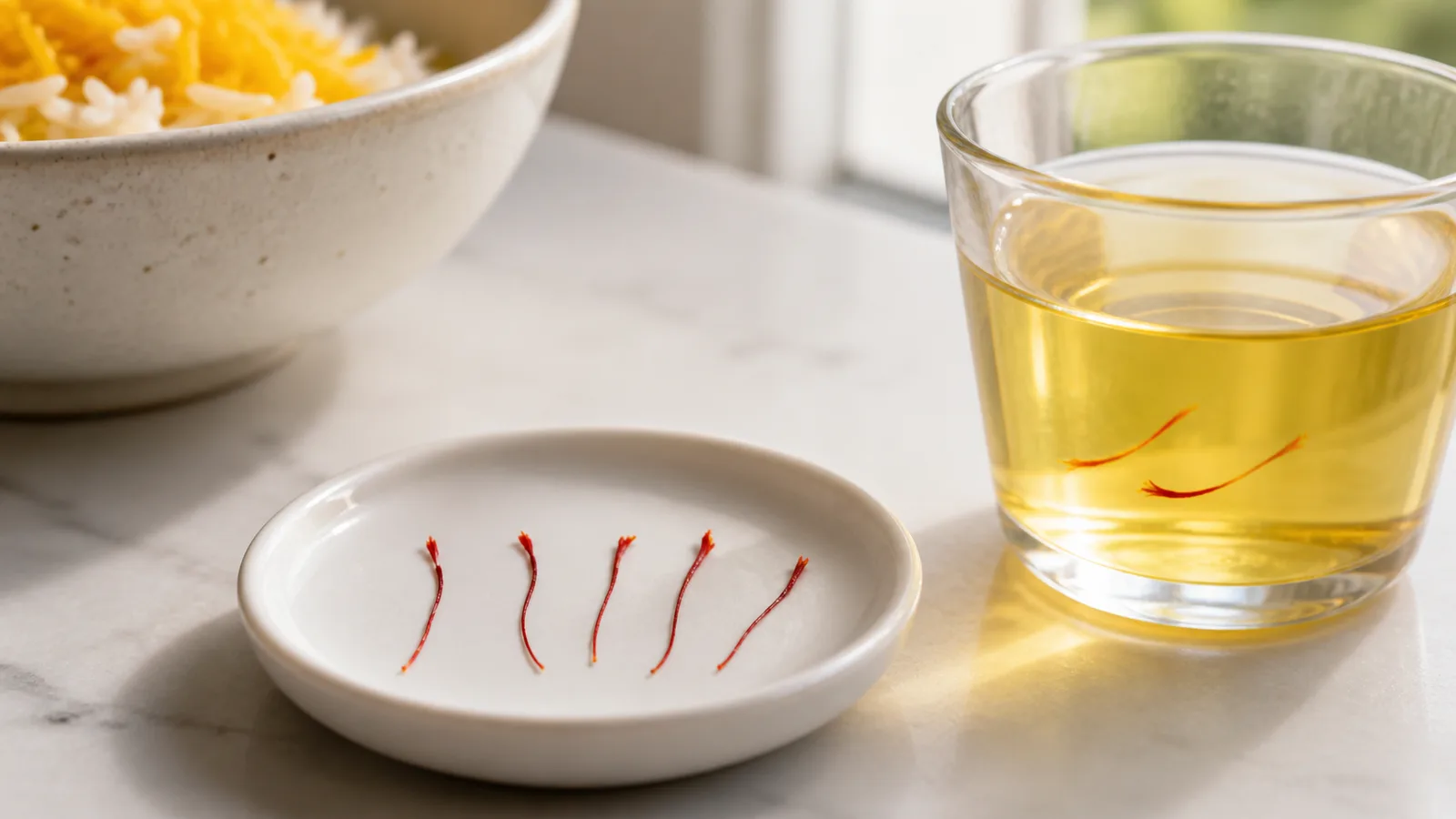
- Poor infusion: a normal measured pinch produces little golden-yellow colour after 10 to 15 minutes in warm water.
- Flat flavour: the infusion lacks saffron’s characteristic aromatic bitterness.
- Faded appearance: the threads have lost much of their deep red colour.
- Damaged condition: there is moisture, clumping, mould, insect activity or an unfamiliar off-odour.
The first four signs mainly point to lost culinary quality. The last group is a reason to discard the product. Do not taste saffron that looks damp, mouldy, contaminated or otherwise questionable.
Can old saffron make you ill?
A dry, uncontaminated spice that has merely passed its best-before date is often a quality problem rather than an automatic safety problem. That does not mean every old jar is safe. Saffron exposed to water, dirty utensils, insects or damaged packaging can be contaminated, and appearance or smell cannot detect every food-safety hazard.
When the storage history is unknown, the seal is broken, or the product shows moisture, mould or pests, discard it. If a manufacturer has issued a recall or gives a firm use-by instruction, follow it.
How to store saffron for a longer life span
- Keep the threads in a clean, food-safe glass or metal container with a tight seal.
- Choose a dark cupboard away from the cooker, oven, dishwasher and sunny windows.
- Open the container briefly and close it straight away.
- Use a completely dry spoon or clean dry fingers; never shake the jar over a steaming pan.
- Keep strongly scented products and household chemicals away from the spice.
- Write the opening date on the outer package if you tend to forget it.
For more detail on container choice and temperature, see where saffron should be stored.
Should saffron go in the fridge or freezer?
For ordinary household use, a stable dark cupboard is usually simpler. Refrigerators and freezers can expose the container to condensation when it is opened before reaching room temperature. If you store a large, well-sealed supply cold, divide it into small moisture-proof portions and let a closed portion warm fully before opening it.
Saffron contains little oil, so it more often becomes stale than truly rancid. Our guide to whether saffron can go rancid explains that distinction.
Test culinary strength before throwing it away
If the threads are dry, clean and free of spoilage signs, make a small infusion. Crush a measured pinch, add warm water and wait 10 to 15 minutes. Compare the aroma and clear golden colour with what you remember from the fresh pack. Weak saffron may still be usable in a larger culinary dose, but it will not recover its original strength.
When replacing an old jar, buy a quantity that matches how often you cook. The available saffron products should arrive sealed and then be stored with the same care.
Will saffron expire?
Its best quality will. Whole threads commonly stay at their best for roughly two to three years under good household storage, with some well-kept batches remaining useful longer; ground saffron generally declines faster. Keep it airtight, dark, dry and away from heat, then discard it if moisture, mould, pests, package damage or an unexplained odour makes its safety uncertain.