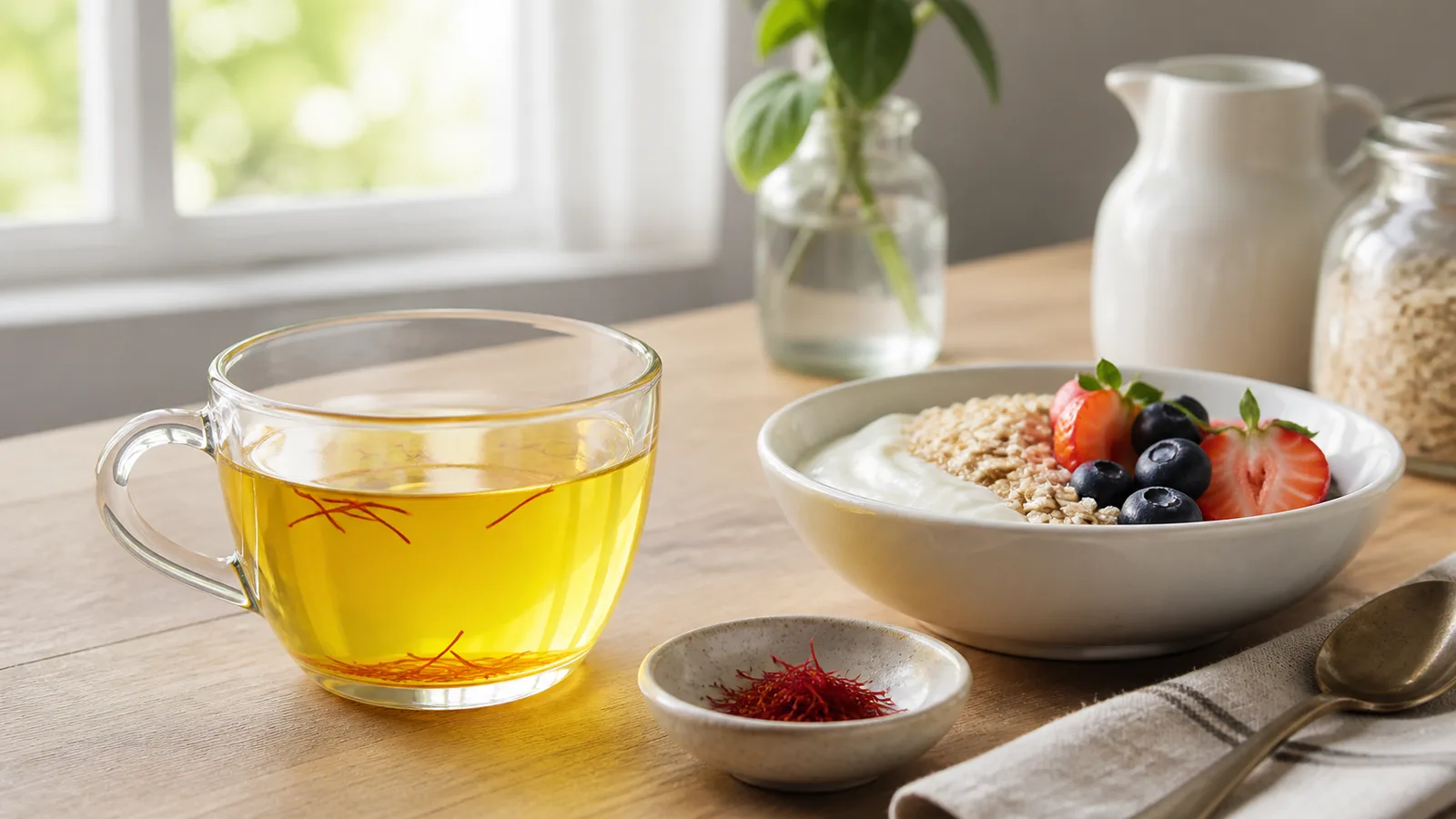
You can usually have a culinary amount of saffron on an empty stomach, but there is no proven advantage to doing so. People often put the question another way: “Can I take saffron on an empty stomach?” The answer still depends on the form and on your tolerance. Some people notice nausea, reflux, abdominal discomfort or loose stools, particularly with a concentrated supplement. If your stomach is sensitive, take it with a meal instead.
Claims about saffron benefits on an empty stomach often mix food, tea and standardized extracts as though they were the same. They are not. The form, amount, other ingredients and reason for taking it all affect the sensible answer.
Saffron on an empty stomach: food or supplement?
A few saffron threads steeped in water are a culinary ingredient. A capsule may contain a measured extract that concentrates particular compounds and may include other ingredients. Clinical research on an extract cannot be used to promise the same effect from saffron water, and a cup of saffron water cannot tell you how a supplement should be taken.
For food, the timing question is mostly about comfort and preference. Saffron is commonly eaten as part of rice, soup, stew or a milk-based drink, so it naturally arrives with food. Taking it before breakfast does not unlock a special property that disappears once a meal is present.
For a supplement, follow the directions on that exact label. The U.S. Food and Drug Administration’s supplement guidance advises people to take supplements only as described on the label and discuss benefits and risks with a healthcare professional. A direction written for one extract should not be borrowed for another.
Does an empty stomach improve saffron absorption?
There is no dependable human evidence that taking saffron without food produces faster or stronger benefits. The old claim that an empty stomach “enhances absorption” sounds plausible, but it is not established for ordinary saffron use. Neither a stronger colour in water nor a faster taste in the mouth demonstrates greater absorption in the body.
Studies use different extracts, formulations and schedules. Some protocols allow a product with or without food; others specify a time. Those instructions help standardize a trial. They do not prove that fasting is better.
What are the benefits of kesar water in the morning?
Kesar is another name for saffron. Drinking kesar water in the morning provides fluid and saffron’s aroma, colour and flavour. It can be an enjoyable caffeine-free ritual. What has not been shown is that the empty stomach itself improves digestion, mood or the activity of crocin and safranal.
If you like saffron water, use a modest culinary amount and judge it as a drink, not as a treatment. It should not replace breakfast, prescribed medicine or care for a digestive problem. The broader question of timing is covered in our guide to taking saffron in the morning or at night.
Can saffron cause stomach upset or diarrhoea?
It can. Can saffron cause diarrhea specifically? That symptom has been reported, although it is not an inevitable response. A 2026 systematic review of human saffron safety data found that gastrointestinal complaints were the most frequently reported category of adverse event in clinical studies. Reports included nausea, abdominal pain, diarrhoea, reflux, bloating and changes in appetite. Most were described as mild and self-limiting, but the review also urged more caution with medicinal use at higher amounts or for longer periods.
The review combined many preparations and patient groups, so it cannot predict whether one person will get stomach pain. It also does not mean that a culinary pinch commonly causes diarrhoea. It tells us not to dismiss a new digestive symptom simply because saffron is a spice.
If discomfort begins after taking saffron, pause it and see whether the symptom settles. Seek medical advice for severe pain, repeated vomiting, persistent diarrhoea, blood in stool, faintness, swelling or breathing difficulty. Those symptoms are not something to manage by adjusting a saffron recipe.
Should you take saffron with or without food?
Choose the option that matches the product and your tolerance:
- Culinary saffron: use it in food or a drink whenever you enjoy it. There is no need to fast first.
- A sensitive stomach: take it with food, or leave it out if symptoms continue.
- A saffron supplement: use only the labelled serving and follow any direction about meals.
- A multi-ingredient product: check every active and inactive ingredient; saffron may not be the cause of a reaction.
- A research-style extract: do not convert its milligrams into an assumed number of threads.
There is also no universal rule that 20 to 30 threads per day is the correct amount. Threads vary in size and weight, while supplements vary in concentration. Our article on how many saffron threads to use explains why a thread count should not become a medical dose.
Who should ask before taking saffron regularly?
Ordinary food use and regular supplement use are different decisions. Speak with a clinician or pharmacist before using a saffron supplement if you are pregnant or breastfeeding, take prescription medicine, have a bleeding disorder, have low blood pressure, are preparing for surgery or are managing an ongoing digestive condition. This is especially important if saffron is being considered for mood, sleep or another health outcome rather than flavour.
Our guide to what to avoid with saffron covers the wider interaction and safety questions. Do not stop or alter prescribed treatment to make room for a supplement.
A comfortable way to try saffron water
For culinary use, crush a small amount of genuine threads, steep them in warm water and add the infusion to a meal or drink. If you prefer it before breakfast, try it without assuming that fasting adds a health benefit. If it feels harsh on your stomach, have it with food next time.
The practical answer is simple: saffron can be taken on an empty stomach, but it does not need to be. Comfort, the product label and your health context matter more than the idea that “empty” automatically means “better.”