Yes, saffron may affect sleep, but the evidence is narrower than the usual “natural sleep aid” claim suggests. Several short clinical trials found modest improvements in self-reported sleep after people took a particular standardized saffron extract. They do not prove that a few saffron threads will make everyone sleepy, and they do not establish saffron as a treatment for chronic insomnia.
If you are considering saffron for sleep quality, it helps to separate three things: culinary saffron, standardized extracts used in studies and the relaxing bedtime ritual of a warm drink. They are related, but they are not interchangeable.
Can saffron help with sleep?
There is a real human evidence base, although most trials have been small, short and focused on people who reported poor sleep rather than a broad range of diagnosed sleep disorders.
In a 2020 randomized, double-blind trial, 63 adults with self-reported sleep problems received either a standardized extract at 14 milligrams twice a day or a placebo for 28 days. The saffron group reported greater improvements on an insomnia severity scale, restorative sleep questionnaire and sleep-quality diary. The analysis included 55 participants, and the authors called for larger and longer studies with objective sleep measures.
A separate 28-day trial involving 120 adults compared placebo with 14 or 28 milligrams of a standardized extract taken one hour before bed. Sleep-quality ratings and some insomnia measures improved more with saffron, while several other questionnaire and diary measures did not differ. Both tested doses produced similar sleep changes.
More recently, a 2025 trial in adults reporting moderate insomnia found a small improvement in insomnia symptoms and self-rated sleep quality after four weeks of 20 or 30 milligrams of another standardized extract. That adds useful evidence, but the results still concern named extracts over a limited period—not an open-ended recommendation for any saffron product.
Does saffron make you sleepy?
It may help some people feel that their sleep is better, but the trials do not show that saffron acts like a fast sedative. A person should not expect to swallow saffron and become immediately drowsy. In the studies, outcomes were generally measured after repeated use over several weeks.
The 120-person trial found a change in evening melatonin concentration, but that single finding does not prove a complete mechanism. The older explanation that saffron simply “boosts serotonin” enough to induce sleep is too certain. Crocin, crocetin and safranal are being investigated, yet researchers have not established one simple pathway that predicts how an individual will respond.
That also answers the closely related question “can saffron make you sleepy?” Possibly, but not reliably or on command. Do not drive or operate machinery if any new supplement makes you drowsy.
Can saffron cause insomnia or keep you awake?
Insomnia was not the expected effect in the sleep trials, and published results generally moved in the other direction. Even so, an average trial result cannot rule out an individual reaction. A supplement may also contain other ingredients, or be taken with caffeine, medicines or additional products that affect sleep.
So, does saffron keep you awake? That is not the typical result in the trials. Reports of saffron causing insomnia are not enough to establish a usual effect, but your own response still matters. If saffron appears to make you more alert, delays sleep or causes repeated waking, stop treating it as a bedtime aid. Check the full ingredient label and consider the timing of caffeine, alcohol, medications and other supplements. Persistent insomnia deserves a proper assessment instead of repeated experiments with new products.
Is saffron tea the same as saffron extract for sleep?
No. The strongest sleep studies used measured, standardized extracts. A cup of saffron tea or warm saffron milk contains an uncertain amount of the plant’s compounds, and the number of threads is not a reliable way to reproduce a research preparation.
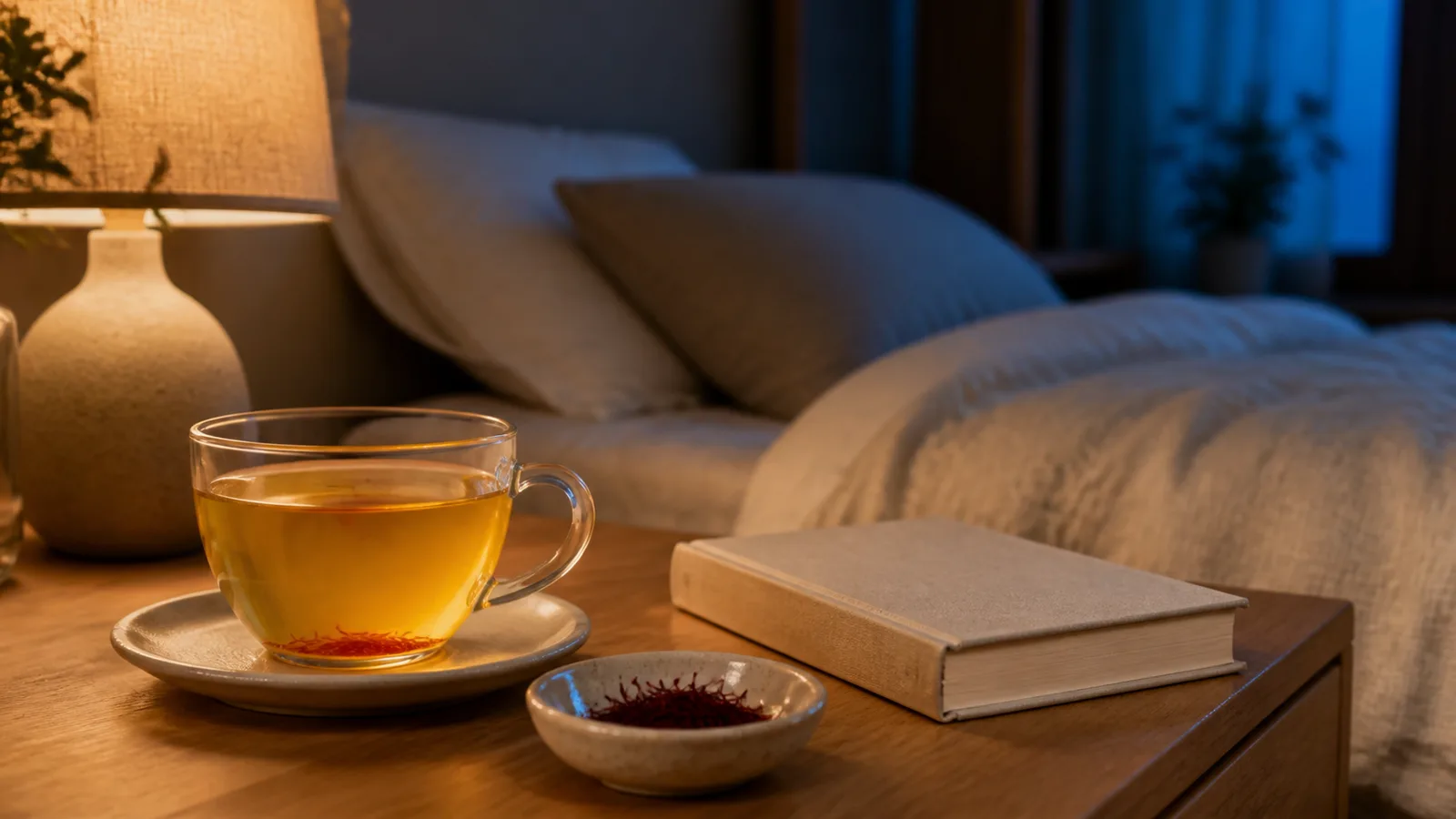
A warm, caffeine-free drink can still be a pleasant part of winding down. Crush a small culinary amount of genuine threads, steep them in warm water or milk and enjoy the flavour. Just keep the claim proportionate: the drink is a comforting routine, not a tested substitute for insomnia care. Our guide to the timing of saffron in the morning or at night explains why there is no single correct hour for every use.
What is the right saffron dosage for sleep?
There is no established universal saffron dosage for sleep. The milligram amounts above describe the particular extracts tested under controlled protocols; they should not be converted into “20 to 30 threads” or applied automatically to culinary saffron. The old formula of 20 to 30 threads taken 30 minutes before bedtime is not supported by these studies. Thread weight varies, extracts use different standardization methods, and supplements may contain very different concentrations.
Do not increase a dose because a product has not made you sleepy. Follow the labelled amount for the exact product and ask a clinician or pharmacist whether it is suitable for you, especially if poor sleep is persistent, you are pregnant or breastfeeding, you have a health condition, or you use prescription medicine.
Can you take saffron and melatonin together?
There is not enough direct evidence to say that combining saffron and melatonin is either more effective or appropriate for a particular person. A study measuring the body’s own evening melatonin after saffron is not the same as a trial of saffron taken with a melatonin supplement.
The U.S. National Center for Complementary and Integrative Health notes that long-term melatonin safety is not established and advises people taking medicines to consult a healthcare provider. Combining two sleep-directed supplements adds uncertainty about side effects and next-day alertness. Check first rather than assuming that two “natural” products are automatically safe together.
When sleep problems need more than a supplement
Occasional restless nights often respond to ordinary changes: a consistent wake time, a dark and quiet room, less late caffeine and enough time to wind down. Chronic insomnia is different. The broader NCCIH guidance on sleep disorders describes the evidence for complementary approaches as inconsistent or too limited in many cases and notes that cognitive behavioural therapy for insomnia is strongly recommended.
Seek medical advice if sleep difficulty lasts for weeks, affects daytime safety or mood, or comes with loud snoring, gasping, restless legs or unusual movements. Those signs can point to a problem that saffron cannot diagnose or fix.
The balanced answer
Does saffron help with sleep? Standardized saffron extracts have produced encouraging short-term results in several controlled trials, so the idea is not mere folklore. The benefit is not guaranteed, the mechanism remains uncertain, and culinary saffron has not been shown to reproduce a study capsule. Use it cautiously, keep expectations realistic and treat persistent insomnia as a health issue rather than a spice problem.