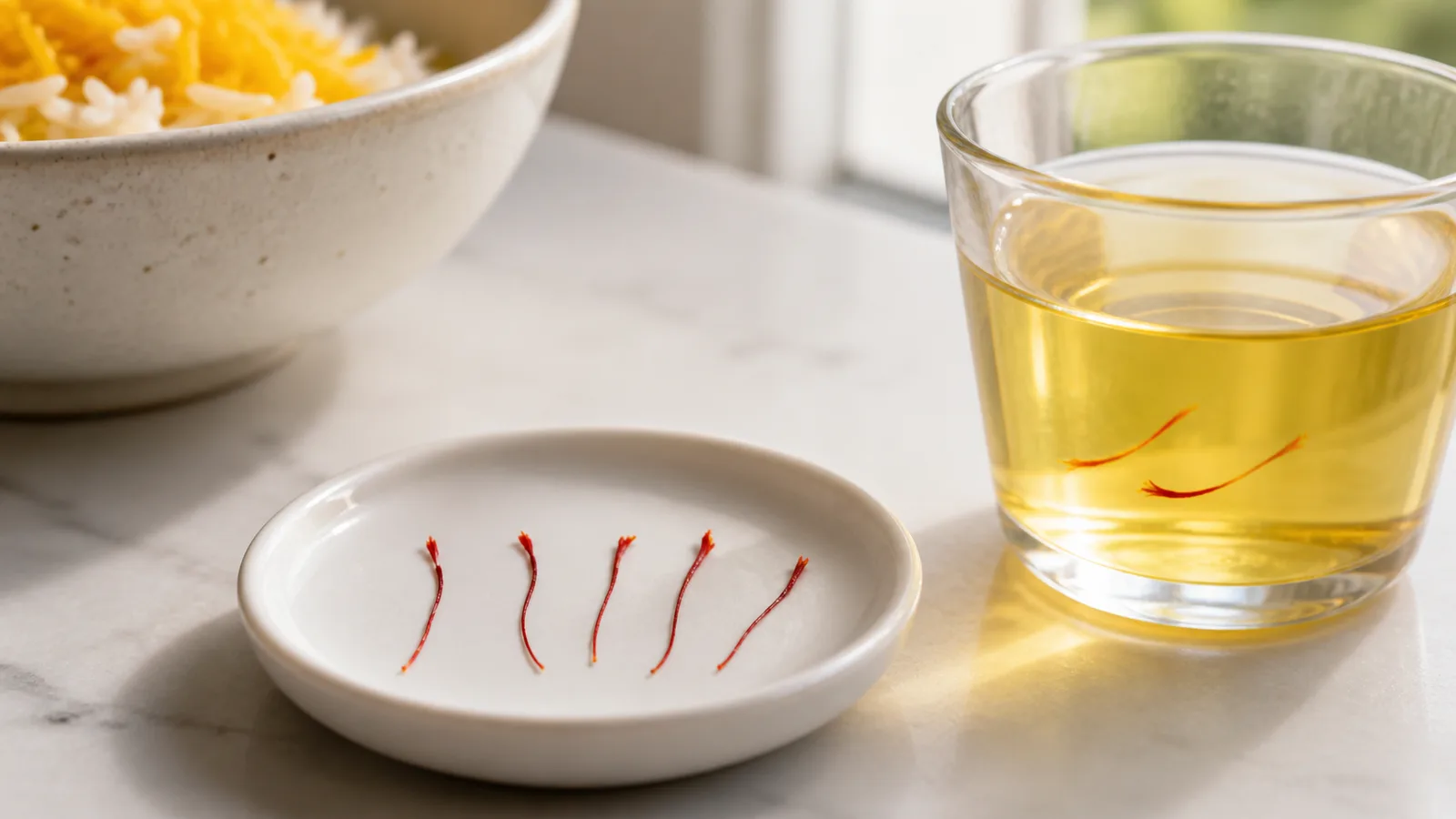
The best saffron to buy is a fresh, traceable batch of genuine Crocus sativus threads whose quality is supported by clear product information. A famous country, an attractive box or the word “premium” is not enough.
Which saffron is the best quality?
For most home cooks, the safest all-round choice is whole red saffron threads from an identified producer or packer, sold in a sealed, light-protective container. The label should state the net weight and origin, and a serious supplier should be able to explain the grade, harvest or packing date, storage conditions and any laboratory testing behind its claims.
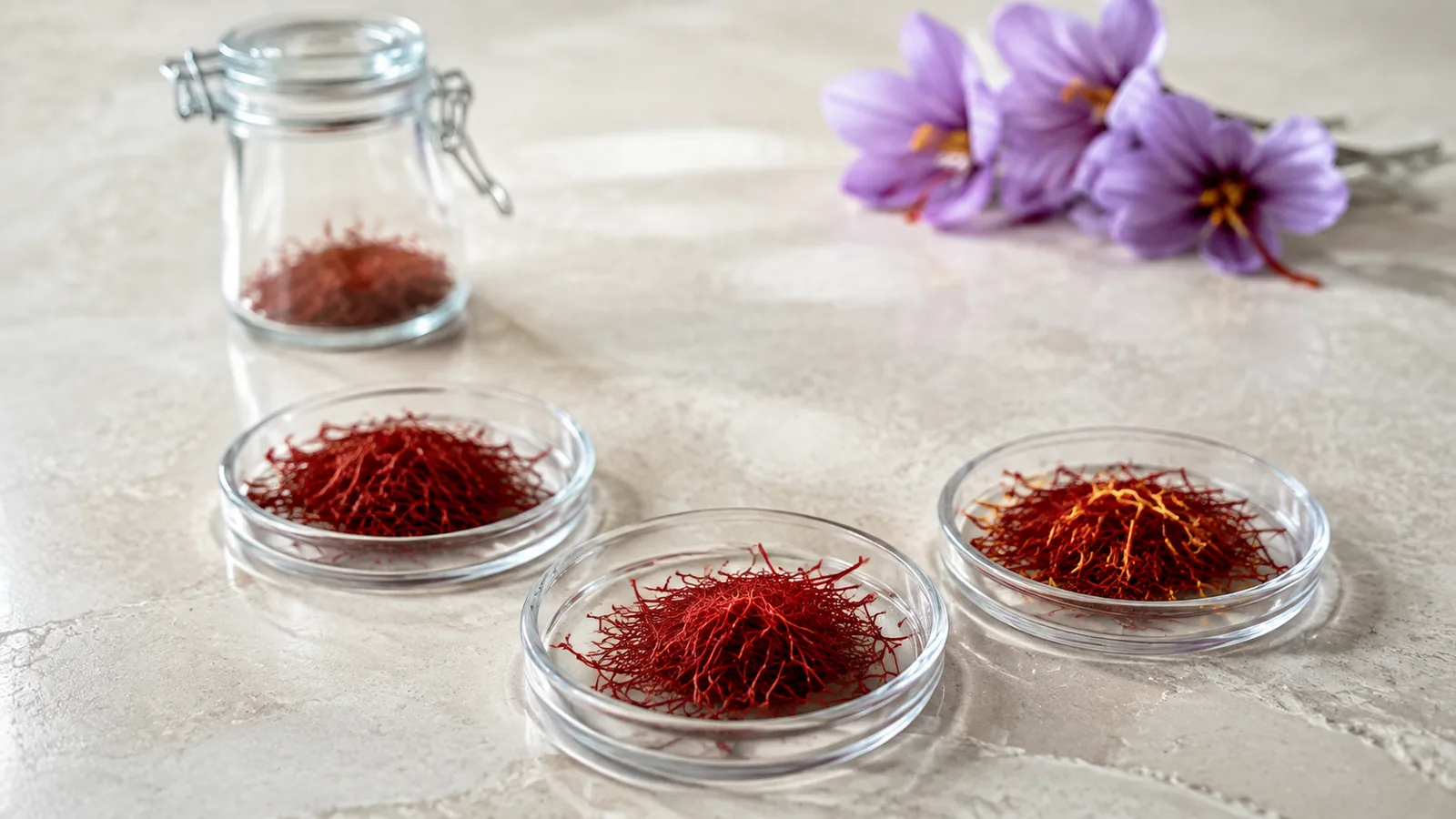
There is no single best saffron for every buyer. Long, visually impressive Negin threads may suit a gift or a dish where the threads remain visible. Sargol offers red-only cut stigmas and is practical for everyday cooking. Pushal retains a little pale style, which provides useful visual evidence that the threads are real flower parts and can still deliver excellent flavour and colour. The best quality saffron for you is the authentic batch that fits the recipe and offers honest value.
What high-quality saffron should be like
Good quality saffron starts with the correct plant material: dried stigmas, sometimes with a permitted portion of the style, from Crocus sativus. The current Codex standard for dried saffron recognises filaments, cut filaments and powder. It also sets expectations for characteristic colour, aroma and flavour, along with limits on moisture, foreign matter and defects.
At home, you can make a useful first inspection:
- Look at the threads. Genuine stigmas widen slightly at one end and are not uniformly straight like dyed fibres. Red is desirable, but colour alone cannot prove identity.
- Smell before judging strength. Saffron has a complex dry, warm aroma. A musty, rancid or plainly artificial smell is a warning sign.
- Check the package. It should be sealed, clean and protected from light. Origin and lot information are more useful than ornamental language.
- Consider age. Even authentic saffron loses sensory quality through poor storage. A traceable recent batch is preferable to an undated one.
Laboratory measures provide stronger evidence than appearance. ISO 3632-1:2025 specifies requirements for saffron in filament, cut-filament and powder forms. Quality assessment commonly examines compounds associated with colour, taste and aroma, including crocins, picrocrocin and safranal. A peer-reviewed review of saffron’s commercial quality explains both these markers and the need for additional techniques when authenticity is in doubt.
Sargol, Negin or Pushal: which saffron is best?
These names describe Iranian commercial cuts, not three different saffron plants and not a universal league table. A peer-reviewed study of the trade categories describes Negin as mostly intact, separated red stigmas; Sargol as red stigma portions that may be shorter or broken; and Pushal as stigmas retaining a small amount of style. The study’s visual comparison of Negin, Sargol and Pushal also shows why appearance can identify a cut without fully measuring its chemical or sensory quality.
Negin and Super Negin
Negin generally refers to long, separated red stigmas with little or no pale style. “Super Negin” is a trade description for especially long, neat, intensely red material, but the wording is not a substitute for a test result. It can be an excellent choice when presentation matters. Our Super Negin saffron listing shows the particular cut and product information available from Rowhani.
Sargol
Sargol consists of red stigma portions separated from the style. Because it is red-only, it is often sold as a high-grade saffron with strong colouring potential. Shorter threads do not make it fake, however, and the label “Sargol” cannot tell you by itself how recently the spice was harvested, how it was dried or whether the package is authentic.
Pushal
Pushal, also written Poushali, includes the red stigma with a small pale or yellow portion of style. It may cost less than an immaculate Negin presentation, yet a sound batch can be very good for cooking. Rejecting every thread with a little yellow as “diluted” oversimplifies a recognised style of saffron.
Does the country tell you where the best saffron comes from?
Iran, especially Khorasan, is the centre of the world’s largest saffron industry. Spain, including the protected La Mancha tradition, India’s Kashmir region, Afghanistan, Greece, Morocco and Italy also have important histories. These origins can differ in growing conditions and customary processing, but nationality does not make every batch equally good.
Iranian saffron is often a strong choice because buyers can select among established cuts such as Negin, Sargol and Pushal. Spanish or Kashmiri saffron may be preferred for a particular regional recipe or protected provenance. Comparisons such as Spanish saffron versus Iranian saffron, Spanish saffron versus Indian saffron, or Turkish saffron versus Iranian saffron should therefore examine the actual grade, freshness, traceability and sensory performance—not rely on a flag or a country ranking.
There is no defensible single winner for the best saffron in the world. The same caution applies to searches for the “best kesar in the world,” the “best Persian saffron brand” or the “best Iranian saffron brand.” Kesar is simply a widely used name for saffron. Brand reputation can help, but transparent batch information and reliable testing are stronger buying signals than a top-five or top-ten list.
Can a home test prove saffron is real?
No single kitchen test proves authenticity. Genuine threads usually release colour into warm water gradually while keeping some structure, whereas an obvious surface dye may run very quickly. But extraction speed changes with thread size, water temperature and processing. A sophisticated adulterated sample can also pass a casual colour test.
Research on market samples uses combinations of microscopy, chromatography and DNA analysis because each method detects different problems. In one multi-method authentication study of 104 samples, no single visual or chemical shortcut found every kind of adulteration. Treat a home water test as a warning screen, not a certificate. Our guide to fake and counterfeit saffron explains the signs in more detail.
Threads or powder?
Threads are usually the better first purchase because you can inspect their shape and condition. They also let you grind only what a recipe needs. Powder can be convenient and may release quickly, but it is harder for a consumer to recognise undeclared plant material or added colour. Buy powder only when the supplier provides unusually clear traceability and quality control.
For cooking, whole threads do not need to remain whole forever. Gently crushing a measured portion and infusing it is different from buying an anonymous powder. The first gives you a chance to inspect the spice before preparation.
How much should you buy?
A small container is often the better value for an occasional cook, whether it is intended for rice, baking or saffron tea. Saffron is used in modest amounts, and an oversized package can lose aroma before it is finished. Frequent cooks, restaurants and food manufacturers may benefit from a larger format, provided they can verify the batch and store it correctly.
Do not use price alone as a purity test. Genuine saffron requires intensive harvesting and cannot realistically be sold at the price of an ordinary dried herb, but a very high price can reflect packaging or branding rather than better spice. Compare the net weight, stated grade, origin, documentation and condition of the actual threads.
How to choose a saffron supplier
A trustworthy saffron supplier makes specific claims that can be checked. Look for a real business identity, contact details, clear product origin, net weight, batch information and sensible storage guidance. If the seller cites an ISO category or laboratory result, ask which batch was tested and what the document actually measures.
Avoid listings that promise a cure, guarantee a home test as scientific proof or use “Grade 1” without naming the standard behind it. Also be cautious when the photographed product and the supplied product do not match. If you are choosing between Rowhani cuts or need documentation for a larger order, ask us about the current batch.
Keep good saffron good after purchase
Once opened, close the container firmly and keep it away from heat, direct light, moisture and strong odours. A dry, dark cupboard is normally more practical than repeated refrigeration. The storage decision matters because premium-looking threads can still become dull if the package is left warm or open. See our detailed advice on whether saffron belongs in the fridge.
The short buying decision
If you want the best saffron to buy for everyday food, choose identifiable whole threads, a suitable cut, a sealed light-protective package and a seller who can answer precise questions about the batch. Let evidence decide between products. Origin, Sargol or Negin terminology and branding can all be useful information, but none should override authenticity, freshness and traceability.