Iran produces the most saffron in the world. As the top saffron producing country, it accounts for about 85–90% of global production in the latest specific estimate from the UN Food and Agriculture Organization that we reviewed, published in November 2025.
Which country produces the most saffron in 2026?
For someone searching for the largest saffron producing country in 2025 or 2026, Iran remains the evidence-based answer. The FAO’s 25 November 2025 update calls Iran the global leader and gives an estimated share of 85–90%.
That range is more defensible than presenting “90%” as a timeless, exact measurement. Saffron harvests vary, national reports are released on different schedules and some of the crop moves through informal or re-export trade. No consistent, complete 2026 harvest table for every producing country was available from an authoritative international source at the time of this review in September 2026.
The short answer is still clear. Whether the question uses “biggest producer of saffron” or “largest producer of saffron,” the evidence points to Iran. The precision belongs in the date and source, not in an unsupported decimal.
Where is most saffron grown within Iran?
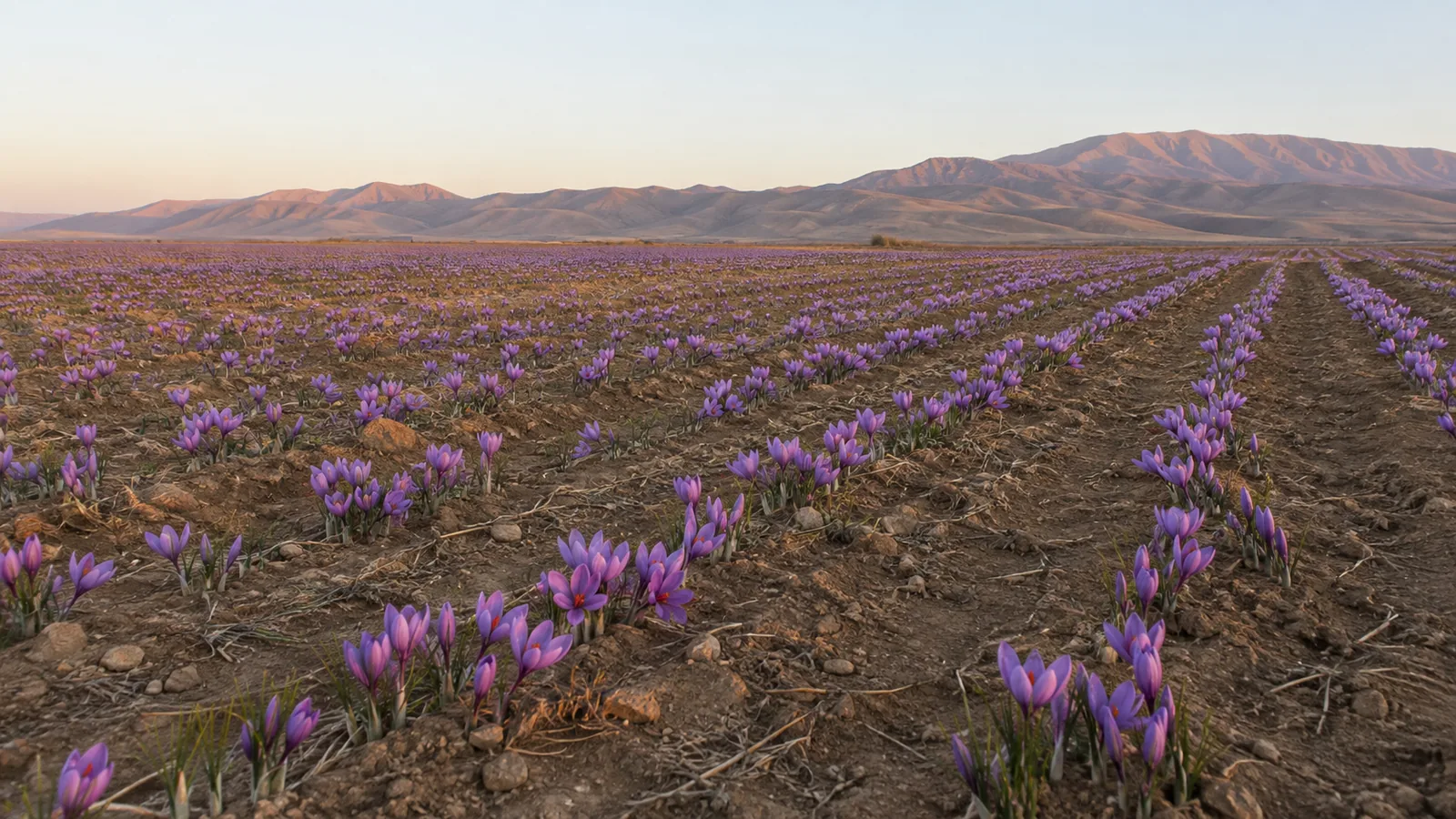
Production is concentrated in the east and northeast, especially Khorasan Razavi and South Khorasan. Names such as Torbat Heydarieh, Gonabad and Qaen appear frequently in the Iranian saffron economy, although cultivation also occurs in other provinces.
The FAO’s page on the qanat-based saffron farming system in Gonabad describes an arid and semi-arid setting where traditional underground water channels support farming under severe water constraints. It is a useful example of how cultivation, local knowledge and water management have developed together.
Why Iran leads world saffron production
Climate suited to the crop
Saffron crocus follows a seasonal rhythm that suits many Iranian growing areas: dry conditions through much of the year, followed by autumn flowering. Climate alone does not guarantee a harvest, but suitable temperature, soil and irrigation conditions make large established production possible.
Concentrated cultivation knowledge
Saffron work is highly time-sensitive. Flowers must be gathered around their short flowering period, and the stigmas then need careful separation and drying. In major Iranian districts, those skills sit within farming communities, specialist businesses and processing networks rather than being learned from scratch for a small experimental crop.
Scale across the value chain
The advantage is not only planted land. Growers, seasonal labour, drying and grading facilities, traders, laboratories and exporters all form part of the system. This scale helps explain why another country can produce excellent saffron without approaching Iran’s total volume.
What are the other saffron producing countries?
Saffron is also cultivated commercially in India, particularly Kashmir; Afghanistan, especially Herat; Greece; Morocco; and Spain. Smaller or developing production exists elsewhere. These origins have distinct traditions and protected regional identities, but their combined output remains well below Iran’s estimated share.
It is better to call them significant producers than to publish a rigid second-to-sixth ranking without comparable harvest-year data. A list copied from an older article can quickly become misleading: acreage changes, weather affects yield, and different sources may count dried stigmas, marketable output or exports in different ways.
India and Kashmir
Kashmiri saffron has a strong regional identity and is grown on a much smaller area than the Iranian crop. Its reputation or market price should not be confused with national production volume.
Afghanistan
Afghanistan has developed saffron farming particularly around Herat. It is an important origin in regional development and trade discussions, but it does not approach Iran’s share of world production.
Greece, Morocco and Spain
All three have recognised saffron-growing regions and long local traditions. Spain, in particular, is prominent in international packaging, branding and trade. That prominence creates a common source of confusion: the country shipping saffron is not necessarily the country that grew all of it.
Production and exports are not the same ranking
A production table asks where the flowers were grown and harvested. An export table asks which country declared the cross-border shipment. Imported saffron can be sorted, packaged and exported again, so the two tables can give very different leaders.
For example, the World Bank’s WITS presentation of UN Comtrade data lists Spain as the top reported saffron exporter by value in 2024. That 2024 gross-export table for HS 091020 does not establish Spain as the largest grower. It measures declared trade, and its own note says the figures are gross exports.
Reporting gaps matter as well. If a producer does not supply a complete record for the selected year, it may be absent or understated in a global trade view. For that reason, an export ranking should never be silently relabelled “top saffron producing countries.”
Does producing the most mean producing the best?
No. Iran’s scale and deep cultivation experience can support excellent saffron, but country name alone is not a laboratory result or a quality grade. Quality varies within every origin according to cultivar material, harvest timing, separation of stigma and style, drying, storage, cleanliness and authenticity.
Colour strength, aroma and bitterness are useful sensory attributes, while documentation, traceability and recognised testing provide stronger evidence for a commercial lot. A smaller producer may offer an outstanding batch, and a famous origin can still be poorly handled or falsely labelled.
How to read changing production claims
When an article says one country supplies a certain percentage of the world’s saffron, check four things:
- The date: a harvest estimate should name its season or publication year.
- The metric: production volume, cultivated area, exports by weight and exports by value answer different questions.
- The source: an official agricultural body or intergovernmental source is preferable to an unattributed market graphic.
- The coverage: incomplete country reporting can make an apparently exact global ranking less complete than it looks.
Our broader saffron production statistics page explains the main datasets and their limitations. The companion analysis of Iran’s 90–94% saffron-production claims tracks why different published estimates should not be treated as interchangeable.
Based on the newest explicit FAO estimate available in this review, the answer remains Iran, at roughly 85–90% of world saffron production. India, Afghanistan, Greece, Morocco and Spain are important producing countries, but export visibility or regional prestige does not overturn the production lead.