


Where is more than 90% of the world’s saffron produced? The two historical Iranian reports on this page answer Iran, placing its share at roughly 90% to 94%. Those percentages were estimates from an agricultural ministry adviser and Professor Kouchaki of Ferdowsi University. Neither report supplies a crop year, a worldwide production table, or a calculation method, so the range should not be presented as a current audited market share.
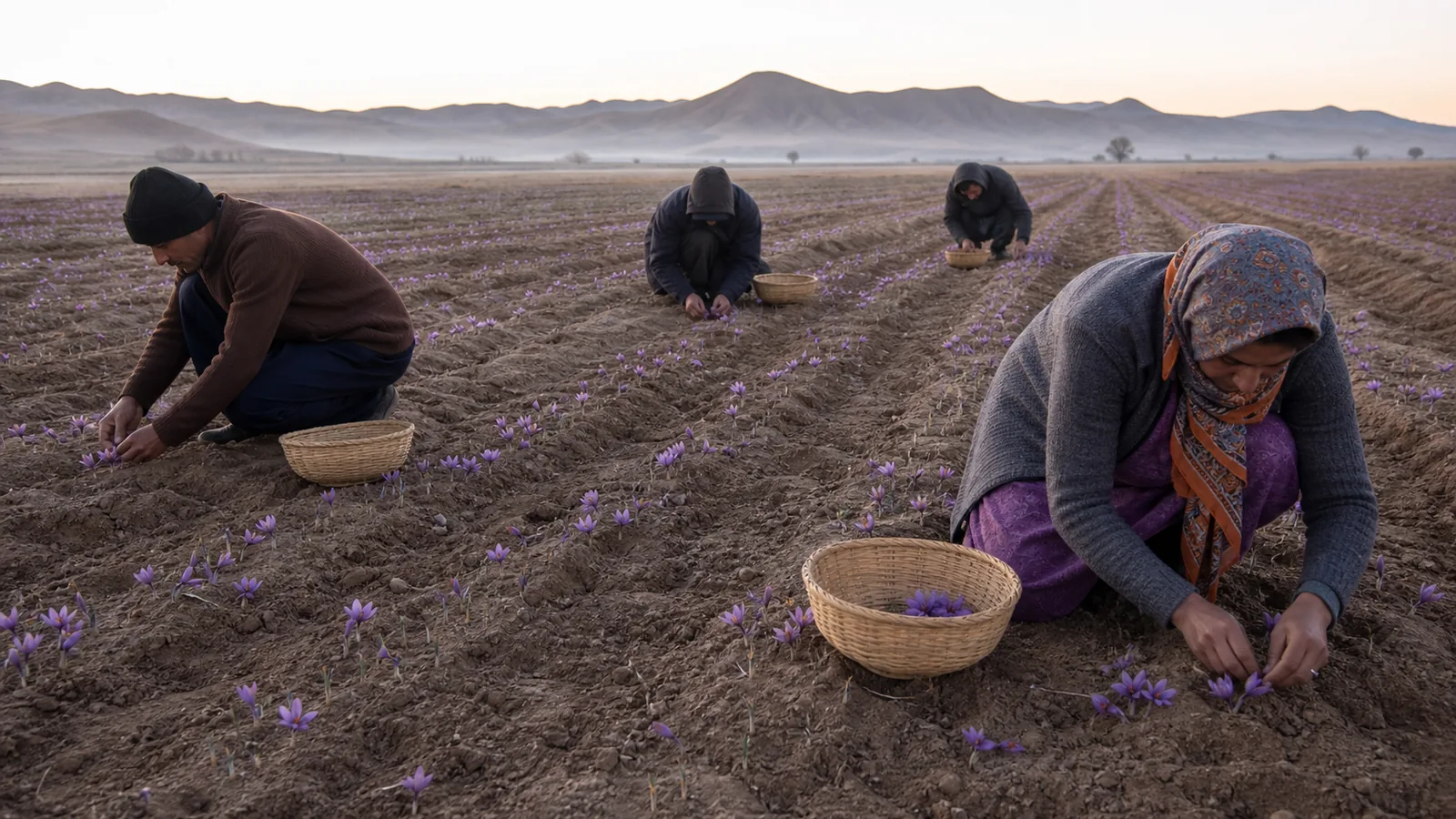
The old headlines say that production “belongs to” Iran. A clearer description is that Iran was estimated to produce the large majority of the world’s saffron. Producing the crop is not the same as capturing all of the value from grading, packaging, branding, distribution, and retail.
Why the reports say 90% and 94%
At the fifth National Red Gold Festival, an adviser to Iran’s agriculture minister put the country’s share at 90%. In a separate account, Professor Kouchaki placed it at 94%. The difference may reflect rounding, different years, or different source estimates, but the reports do not provide enough data to choose among those explanations.
Both figures should therefore be retained as attributed historical estimates. They support the broad conclusion that Iran was the dominant producer in the reporting period, not the claim that one precise percentage applies unchanged today.
This distinction also protects the query for which the page has appeared in search—“where is 90% of saffron produced”—without turning the query wording into an unsupported current statistic.
Average yield was reported at 3.5 kg per hectare
The ministry adviser reported an average yield of 3.5 kilograms per hectare and described 7 kg/ha as a goal in the comprehensive saffron plan. The second number was a target, not a measured national result.
Doubling an average requires more than setting a target. The reports provide no baseline distribution by field age, irrigation, corm size, climate, grade, or province, and no later measurement showing that 7 kg/ha was achieved. A high-performing field also cannot be treated as the national average.
Kouchaki’s remarks reinforce that caution. He said cultivated area had expanded while yield had not improved at the same pace. One translated sentence claims 40,000 hectares were added every year for ten years, but that is incompatible with the same article’s 130,000-hectare projection. The 40,000 figure may refer to total growth over the decade; the original-language record is needed before using it.
The 130,000-hectare and 598-tonne targets
Kouchaki described a forward plan in which saffron would be cultivated in 21 provinces, area would reach 130,000 hectares within a decade, and annual production would reach 598 tonnes. He argued that the production target was unlikely under the yield trend he was observing.
The relationship between the two targets is useful. Producing 598 tonnes from 130,000 hectares would require an average near 4.6 kg/ha if all reported hectares were productive. That is above the 3.5 kg/ha average in the other report but below its 7 kg/ha aspiration.
These were planning figures with an unspecified starting year in the translated article. They are not evidence that the area or production target has since been reached.
The historical value estimates need context
Kouchaki estimated global saffron sales at about US$1 billion and Iran’s portion at about US$500 million. The article also says saffron represented 5% of “world trade,” but it never identifies the category. It cannot plausibly mean 5% of all global commerce, so that percentage is not repeated as a fact without the missing denominator.
The ministry adviser focused on a different gap: Iranian saffron was often sold in bulk, then processed, packaged, branded, and resold elsewhere at higher prices. He argued that too little of the resulting added value reached Iranian growers and exporters.
The reports do not provide shipment records, price levels, margins, or a method for the US-dollar estimates. The figures are best read as historical industry estimates illustrating the difference between production dominance and value capture. The site’s account of saffron price volatility and export conditions gives additional examples of why farm supply, wholesale price, and export value should not be collapsed into one number.
Farms, producers, jobs, and labor
Kouchaki reported about 148,000 saffron farms in Khorasan, 160,000 producers, and 77,000 jobs associated with the crop. The article does not define whether “jobs” means full-time equivalents, seasonal positions, or another measure, so the three counts should not be added or compared as if they described the same unit.
He also estimated annual labor demand at 220 person-days per hectare, allocated approximately as follows:
- 10% for planting, about 22 person-days;
- 25% for field maintenance, about 55 person-days; and
- 64% for harvest and flower separation, about 141 person-days.
The percentages total 99%, which is consistent with rounding. The figures are attributed planning estimates, not a staffing requirement for every farm. Mechanization, field layout, yield, flower density, and how family labor is counted can change the actual total.
Technology, planting time, and climate pressure
Kouchaki argued that saffron technology had advanced too slowly and expected greater use of smart tools as a younger generation became less willing to perform intensive manual field work. This was a forecast, not evidence that a particular technology had already solved the labor constraint.
He also noted a shift in some planting from September to June. The observation is retained as evidence that practice was changing, not as universal planting advice. Suitable timing depends on local climate, corm condition, soil preparation, irrigation access, and extension guidance.
Finally, he identified climate change and altered flowering time as growing problems. The source gives no temperature series or phenology data, so this article does not assign a quantified national yield loss. It preserves the issue as an expert concern that a current production assessment should test with regional evidence.
What Iran’s production dominance does—and does not—show
The combined record supports a careful conclusion. Iran was described as producing roughly nine-tenths or more of world saffron, with extensive farm participation, high seasonal labor demand, and ambitious area and yield plans. At the same time, the speakers identified stagnant yield, weak value capture, slow technology adoption, and climate pressure.
A current version of the global-share figure would need the same crop year for Iran and every other producer, a consistent definition of dried saffron production, and a transparent source. Until that exists, 90%–94% remains a useful historical estimate—not a timeless exact percentage.

![Exporting Saffron to Turkey + Price Guide [Complete 0 to 100]](https://img.rowhanisaffron.com/20260827003933/saffron-export-turkey-quality-inspection.webp)



