


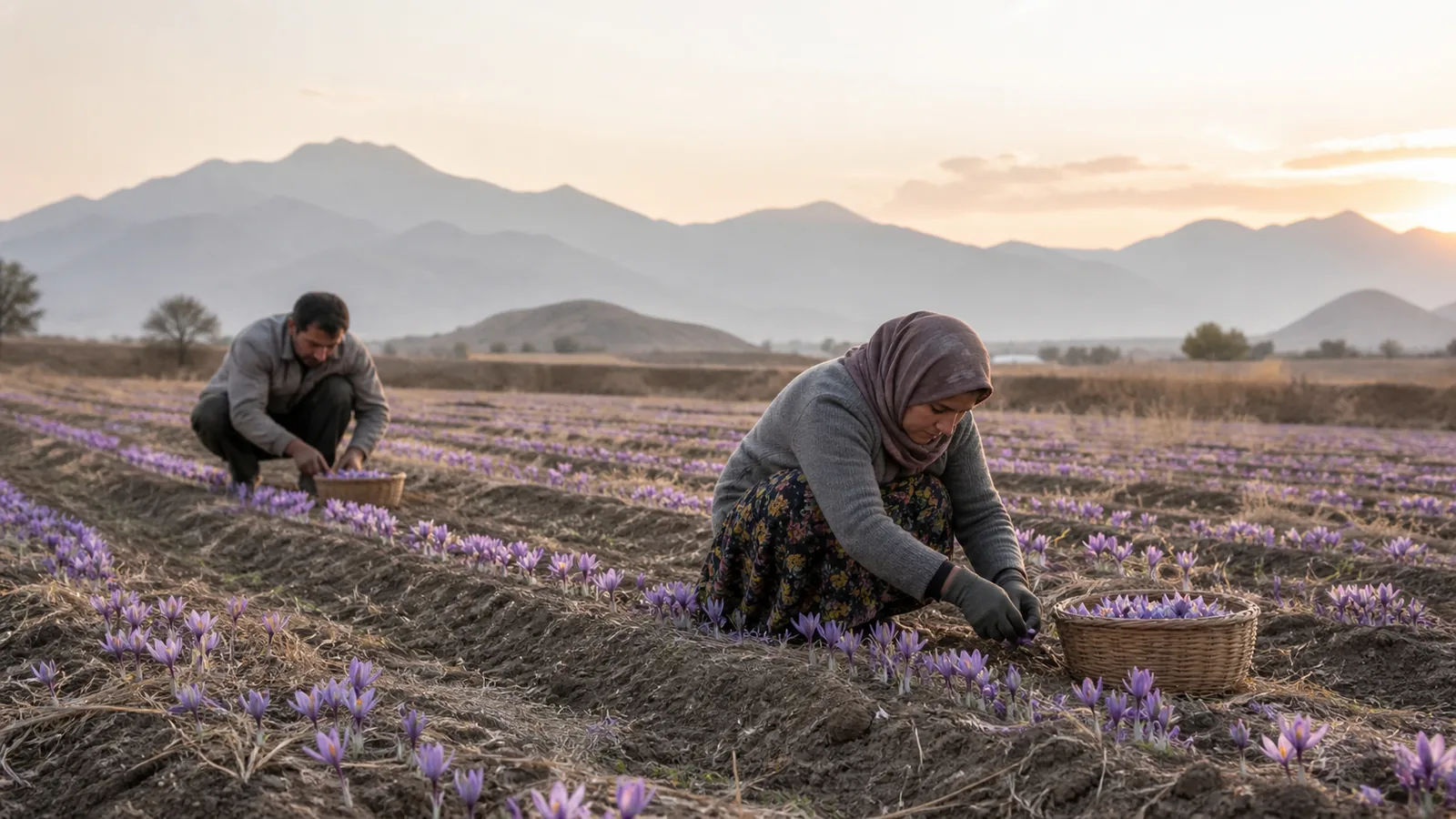
Saffron harvest began on 65 hectares of farms in Marand city after the planted area reportedly grew by 30% in one crop year. The local forecast was more than 180 kilograms of dried saffron. Reports from the same period in Neyriz and Neishabour describe very different scales, yields and support programmes, making them useful comparisons rather than interchangeable statistics.
All figures below come from historical local agricultural announcements. Forecasts are identified as forecasts, and claims that were not accompanied by final harvest records, test reports or cost data remain attributed to the officials who made them.
The Marand saffron harvest forecast
Ali Rokhafrooz, identified in the report as director of Marand’s Agricultural Jihad office, said the city’s saffron area had reached 65 hectares, 30% more than in the previous crop year. He forecast a harvest of more than 180 kilograms.
Dividing 180 kilograms by 65 hectares gives about 2.77 kilograms per hectare. Because the announcement said “more than” 180 kilograms, this is a minimum implied average rather than a final measured yield. The report did not separate mature plots from newly planted fields, which can make a district-wide average difficult to interpret.
For Marand’s climate, the official advised planting from late September to early October. He said flower production begins in the first year and increases as a field matures. His reported expectation of six to ten kilograms per hectare in years five to twelve should be treated as a local agronomic target, not a guaranteed range for every field or a universal recommendation to keep a planting for twelve years.
What determines yield beyond planted area
A hectare total is only the first part of a harvest report. Field age, corm size and health, planting density, drainage, irrigation timing, frost, weed pressure, flower-picking speed and drying all influence the final dry weight. A district adding young fields can increase its cultivated area while its average yield temporarily falls.
The older Marand article called saffron a perennial crop with modest demands on water and soil fertility. Saffron does return for multiple seasons from underground corms, but “low demand” must not be read as “no management.” Waterlogged soil, unhealthy planting material or poorly timed field work can undermine a crop even in a suitable climate.
Harvest in Neyriz, Fars Province
Neyriz reported a slightly larger planted area than Marand: 75 hectares. Alireza Basiri, the local Agricultural Jihad director named in the source, forecast 450 kilograms of saffron, 10% more than the previous year. The stated forecast equals six kilograms per hectare.
The Neyriz harvest reportedly began on November 7 and was expected to continue for about 45 days. Most production was associated with the Poshtkuh area, particularly Meshkan and Dehchah. These calendar details illustrate how flowering and harvest timing can differ between districts; Marand’s report discussed its planting window, while Neyriz’s focused on the later flower-picking season.
Basiri also said the harvest period would create more than 6,000 temporary work opportunities. The report did not define whether that number represented individual workers, workdays or repeated short engagements. It should therefore be understood as an attributed estimate of seasonal labor activity, not 6,000 permanent jobs.
The Neyriz quality-mark claim
The source reported that Neyriz’s first license to use a “Persian saffron pollutant-limit” mark was issued to Ahmad Khosropour’s five-hectare model farm. It did not name the certifying body, list the tested contaminants, give laboratory results or specify the applicable limits.
That omission matters. The historical license can be recorded, but it should not be presented as proof of compliance with every current food-safety or saffron-quality standard. Codex CXS 351-2022, amended in 2025, and ISO 3632-1:2025 define particular requirements and test frameworks; an unnamed local mark cannot automatically be treated as equivalent.
Neishabour’s 7,600 kg forecast
Neishabour in Khorasan Razavi operated at a much larger scale. Director Ali Dehbashian reported 2,460 hectares under saffron: 1,900 hectares described as fertile or productive and 560 hectares of young, not-yet-productive fields. Applying his expected average of four kilograms per hectare to the 1,900 productive hectares produces the stated forecast of 7,600 kilograms.
This arithmetic is internally consistent, and it also explains why the full 2,460-hectare figure should not be used as the forecast denominator. On the full area, the apparent yield would be about 3.09 kilograms per hectare, but that would mix producing and immature fields.
Dehbashian attributed more than 94% of Iran’s saffron production at the time to Khorasan Razavi and South Khorasan. He argued that selling much of the crop in bulk limited the income retained by producers. Both are historical statements from the announcement, not current national-market figures.
Frost response on 1,600 hectares
The Neishabour report described a free “saffron rescue plan” across 1,600 hectares after damaging cold. It said fields were sprayed with a product translated as Delfard fertilizer to strengthen the corms after frost injury. The translated article labels the frost year as “1986,” but its chronology is unclear and may reflect a calendar-conversion error. No Gregorian year is assigned here.
The announcement did not provide a product specification, treatment protocol, control fields or measured recovery result. For that reason, the programme is preserved as a historical intervention, not recommended as proven frost treatment.
Why Neishabour warned against uncontrolled expansion
Despite the crop’s value, Dehbashian warned growers not to expand onto unsuitable land simply because prices had risen. He said saffron area had increased by about 30% as prices encouraged planting, sometimes without enough attention to suitability.
This warning connects all three districts. Marand’s 30% expansion, Neyriz’s year-on-year production forecast and Neishabour’s large productive base may sound like straightforward growth. In practice, added hectares only create value when the soil, climate, planting material, labor and route to market support a saleable crop.
Comparing Marand, Neyriz and Neishabour carefully
- Marand: 65 hectares, more than 180 kg forecast, and about 2.77 kg/ha as the minimum implied average.
- Neyriz: 75 hectares, 450 kg forecast, six kg/ha implied average and a 45-day harvest window.
- Neishabour: 1,900 productive hectares within 2,460 hectares planted, with a 7,600 kg forecast at four kg/ha.
These are not a league table. The announcements cover different districts, field ages and reporting periods. Marand and Neyriz gave district forecasts; Neishabour explicitly separated productive from young fields. Final dried weight, tested quality and farm-gate price would be needed for a sound economic comparison.
What a complete harvest report should include
A stronger follow-up would record final dry saffron weight, productive and immature hectares, flower-to-dry-stigma conversion, labor days, weather losses, corm and irrigation costs, laboratory grade and contaminant results, and the price growers actually received. It would also distinguish a certification name from the standard and test report behind it.
The historical reports remain useful because they preserve scale, timing and local decisions. Marand’s established page continues to document its 65-hectare harvest, while the Neyriz and Neishabour material adds context: harvest growth needs seasonal labor, verifiable quality systems, suitable land and measured results—not hectares alone.

![Exporting Saffron to Turkey + Price Guide [Complete 0 to 100]](https://img.rowhanisaffron.com/20260827003933/saffron-export-turkey-quality-inspection.webp)



