


Sargol saffron production in Tabas was forecast to fall by 35% in the season covered by this local agricultural report. The estimate put the crop at about 1,000 kilograms from 340 hectares and linked the decline to drought, depleted water resources and rainfall that did not arrive when farms needed it.
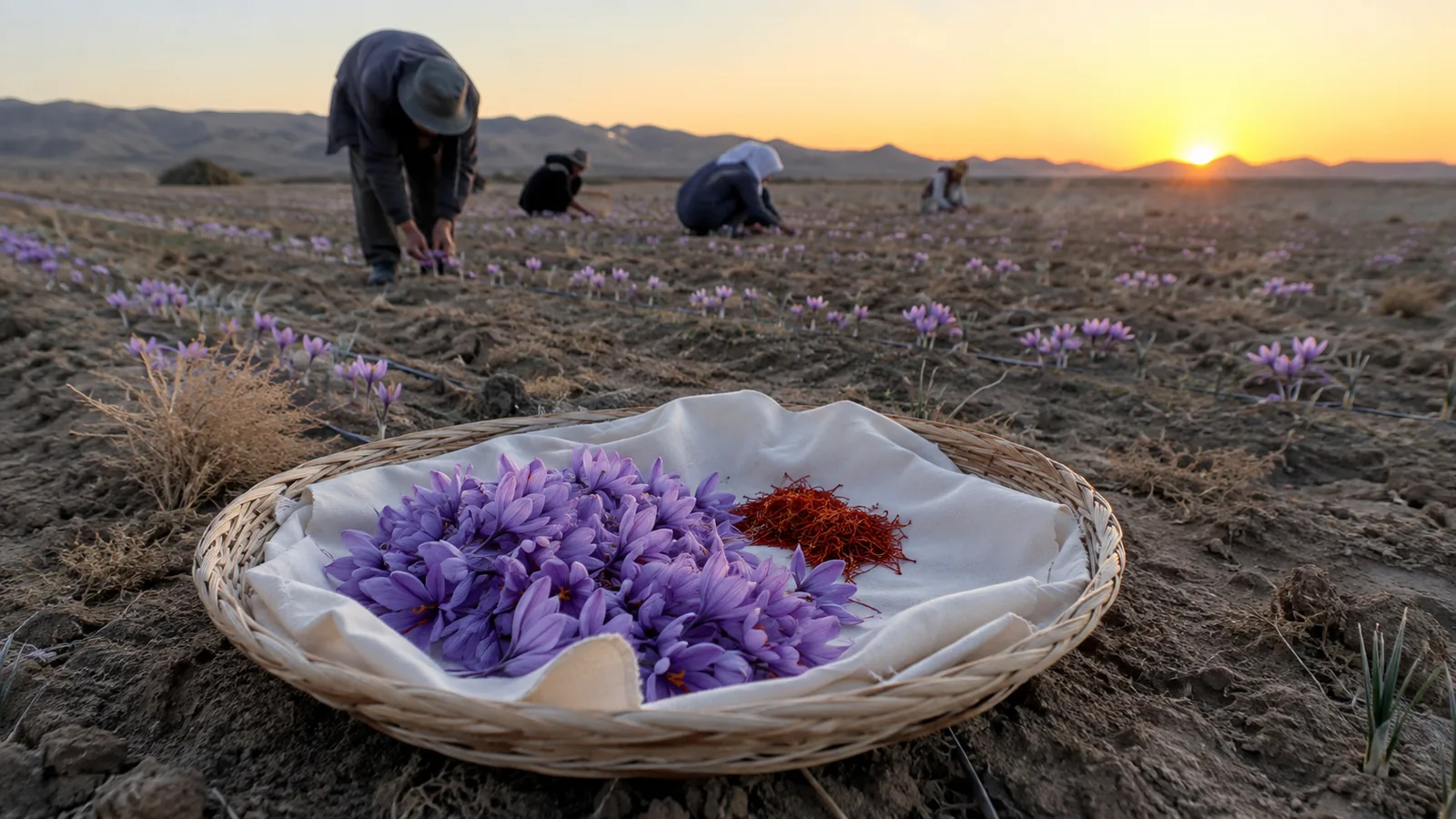
What the 35% reduction referred to
The figure was a year-on-year forecast given by Mohammad Asadi, identified in the original report as the director of Tabas Agricultural Jihad. It described one harvest season in Tabas, not a permanent trend for the county or a prediction for today’s crop.
The surviving English text labels the season as “1985,” but that date does not fit the context and appears to be a damaged calendar conversion or translation. Because the original Persian date is not preserved on this page, assigning a replacement year would create false precision. The reliable parts of the report are the stated 35% decrease, 340 hectares and forecast of roughly one tonne of Sargol saffron.
Why Sargol was named in the forecast
Sargol is the all-red grade produced after the yellow style and other flower material have been separated from the red stigmas. In a harvest report, “Sargol production” therefore refers to the finished dried saffron expected after picking, separation and drying, rather than the much heavier weight of fresh purple flowers.
A lower finished yield can reflect fewer flowers, smaller stigmas or losses during handling. The brief report attributes the main reduction to growing conditions, particularly sustained drought and a severe decline in available water.
Water stress behind the Tabas harvest
Tabas lies within South Khorasan’s dry production landscape. Saffron is often described as suitable for water-scarce areas, but that does not mean it can produce normally without well-timed moisture. The corm’s condition, the timing of irrigation and seasonal rainfall can all influence flowering and the following year’s growth.
The Food and Agriculture Organization’s account of Iran’s qanat-based saffron system explains why reliable water remains important even for a crop adapted to an arid climate. Research catalogued by FAO’s AGRIS database also found a relationship between drought indicators and saffron yield in several South Khorasan locations.
According to Asadi, local conditions combined continuing drought, falling water resources and a lack of timely rain. Mobile tankers began supplying some water from the second half of December to compensate for part of the shortage. That was an emergency response described in the historical report, not a general irrigation recommendation for growers.
Why the timing of water matters
Saffron has a seasonal cycle. Flowering normally comes in autumn, while leaves continue supporting the corm after the flowers have gone. Moisture at the wrong time cannot always make up for stress during a more sensitive stage.
A South Khorasan drought study indexed by AGRIS examined 25 years of weather and yield data. Its results showed that the relationship varied by location and by the months in which drought occurred. That helps explain why a county-wide shortage can affect districts differently rather than producing one uniform result.
Different harvest conditions across Tabas
Asadi noted that Tabas covers a broad area with varied climatic conditions, so saffron did not ripen everywhere at the same time. Dastgerdan and Dehuk were identified as the districts with the county’s largest cultivated areas in that report.
The harvest window ran from the second half of November to the second half of December. That range should be read as a local seasonal account. Field altitude, temperature, planting age and irrigation can shift flowering even within the same county.
Training intended to protect yield and quality
The local agricultural office had held seven training and extension classes covering planting, crop care, harvesting and processing. These stages are connected: poor corm selection or field management can limit flower production, while slow separation and uncontrolled drying can reduce the quality of saffron that has already been harvested.
Training cannot replace water, but it can help growers use the available crop more carefully. Clean picking containers, quick separation of the stigmas, controlled drying and dry storage protect the finished Sargol from contamination, moisture and unnecessary handling loss.
How to interpret the one-tonne estimate
Dividing the stated 1,000 kilograms by 340 hectares gives a simple average just under three kilograms per hectare. That calculation is only a broad indicator. Fields of different ages and conditions do not contribute equally, and the report does not say whether every hectare was fully productive.
The 35% figure is more useful as evidence of a difficult season than as a benchmark for current Tabas farms. Another Rowhani Saffron report records a later Tabas forecast of 1,372 kilograms of dry saffron. The totals should not be treated as a direct trend unless the crop year, planted area and reporting method are compared on the same basis.
What remains important in the Tabas report
The lasting point is not that Tabas always produces 35% less saffron. It is that a low-water crop can still lose substantial yield when drought persists and water arrives too late. The report also shows why local detail matters: cultivated area, harvest timing and water pressure differed across the county.
For buyers, the harvest estimate provides regional context rather than a quality verdict. Sargol should still be assessed by its aroma, colour, cleanliness, dryness, traceability and testing. A smaller crop can affect availability, but the percentage decline alone does not determine the quality of the saffron in a particular package.

![Exporting Saffron to Turkey + Price Guide [Complete 0 to 100]](https://img.rowhanisaffron.com/20260827003933/saffron-export-turkey-quality-inspection.webp)



