


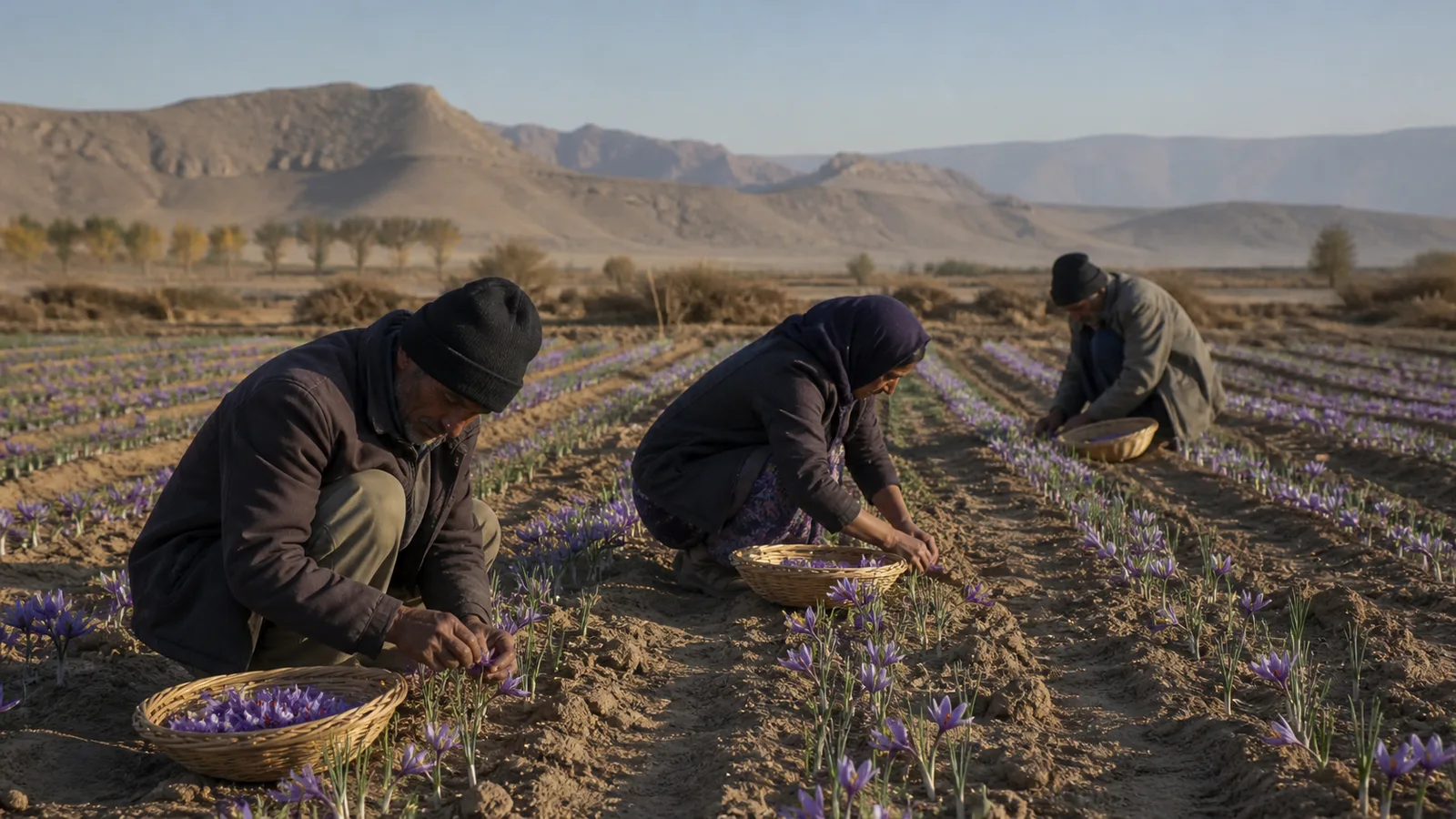
A historical agricultural report forecast 1,372 kilograms of dry saffron from Tabas fields covering 404 hectares. Harvest was expected to begin in the second half of November and continue through late December, with timing varying across the large and climatically diverse county. A second report described a much smaller 1.5-hectare planting near Jahrom, where growers expected about eight kilograms.
The figures are local forecasts, not current production totals or guaranteed yields. Read together, they show two different stages of saffron farming: an established South Khorasan area receiving training, inputs, and recovery finance, and a small Fars Province planting testing the crop around Khafr.
The Tabas dry-saffron forecast
Davood Bakhshi, identified in the destination as the director of the local Agricultural Jihad office, put Tabas saffron area at 404 hectares. He expected almost 1.372 tonnes of dried saffron from those fields during the reported season.
If the entire 404 hectares were productive, the forecast implies an average of about 3.4 kilograms per hectare. That is arithmetic from the reported totals, not a measured yield for every farm. Field age, stand density, corm health, water, and microclimate can produce wide differences within the county.
The original headline and existing URL are centered on “1,372 kg dry saffron from Tabas fields.” That meaning remains intact because it is the clearest answer the historical report provides.
Harvest timing varied across Tabas
Bakhshi said harvesting would start in the second half of November and continue to the end of December. The long window reflects the size and climate variation of Tabas County rather than one field flowering continuously for six weeks.
The machine-translated article names the leading cultivation areas as “Dunteran” and “Dijuk.” These appear likely to be Dastgerdan and Deyhuk, known administrative areas associated with Tabas, but the stored English copy is not enough to guarantee the correction. The locations are therefore preserved with that uncertainty disclosed.
At farm level, flowers still need prompt picking and processing once they open. A county-wide calendar cannot replace daily observation of each plot.
Repeated drought shaped the forecast
The destination linked the 1,372-kilogram estimate to consecutive drought years. It does not provide rainfall, irrigation, temperature, or a prior-year harvest, so it cannot quantify how much production drought had removed.
A forecast made before harvest is vulnerable to late weather, uneven flowering, labor availability, and drying losses. The final dried weight may differ even when the field area remains unchanged.
This is why the 3.4 kg/ha implied figure should be treated as a planning estimate. It is not a permanent productivity rating for Tabas.
Training covered planting, crop health, and processing
The local agricultural office reported two training classes for saffron growers. Subjects included correct planting principles, recognition of pests and diseases, and hygienic handling and processing after harvest.
Those topics belong together. Weak or infected corms can compromise a field before flowering, while poor separation or drying can reduce the quality of a crop that was healthy in the ground. Training is most useful when it connects field records to a tested final product.
The article does not give attendance, course duration, or measured outcomes. It supports the existence and subject of the classes, not a claim that training had already raised yield or quality.
Farm services and inputs need careful interpretation
Reported support included expert advice, farm inputs, and purchase of a cultivator for rehabilitation work in saffron fields. The translated copy also lists pesticides under the literal word “poisons.” No product, target pest, application rate, or safety direction is provided, so it should not be read as pesticide advice.
For 12 hectares, the report recorded 112 kilograms of a fertilizer whose name is rendered as “Suluptas” and 60 liters of humic acid. The first product cannot be identified confidently from the English copy, and neither amount establishes an appropriate dose for another field.
Inputs should answer a diagnosed need and follow a valid local label or agronomic recommendation. More product is not automatically better, and a historical distribution program is not a universal recipe.
Recovery finance after field damage
The article said 39,525 million rials—39.525 billion rials—had been allocated as low-interest, long-term facilities for 1,152 saffron growers after damage to the county’s fields. A garbled phrase appears to associate the damage with 348 hectares.
More than 20% of the credit had reportedly been taken up at the time of the report. Allocation and absorption are different: the larger number describes the facility made available, while the smaller share indicates what growers had actually accessed so far.
The stored text does not show individual loan amounts, eligibility rules, repayment terms, or final disbursement. Those details should not be reconstructed from the aggregate.
The smaller Jahrom harvest
Mohammad Reza Shahabi, then described as Jahrom’s agricultural director, announced the start of saffron harvesting on 1.5 hectares. Most of the reported area was around Khafr, and approximately eight kilograms of saffron were expected for market.
If all 1.5 hectares contributed, that forecast implies about 5.3 kilograms per hectare. The figure is higher than the Tabas average forecast, but comparing two single-season estimates does not prove that Jahrom is inherently more productive. Plot age, growing conditions, measurement scope, and forecast method may differ.
The Jahrom source says corms were planted from late September and harvest began in mid-November as flowering started. It also says the local climate supported pistachio and nursery-flower production, without supplying measurements that connect those crops to saffron performance.
Two locations, two kinds of evidence
Tabas supplied a county-scale area and output forecast, together with public support measures. Jahrom supplied a small-area expansion report with a planting date, expected yield, and local concentration around Khafr.
Neither report gives a completed, independently verified harvest. Their implied yields are useful for checking scale, but not for choosing a farm location or promising a commercial result.
For broader context on how saffron cultivation has moved into new Iranian regions while remaining concentrated in the Khorasan provinces, see our guide to the expansion of saffron cultivation in Iran.
What a reliable harvest report should include
A strong harvest record separates planted area from productive area and forecast weight from final dried weight. It also identifies field age, irrigation, flower weight, drying method, quality grade, and the date measurements were taken.
The Tabas and Jahrom articles preserve useful local history, but their limitations matter. The defensible conclusion is that Tabas expected 1,372 kilograms across 404 hectares and Jahrom expected eight kilograms across 1.5 hectares—not that every hectare in either location would perform at the calculated average.

![Exporting Saffron to Turkey + Price Guide [Complete 0 to 100]](https://img.rowhanisaffron.com/20260827003933/saffron-export-turkey-quality-inspection.webp)



