


The statement that 80% of the world’s saffron is produced in Iran was an estimate from an earlier report. It captured Iran’s dominant role at the time, but a world-production share changes as harvests rise and fall in every producing country.
What the 80% figure meant
The original article quoted Dr Kafi, a University of Tehran horticulture professor, discussing Iranian saffron production, quality and exports. His central concern was that Iran produced most of the world’s saffron but did not receive the full commercial recognition that such a large share might suggest.
The 80% headline should be understood as a dated estimate, not a permanent statistic. A later Food and Agriculture Organization profile of Gonabad’s saffron system describes Iran as the world’s largest producer and gives a share above 90%. Different years and methods can yield different percentages, so the source and crop year always matter.
Production leadership did not guarantee market recognition
Dr Kafi argued that weak direct marketing in foreign markets allowed the origin of Iranian saffron to become less visible. When saffron leaves the producing country in bulk, another business may grade, package or market it before it reaches the final customer.
His proposed direction was clear: export standardized saffron in hygienic packaging that identifies Iran as its origin. Packaging alone cannot create quality, but it can protect the product, improve traceability and help the grower’s country remain visible to buyers.
The drought-related production decline
The report said drought had reduced saffron output by roughly 35% to 40% over the preceding two years. That was a period-specific observation, not a current loss estimate.
Saffron is associated with arid and semi-arid regions, yet flowering and yield still depend on weather, healthy corms and correctly timed water. A crop’s relative tolerance of dry conditions does not remove the risk created by a prolonged drought.
Why traditional drying was identified as a problem
Fresh saffron stigmas must be dried after separation from the flowers. The stored English translation says the traditional process took “13 to 4 days”; the order is evidently damaged and is best read as a range of about four to thirteen days rather than thirteen down to four.
Dr Kafi warned that gradual drying could reduce colour quality and expose the stigmas to soil, dust or other contamination. The broader principle is supported by research: a peer-reviewed study indexed by PubMed found that drying temperature and airflow altered the retention and formation of saffron’s important aroma and colour compounds.
That does not mean one temperature is suitable for every farm or dryer. Process controls, layer depth, airflow, equipment hygiene and final moisture all need to be managed together.
The sieve-and-heater method described in the report
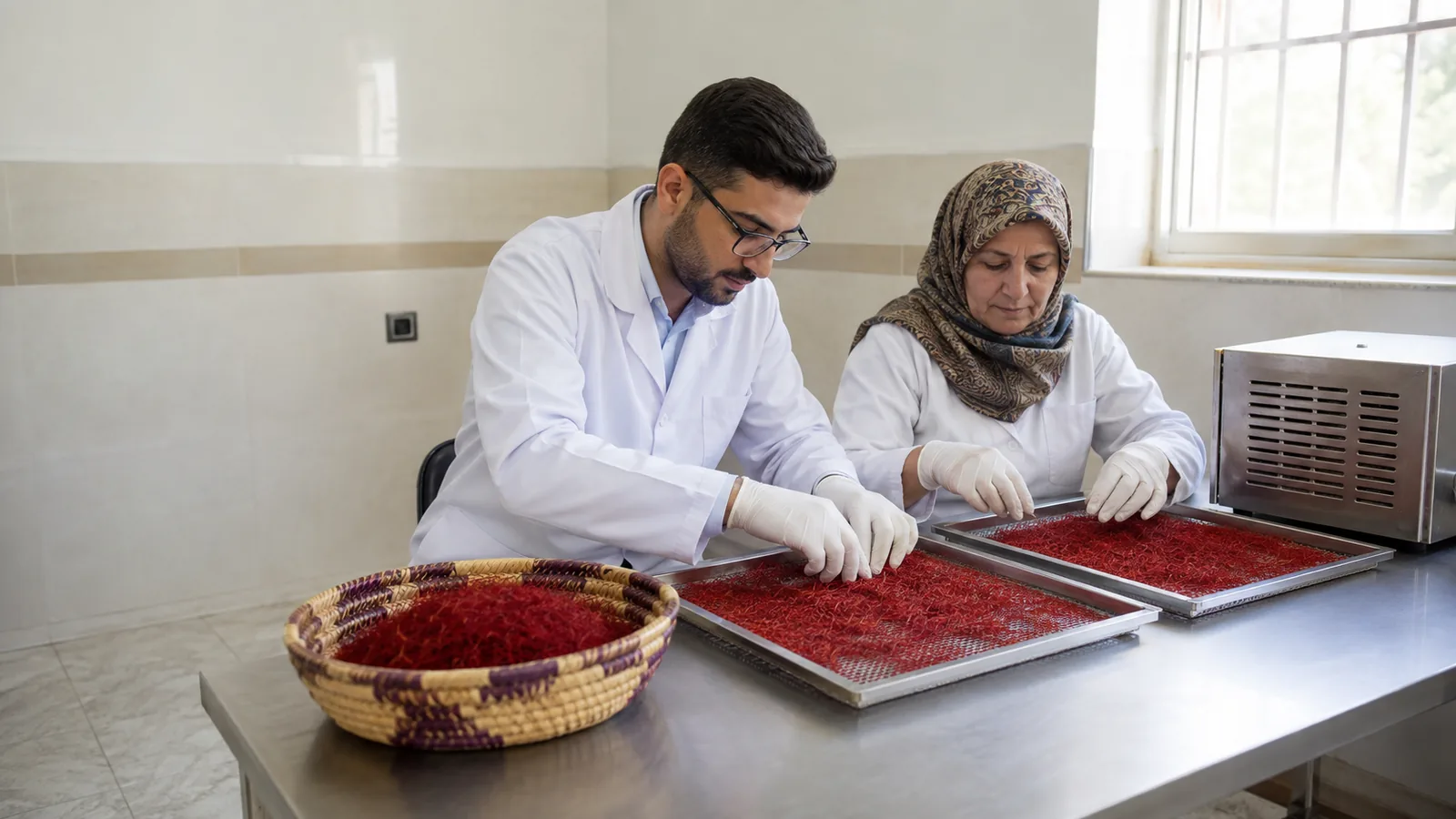
Dr Kafi described a simple setup using three sieves and an electric heater. Farmers placed the separated stigmas in the sieves and exposed them to controlled heat so that drying could be completed in hours instead of several days.
The report presented the method as a way to limit contamination and preserve quality. Safe use requires more detail than the short article provides: food-contact surfaces must be clean, the heat source must not add smoke or odours, and the saffron should be spread evenly rather than piled into a thick layer.
Quality control and farmer organization
The professor also referred to efforts by the Ministry of Agricultural Jihad to strengthen the Khorasan Saffron Farmers Union, which had faced financial difficulties. Stronger producer organizations can help growers share knowledge, coordinate processing and meet buyer requirements.
Another proposal was to increase the number of saffron quality-control laboratories. Laboratory testing can support grading and detect problems that cannot be judged reliably from colour alone. The report also anticipated greater use of standardized saffron in retail shops.
Marketing, advertising, packaging and sales
Dr Kafi grouped Iran’s obstacles under four practical headings: marketing, advertising, packaging and overseas sales. They are connected. A producer may grow excellent saffron, but inconsistent grading or weak traceability makes it harder for a distant buyer to assess what is being offered.
Good export preparation starts with the product itself: clean separation, controlled drying, suitable storage and evidence of quality. Clear origin information and professional packaging then help carry that value through the supply chain.
The USD 41 million and 100-ton metadata note
The page’s old meta description contains another historical statement: about 100 tons of saffron exports generated USD 41 million in foreign-exchange income annually. That sentence is not present in the surviving body copy, and the original year and customs table are not identified.
For that reason, the 100-ton and USD 41-million figures are preserved here as an archival metadata note, not presented as current verified trade data. A valid modern comparison would need the reporting year, shipment weight, value, destination set and product code.
How to read Iran’s share of world saffron production
The durable conclusion is that Iran was, and remains, the leading saffron-producing country. The exact share should always be tied to a source and year. On this page, 80% belongs to the historical headline; the FAO’s later estimate above 90% belongs to a different reporting context.
The rest of Dr Kafi’s message remains useful: production volume alone is not enough. Careful drying, quality testing, traceable packaging, farmer organization and direct market recognition determine how much of saffron’s value stays connected to its Iranian origin.

![Exporting Saffron to Turkey + Price Guide [Complete 0 to 100]](https://img.rowhanisaffron.com/20260827003933/saffron-export-turkey-quality-inspection.webp)



