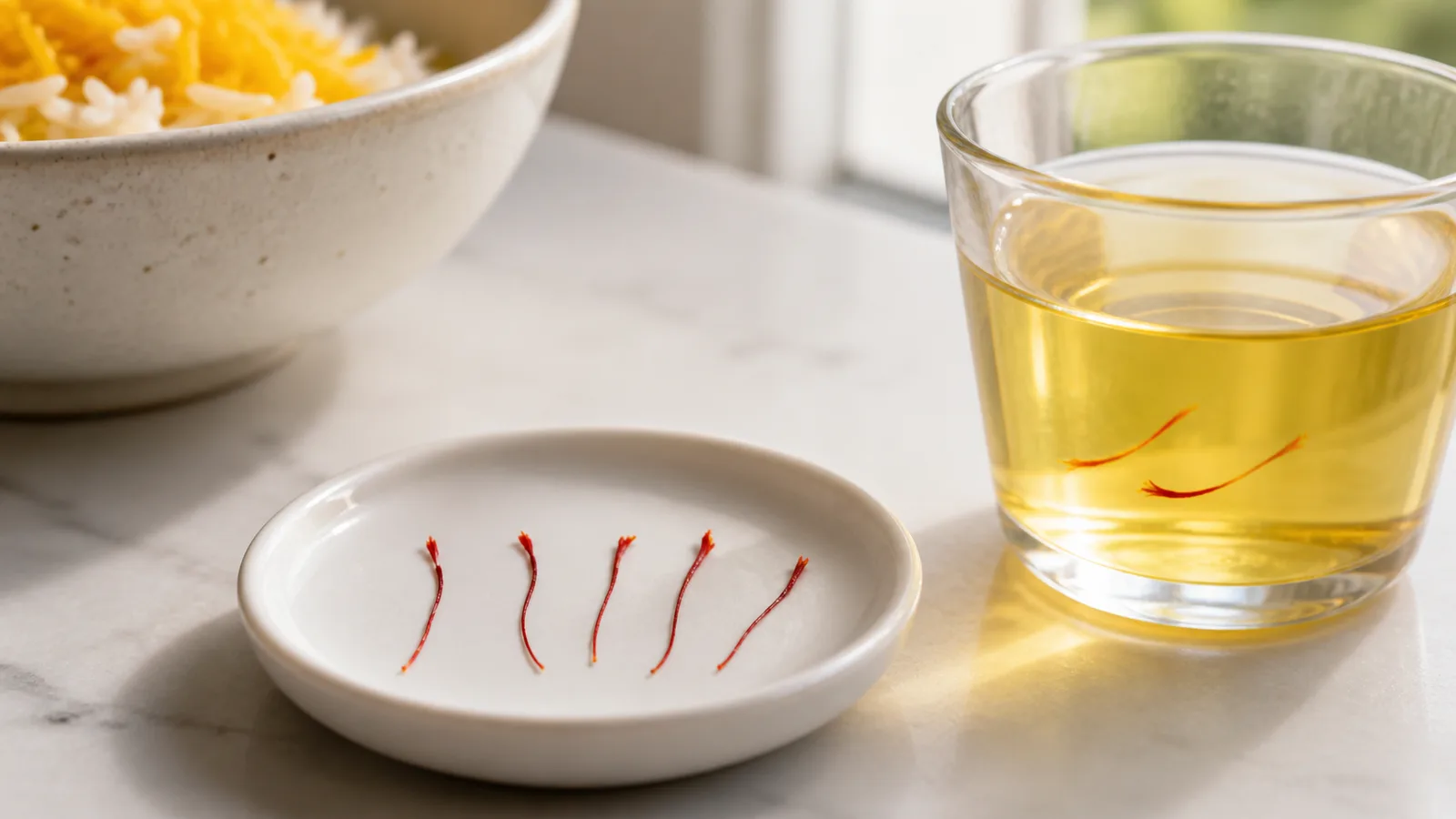
Which country has original saffron? The answer depends on what “original” means. Current genetic and historical evidence points to early domestication in ancient Greece, while Iran is the modern world leader in saffron production. Neither fact proves that every Greek or Iranian batch is automatically the best: authenticity and quality belong to the product in the pack.
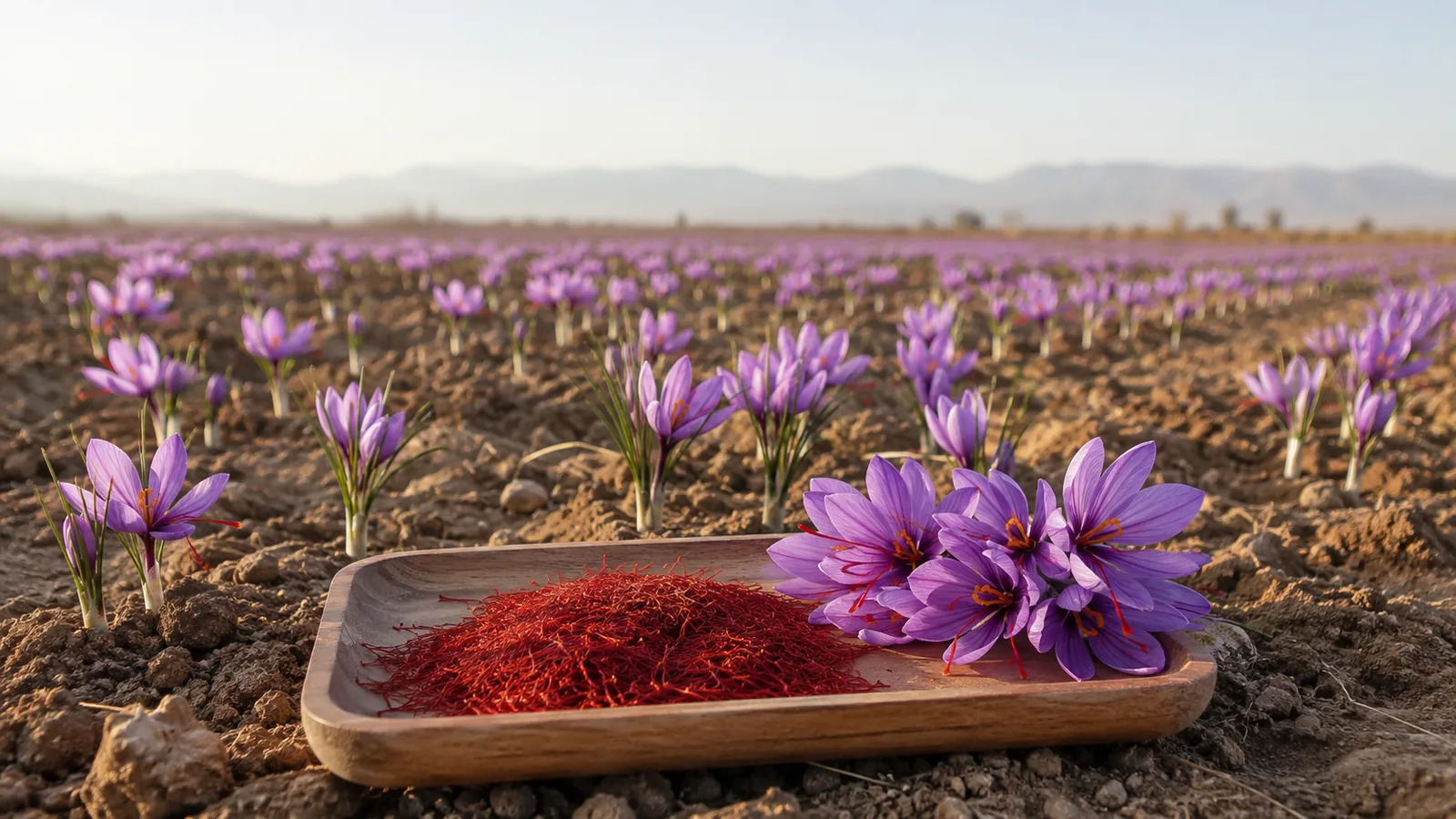
“Original saffron country” can mean three different things
People asking where saffron comes from often combine three separate questions:
- Where was the cultivated saffron crocus first domesticated?
- Which country produces the most saffron today?
- Which country has the best saffron to buy?
Those questions do not have one shared answer. Ancient origin is a matter for archaeology and plant genetics. Production leadership is measured by agricultural output. “Best” depends on a particular batch’s identity, processing, storage and intended use.
If your question is phrased as “original saffron from which country?” or simply “saffron from which country?”, this distinction matters. A label’s saffron country of origin tells you where that crop was grown; it does not, by itself, identify the first place the plant was domesticated or certify the contents.
Where did cultivated saffron originate?
Culinary saffron is made from the dried stigmas of Crocus sativus. The plant is sterile and has been maintained by people through its corms rather than spreading as an ordinary seed-grown crop. That long human history makes its first place of domestication difficult to reconstruct.
A 2022 peer-reviewed review in Frontiers in Plant Science brought together ancient artworks, cytogenetics and sequencing research. Its authors concluded that the evidence converges on early Greece, with Attica a likely region and Bronze Age Aegean cultivation depicted around 1700 BCE. They also described the long-standing debate rather than claiming that every historical question is settled.
Persia, Mesopotamia and other Mediterranean and western Asian cultures also have deep saffron histories. Iran’s centuries of cultivation are real and important, but a modern border should not be projected neatly onto a plant domestication story thousands of years old. Calling any present-day nation the only “original saffron country” hides that distinction.
Which country is the largest producer of saffron?
Iran is the largest producer of saffron in the world. In a 2025 value-chain report, the UN Food and Agriculture Organization described Iran as producing about 85–90% of the world’s saffron. The percentage should be attached to its source and period; production changes, and an estimate is not a permanent law.
Whether the wording is largest, biggest or highest producer of saffron, the current production answer is Iran. It is also where most saffron is grown by a wide margin, according to the FAO estimate.
Iran’s production is strongly associated with Khorasan Razavi and South Khorasan. Generations of growers have adapted cultivation, flower picking, stigma separation and drying to an arid and semi-arid environment. Each flower supplies three stigmas, so even a modest dried weight represents a large number of flowers and careful seasonal labour.
This scale is why Iran is often called the “land of saffron” and why Iranian saffron is prominent in global trade. Production leadership, however, should not be confused with a guarantee about every package. Re-exporting, blending and weak traceability can separate the country named by a seller from where a crop was actually grown.
Which other countries produce saffron?
Saffron growing countries include India, Spain, Greece, Afghanistan, Morocco and Italy, along with smaller or newer cultivation elsewhere. These saffron producing countries show where the crop is established outside Iran. Their crops share the same botanical species, but local conditions, harvest timing, stigma separation, drying and storage can produce differences between batches.
Kashmir saffron from India
Kashmir has a distinct saffron tradition and a legally registered geographical indication. The official Intellectual Property India record for Kashmir Saffron lists GI application 635 as registered for Jammu & Kashmir. That protection identifies a defined origin; it does not turn every loose packet using the word “Kashmir” into a verified GI product.
La Mancha saffron from Spain
Spain’s La Mancha saffron has a protected designation of origin. The current EU product specification for Azafrán de la Mancha defines it as threads obtained by roasting the stigmas of Crocus sativus and sets geographic, physical, chemical and labelling conditions. Spanish saffron is closely connected with dishes such as paella, yet cuisine does not establish a worldwide quality ranking.
Other established regions
Greece, Afghanistan, Morocco and Italy also have recognised saffron-growing areas. A study of authenticated samples from Greece, Iran, Italy and Spain found that combined stable-isotope data could distinguish those samples by geographic origin, although the authors said broader years and producer coverage were needed. That geographic-origin study illustrates both the possibility and the limits of provenance testing.
Which country produces the best saffron?
Where does the best saffron come from? There is no official league table that names a single best saffron country or declares one country’s saffron the best saffron in the world. Iran is the highest producer and supplies a wide range of commercial styles and grades. Kashmir Saffron and Azafrán de la Mancha have protected geographic identities. Other regions can also produce excellent spice. Those are useful facts, but they measure different things.
For the person opening a jar, the following characteristics matter more than a national superlative:
- Botanical identity: the spice should be dried stigma material from Crocus sativus, not a similarly coloured substitute.
- Purity: deep red stigma material should not conceal foreign plant matter, excess style, added dye, moisture or other weighting material should not be hidden in the product.
- Processing: prompt, controlled drying helps preserve the compounds behind colour, aroma and flavour.
- Storage: heat, moisture, oxygen and strong light can weaken saffron after an excellent harvest.
- Traceability: a lot number, responsible seller and batch-specific evidence are more meaningful than an unexplained origin badge.
- Fitness for use: intact threads are easier for a buyer to inspect, while a verified powder may suit recipes that need quick, even dispersal.
The current ISO 3632-1:2025 specification covers saffron in filament, cut-filament and powder forms. A laboratory result should name the standard and batch tested. “ISO quality” printed on a listing without traceable evidence is not enough.
Our guide to choosing the best type of saffron explains thread grades and buying priorities. It is more useful than assuming that country alone predicts cooking performance.
Country of origin is not the same as authenticity
Authentic Iranian saffron was grown in Iran; authentic Kashmir Saffron must meet the conditions attached to that registered name; and authentic La Mancha PDO saffron must meet its protected specification. A seller cannot make ordinary saffron acquire those origins by packing or reselling it in another country.
At the same time, saffron can be genuine Crocus sativus without carrying a protected geographic name. The practical questions are whether the label is truthful and whether the batch has the quality promised. Nationality is not a substitute for testing.
Be especially careful with very cheap powder or anonymous loose threads. Look for the botanical name, net weight, country-of-origin statement, seller details and lot information. Whole threads should show natural variation and the characteristic stigma form, but appearance and a home water test cannot prove purity. The guide to telling real saffron from fake saffron sets out what a buyer can screen and what needs laboratory analysis.
How to choose saffron without relying on a country claim
- Decide whether a verified geographic designation matters to you or whether a traceable quality batch is the priority.
- Read the full label and check Crocus sativus, net weight, origin, packer or seller, lot and date information.
- Prefer intact threads when you want to examine shape and foreign matter yourself.
- Ask what testing was performed and whether the report applies to the same batch.
- Compare price per gram, not package price alone; an implausibly low offer deserves extra scrutiny.
- After purchase, keep the spice airtight, dry and away from heat and light so origin quality is not lost in storage.
A trusted seller should answer a specific provenance question clearly. If a product listing leaves its saffron origin country or test scope uncertain, use the Rowhani contact page before ordering rather than filling the gap with an assumption.
The short answer
Ancient Greece is the best-supported answer for the early domestication of cultivated saffron; Iran is the world’s leading saffron producer today, at an FAO-reported 85–90% of production in 2025. India, Spain and several other countries have genuine, established saffron traditions. The best saffron does not come from a country name alone: choose a fresh, pure, traceable batch whose identity and handling support the claim on its label.