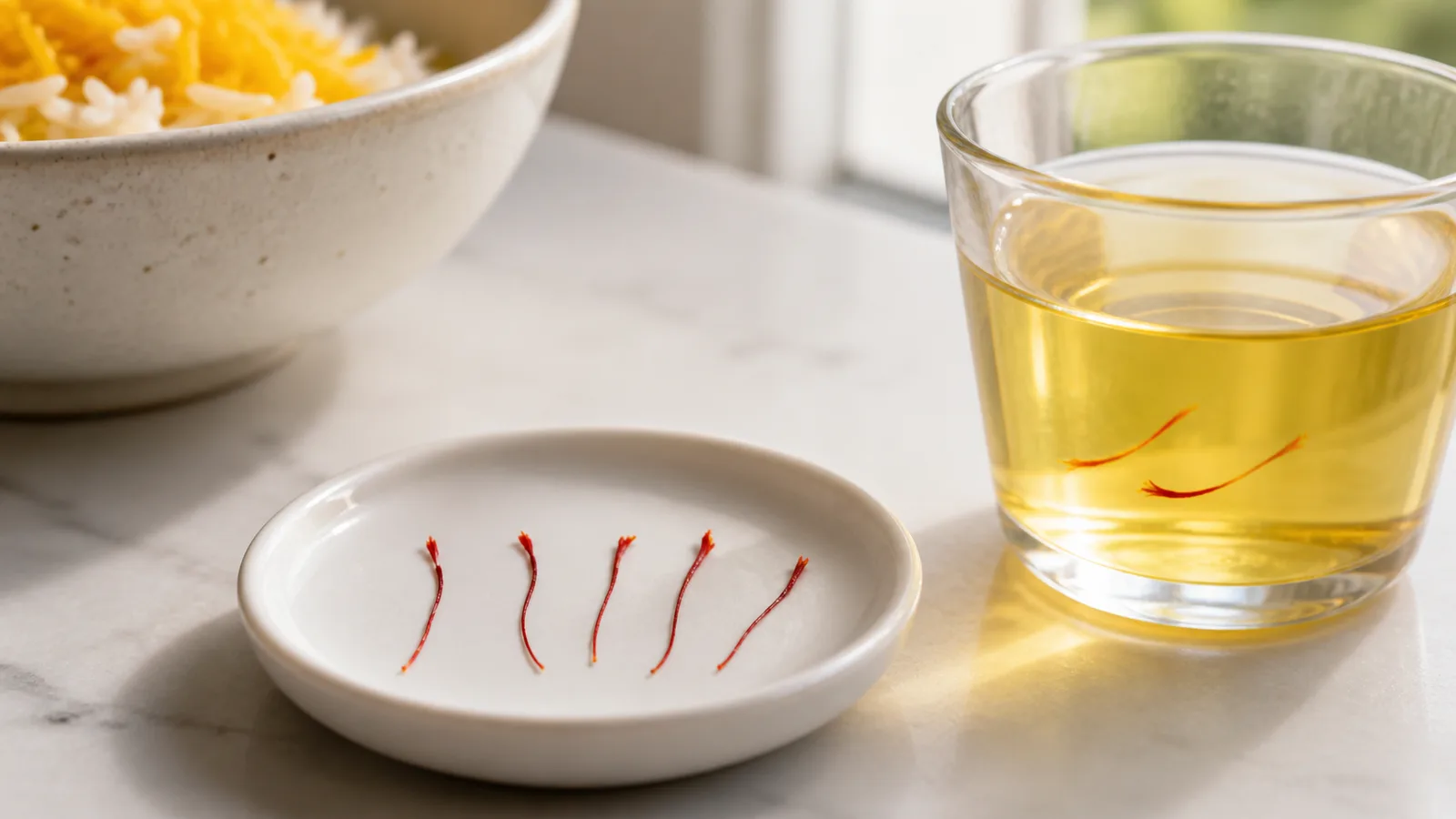
Saffron has often been described as “worth more than gold,” but that is not a timeless historical fact. The answer changes with the date, market, quality, pack size and the kind of gold used for comparison. Saffron was an exceptionally valuable spice and dye; whether it literally cost more per gram requires a like-for-like price record.
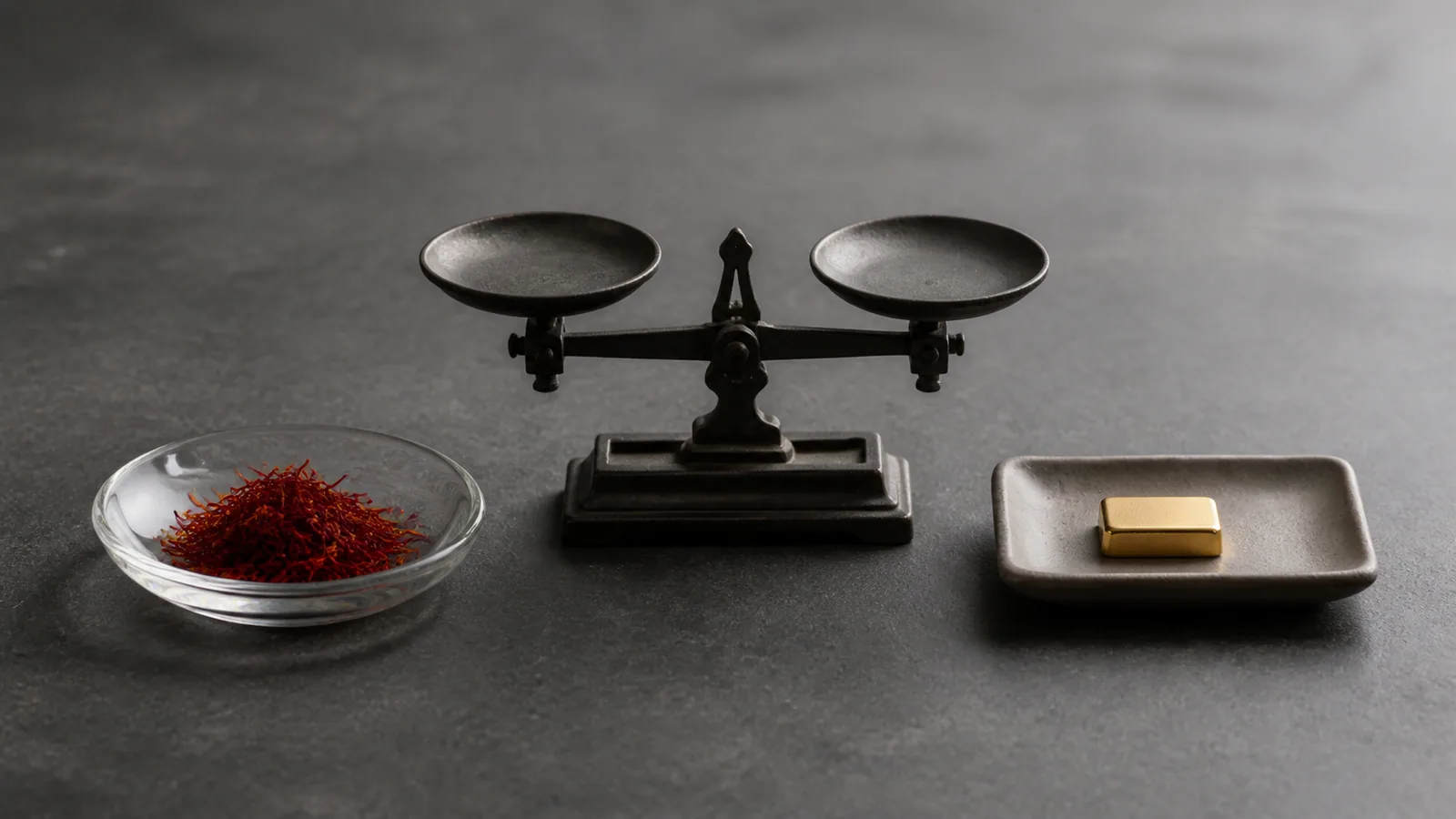
Saffron value compared to gold: what is a fair comparison?
A gold quote is normally expressed per troy ounce, while saffron is commonly sold by the gram. One troy ounce is about 31.1035 grams. To compare them, convert both to the same currency, date and unit of weight, then distinguish a wholesale commodity price from a small retail pack.
The LBMA Gold Price is an internationally recognised benchmark set twice each business day in US dollars per troy ounce. The World Gold Council’s gold-price data explains that spot, benchmark and regional prices all exist. Any claim that saffron beats gold must name the gold benchmark and date.
Saffron has no single global daily benchmark. A farmer’s price for a bulk crop, an exporter’s quotation and the price of a one-gram gift jar can differ sharply. Packaging and retail margins may make a tiny jar look expensive per gram without changing the crop’s underlying value.
Was saffron ever literally more expensive?
It may have been in a particular place, period or luxury retail transaction, but “saffron was worth more than gold” should not be presented as a universal historical exchange rate. Records use different currencies, weights, qualities and markets. Without those details, the phrase works as an image of rarity rather than a verified calculation.
The safer historical conclusion is that saffron was a high-value material. A peer-reviewed study of ancient artworks and saffron’s history traces its cultivation and use across Mediterranean and Persian cultures for more than three millennia, including its role as a spice, colourant and textile dye. Historical medicinal use is evidence of cultural importance, not proof that every traditional remedy worked.
Why saffron costs so much
Each flower gives a tiny harvest
Every Crocus sativus flower produces three red stigmas. Those stigmas are the culinary spice. An FAO production reference reports that workers process around 150,000 to 170,000 flowers for one kilogram of saffron. That is roughly 150 to 170 flowers per gram, not thousands for a single gram.
The harvest window is short
Flowers open during a brief autumn season and need prompt collection. Growers often work early in the day while blooms are fresh. The red stigmas then have to be separated from petals, yellow stamens and pale style material.
Drying and sorting require care
Fresh stigmas must lose most of their moisture without scorching or developing musty odours. Drying influences colour, aroma and flavour, and the small threads are then sorted and protected from contamination. Much of the value can be lost after harvest through poor handling.
Climate and soil affect yield
Corm health, rainfall, temperature, soil drainage and field management affect how many flowers a plot produces. A weak season spreads cultivation and labour costs across a smaller crop. Origin matters because it shapes those conditions, but a country name alone does not prove quality.
Do deep-red, long stigmas justify a premium?
Deep-red stigma material is generally valued more highly than a cut containing a large proportion of yellow or white style. Long, intact threads also give a buyer more visual information than powder. Neither length nor uniformity guarantees superior strength.
Colouring strength, aroma and flavour depend on chemistry, processing, moisture, age and storage. A smaller broken thread can be authentic and potent; a beautiful long thread can be tired or poorly stored. Price should reflect evidence about the batch, not only its appearance.
Why saffron became a symbol of luxury
The spice concentrates a great deal of work into a light, portable product. Its colour is vivid, its aroma is distinctive, and cooks need only a small pinch. Those traits made it useful in royal kitchens, dyed textiles, perfumes, ceremonies and traditional remedies. Its association with wealth grew from real scarcity and labour, then became part of the language used to sell it.
“Red gold” is still a useful nickname when it points to careful cultivation and trade. It becomes misleading when it is used as proof of an investment value, a fixed price or guaranteed quality.
Is saffron more expensive than gold today?
There is no permanent yes or no. Gold moves daily; saffron prices vary by origin, grade, quantity, seller and season. On many modern dates, benchmark gold costs more per gram than ordinary culinary saffron. A rare, heavily marked-up saffron presentation may produce a different retail comparison.
For a current calculation, divide the day’s gold price per troy ounce by 31.1035, then compare that number with the delivered saffron price per gram. Do not compare a wholesale gold benchmark with a luxury gift jar and call the result a universal commodity fact. Our companion article asks whether saffron is actually worth more than gold using the same weight-for-weight discipline.
What gives saffron real value to a cook?
For most buyers, saffron’s useful value is not its resemblance to a precious metal. It is the number of good dishes a measured pack can season. A small amount, bloomed correctly, can colour and flavour several recipes. Compare the cost per gram, authenticity, storage and performance rather than choosing the most ornate box.
- Check net weight and delivered price per gram.
- Prefer an accountable, trusted supplier with clear origin and batch details.
- Look for recognisable dry red stigmas and sensible storage guidance.
- Be cautious with guaranteed potency, health or investment claims.
- Start with a small pack and judge an equal-weight infusion.
If a low offer seems implausible, read why some saffron is cheap before deciding. The products page shows current pack sizes for a real per-gram comparison.
The honest answer
Saffron’s historical reputation was earned by rarity, demanding cultivation, a labour-intensive harvest and centuries of cultural significance. That makes it one of the world’s most expensive spices. It does not establish that saffron was always, or is always, worth more than gold. A literal answer needs a dated price, a defined quality and the same unit of weight.