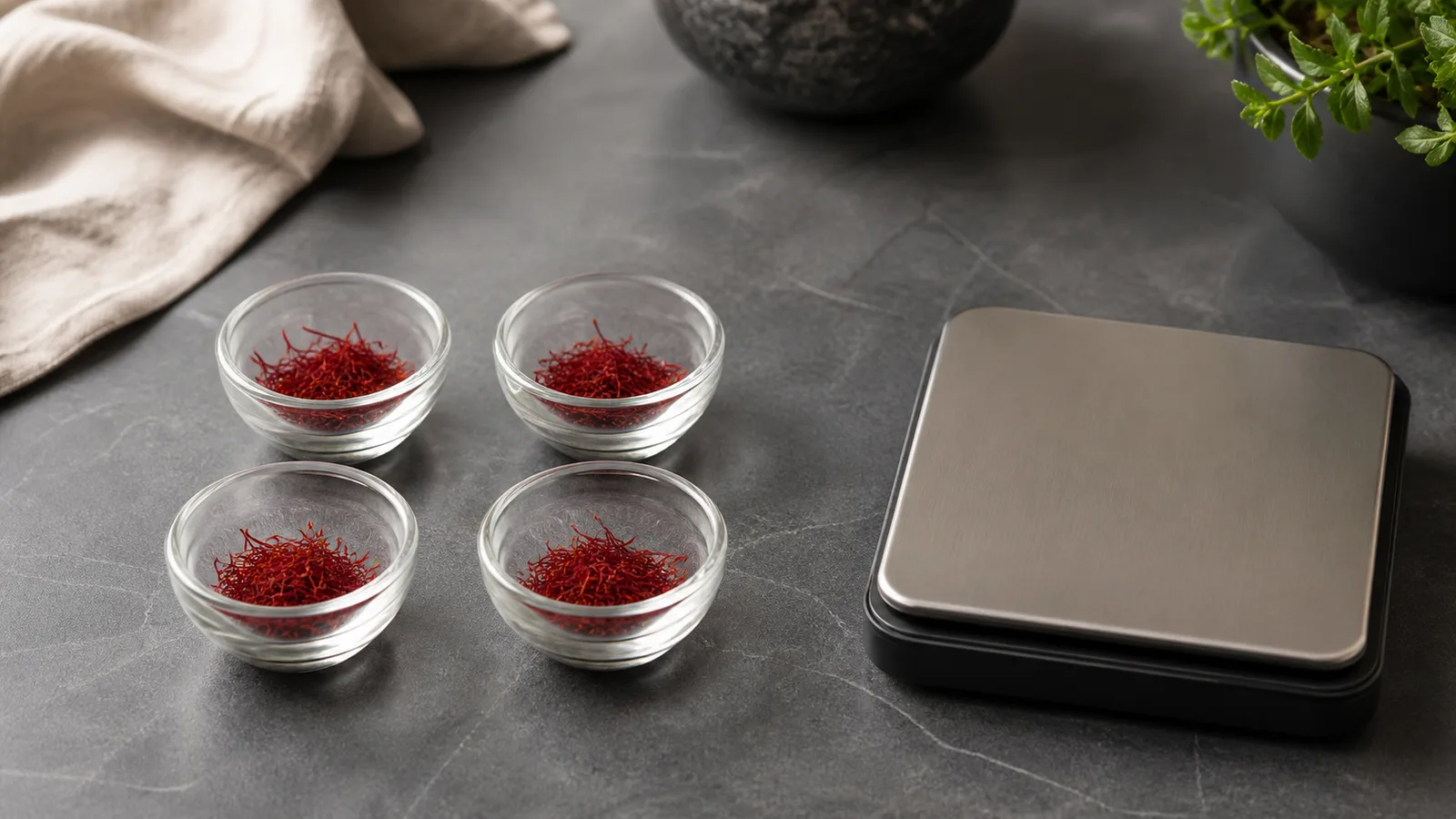
The price of four grams is four times the seller’s current price per gram, plus any tax or delivery charge. Because saffron prices change with grade, harvest, currency and seller, a fixed dollar figure in an undated article quickly becomes misleading. The most accurate answer is to check a current four-gram listing or make that simple calculation.
When comparing the saffron price for 4 grams, make sure every offer describes the same kind of product. Whole red stigmas, mixed styles, broken threads and powder can carry very different prices.
Whether the question is “How much is a gram of saffron worth?” or “How much is saffron per gram?”, the answer must refer to a specific product, market and date. A per-gram figure without those details is not a dependable valuation.
How to calculate the current price
If a jar is already sold as four grams, use its displayed total. Otherwise:
- Find the net weight, excluding the jar and packaging.
- Divide the product price by that weight to get the saffron price per gram.
- Multiply the per-gram figure by four.
- Add tax, shipping and any currency-conversion charge.
For example, if a comparable batch costs 8 currency units per gram, four grams cost 32 before delivery. This is an illustration of the calculation, not a quotation for today’s market.
What changes the saffron cost per gram?
Thread composition and grade
A product made predominantly from red stigmas usually costs more than one containing a larger share of yellow or white style. Long presentation-grade threads can attract a premium, but some breakage does not automatically reduce aroma or colouring performance. Powder is harder to inspect and should not be compared casually with a jar of whole threads.
Origin and traceability
Iranian, Kashmiri and Spanish saffron have different trade histories and supply chains. An Iranian saffron price may therefore differ from a Spanish retail price, but origin alone does not establish grade. When comparing the Iranian saffron price per gram or a Persian saffron price, look for batch, harvest and seller information rather than relying on the geographic name.
The saffron price in Iran can also be quoted at a farm, wholesale or retail level and in different grades. That is why a search for “saffron Iran price” may produce figures that cannot be compared directly with a sealed four-gram jar delivered abroad.
Harvest, labour and supply
Each flower produces three stigmas, and picking and separation are carried out by hand during a short harvest. Yield, drying, storage and market supply all affect the price of saffron. Retail costs then add packaging, testing, fulfilment and seller margin.
Quantity and channel
A larger package often has a lower price per gram than a small gift jar. Wholesale figures can be lower again. However, buying more is only good value if the saffron will be stored well and used while its aroma remains strong.
Why kilo and pound prices can mislead
The price of saffron per kg is mathematically 1,000 times a per-gram price, and the price of saffron per pound uses about 453.6 grams. In practice, bulk lots are negotiated differently from retail jars. Multiplying a boutique one-gram price can greatly overstate a wholesale saffron price per kilo; dividing an industrial lot can understate the saffron cost per pound for a consumer package.
Use the unit that matches what you are actually buying. For a four-gram purchase, the current price per gram saffron sellers display for the same batch is the useful benchmark.
How to judge value, not just price
A low figure does not necessarily mean a bargain. It may describe more style material, older stock, broken threads, unidentified powder or an untraceable product. An expensive jar is not automatically superior either; presentation and packaging can add cost without improving the spice.
Check for:
- clear net weight and price;
- whole, predominantly deep-red stigmas that can be inspected;
- a clean floral, hay-like aroma rather than dampness or artificial perfume;
- origin and lot information from an identifiable seller;
- appropriate packaging that protects against moisture, light and strong odours.
Home colour-release checks can reveal crude dyeing, but they cannot prove grade or origin. If a commercial purchase depends on a quality claim, ask what batch test supports it.
So, how much is 4 grams of saffron?
It is four times the current saffron prices per gram for the exact product you choose. That answer changes by market and date, so verify the live listing rather than relying on an old $20–$60 range. Our saffron products page shows currently available quantities and prices, allowing you to calculate four grams from a real offer.
The best saffron value comes from comparing like with like: the same preparation, quality evidence, origin detail, quantity and delivery terms. That gives a more honest answer than any timeless price claim.