


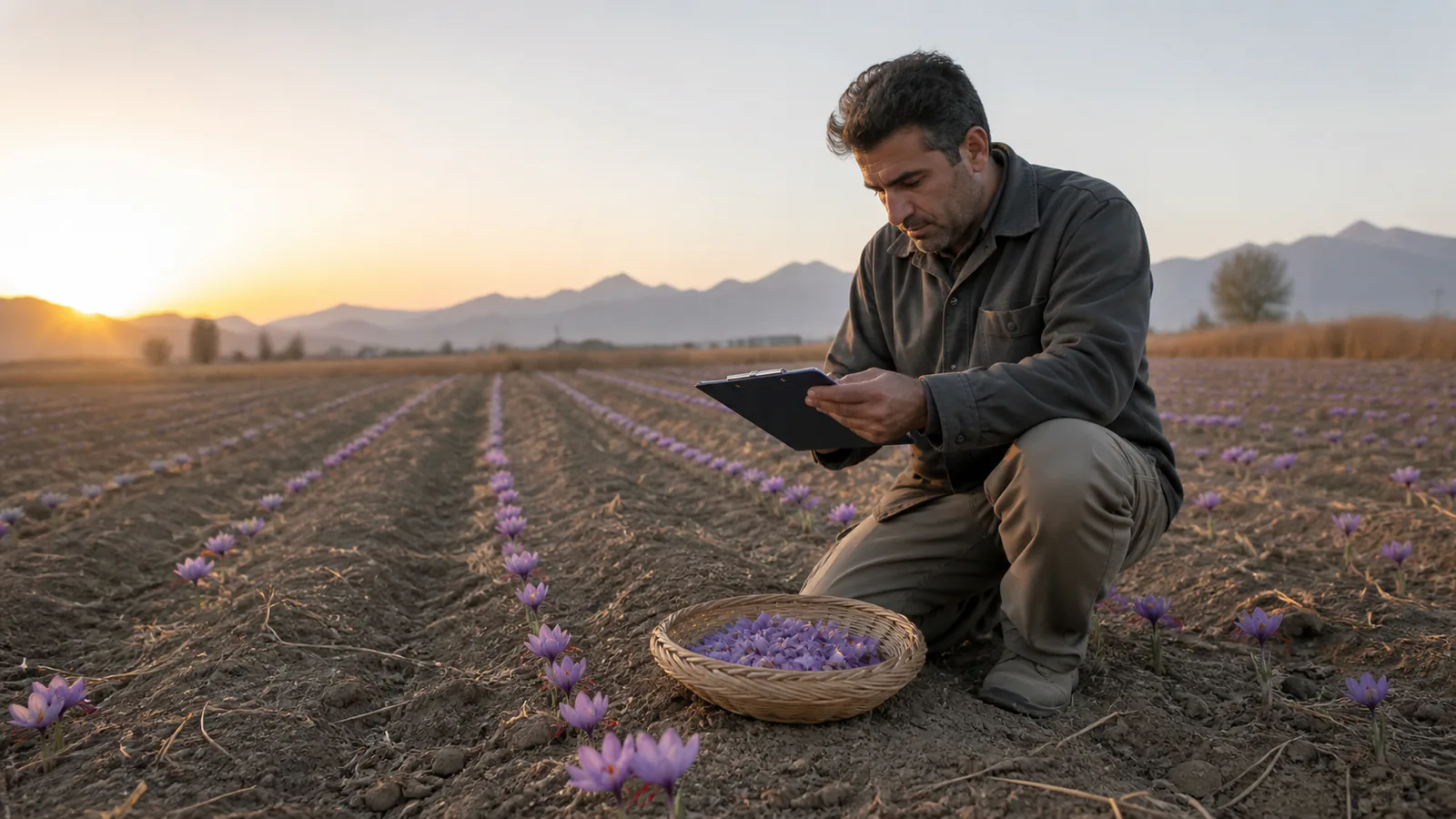
Saffron production decreased by 30% in the season described in this report. That headline belongs to an earlier National Saffron Council interview, not to the current crop. The episode is still useful because it shows how quickly lower field output, quality work and export-market development can become the same problem.
In that interview, council secretary Farshid Manouchehri said the year’s production decline had reached about 30%. He also described domestic consumption as sensitive to price changes and estimated that Iran used roughly 25–30% of its crop at home. Those figures are a historical snapshot; they should not be read as today’s production or consumption totals.
Why saffron production can fall sharply
A national percentage hides many local decisions. Saffron yield is measured in kilograms of dried stigmas per hectare, but the result begins with corm health, planting density, field age, irrigation timing, soil condition, weather during flowering, labour availability and the speed of post-harvest separation and drying. A larger planted area therefore does not guarantee a larger crop.
A peer-reviewed analysis of Iranian farms documented a long decline in average yield and found substantial differences in technical efficiency between farms. Its practical lesson is important: growers may recover part of a production shortfall through better use of existing inputs, but no single intervention works everywhere. Field diagnosis comes before a recipe. The detailed evidence is discussed in our review of Iran’s saffron production decline and yield per hectare.
Training matters, but it must reach the field
Manouchehri linked future improvement to an agricultural training programme. That idea remains sound when training is specific: how to select healthy corms, choose planting depth and density, manage weeds and rodents, schedule irrigation for local soil and weather, pick flowers promptly and dry stigmas under controlled conditions. General encouragement does not replace measured field records.
For growers, a useful annual record includes planted area, corm age, irrigation dates, harvest dates, fresh-flower weight and final dry-saffron weight. Comparing those numbers with the previous season separates a weather shock from a persistent field problem. Our saffron planting guide explains the cultivation sequence, while the processing guide covers the hours after picking, when careless handling can reduce the value of an otherwise good crop.
Quality is part of the production result
The earlier report referred to an FAO-supported quality plan in Khorasan Razavi. The exact budget quoted at the time should not be treated as a current programme total. What can be verified today is the continuing direction of the work. In 2024, the Food and Agriculture Organization and Iran’s Ministry of Agriculture Jahad announced a two-year saffron project focused on authenticity, testing and supply-chain traceability. In 2025, FAO reported additional work on post-harvest guidance and laboratory methods.
This matters because production is not only the weight leaving a field. Buyers also judge colour, aroma, flavour, cleanliness, moisture, authenticity, batch consistency and documentation. Poor separation or drying can turn a normal harvest into a commercial shortfall. Better testing cannot create saffron that was never harvested, but it can protect more of the crop’s value.
What the Hong Kong initiative added
A second interview from the same period described Hong Kong as a market under active study. Manouchehri said the council was evaluating saffron-buying countries and advertising opportunities, while clarifying that Russia and Central Asia were not the targets of that particular initiative. He reported export growth of about 22% year on year; the production interview used a nearby figure of 23%. These are two rounded statements from an earlier reporting period, not current growth rates.
Hong Kong was not an imaginary destination. World Bank WITS data based on UN Comtrade show that Hong Kong imported 93,204 kg of saffron in 2020, including 87,396 kg reported from Iran. The same database records a much smaller 2,831 kg imported from all partners in 2024. The change is a warning against turning one strong year into a permanent forecast. A market has to be checked again for demand, customs treatment, buyer concentration and re-export patterns.
Production concentration and promotion costs
Manouchehri’s Hong Kong interview said South Khorasan and Khorasan Razavi together supplied 94% of Iranian saffron at the time. The precise share varies by season, but production remains strongly rooted in the Khorasan region. FAO’s 2025 account likewise identifies Khorasan Razavi and South Khorasan as the principal producing provinces and estimates that Iran supplies 85–90% of the world’s saffron.
The interview also argued that the Iran and Mashhad chambers of commerce were carrying 75% of export-promotion costs, without support from the provincial agriculture authority. That is best understood as the speaker’s contemporary account of how promotion was financed, not as a current public-budget fact. It nevertheless identifies a durable business question: who pays for market research, exhibitions, samples, testing, packaging development and follow-up with importers?
How lower output and export development connect
A production decline does not automatically mean exports fall by the same percentage. Domestic demand, stocks held from previous crops, product grade and exporter purchasing all affect the amount available for shipment. Equally, export growth in one period does not prove farm profitability improved. A producer can face higher costs while traders draw on inventory.
The safer way to read these indicators is together:
- Field output: dried saffron kilograms and yield per hectare.
- Quality: test results, moisture control, authenticity and batch consistency.
- Domestic use: demand at the prices consumers actually face.
- Exports: net weight, declared value, destination mix and changes over several years.
- Farmer return: the price received after production, labour and handling costs.
For buyers, the lesson is similar. A dramatic production headline is context, not a quotation. Ask for the current harvest year, origin, grade, laboratory evidence, available volume and delivery terms. Compare like with like when checking the current saffron price.
What should improve before the next short crop
The two archived interviews point to one joined-up response. Improve farm practice where measurements show a recoverable yield gap. Protect quality immediately after harvest. Verify authenticity and traceability. Then develop export markets from current trade evidence, not assumptions carried forward from an old season.
Iran remains the centre of global saffron production, but leadership is not self-maintaining. A resilient sector needs healthy fields and buyers who can trust what arrives. The 30% decline was a warning from its own year; the useful response is a production and market system that can detect the next problem sooner.

![Exporting Saffron to Turkey + Price Guide [Complete 0 to 100]](https://img.rowhanisaffron.com/20260827003933/saffron-export-turkey-quality-inspection.webp)



