


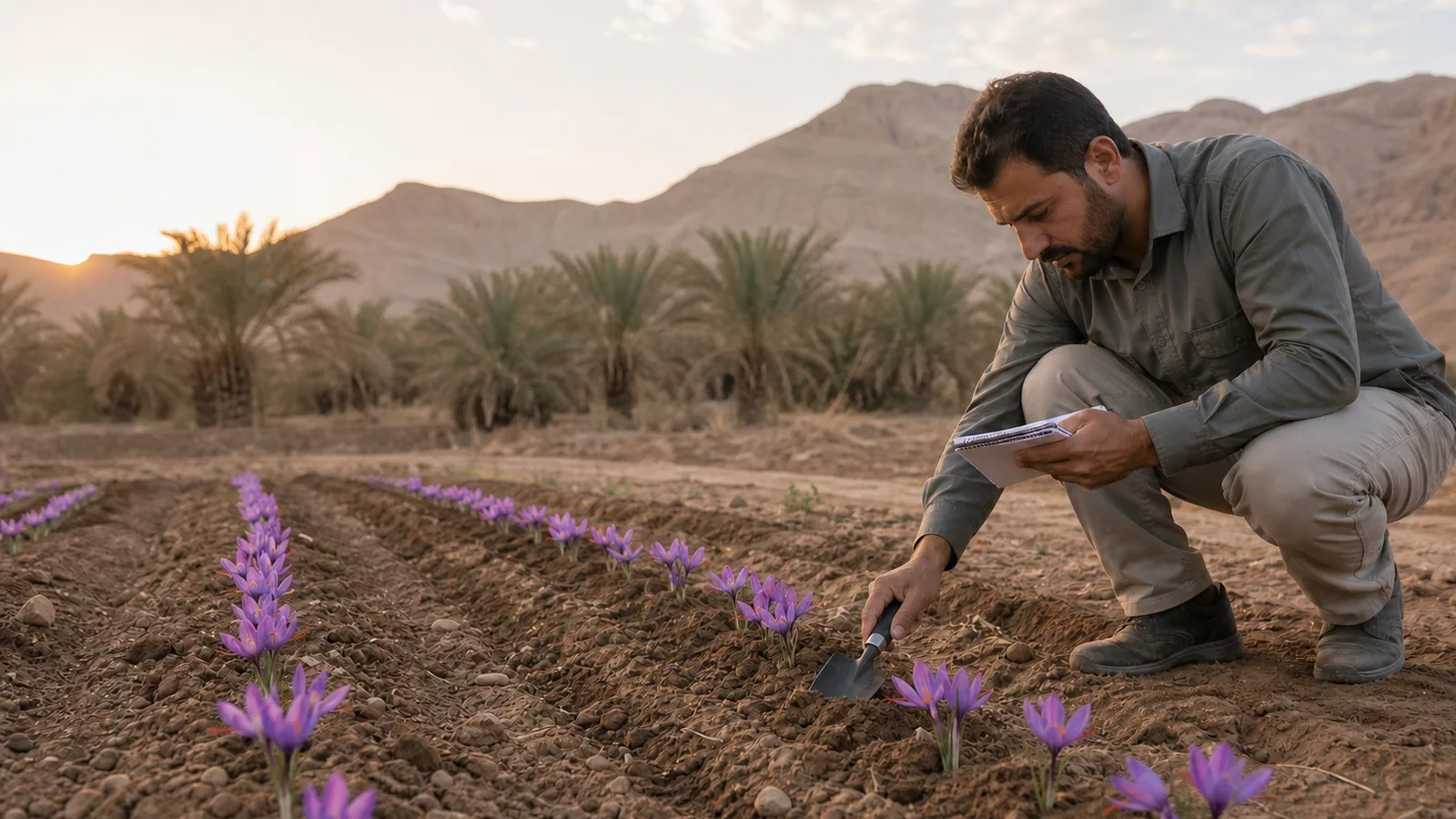
Planting saffron in Rigan is an appealing idea for a district whose farm economy is heavily dependent on dates. Yet the title of the old report on this page did not match its text: it contained no evidence that saffron had actually been planted in Rigan. It quoted Amin Bagheri on early date harvesting, price formation and possible uses for palm waste.
That mismatch matters. Saffron can be a useful diversification crop in dry regions, but it should not be presented as locally proven without a field record. The responsible question is whether a particular Rigan field has the autumn temperatures, soil, water quality, labour and market access that Crocus sativus requires.
What the original Rigan report actually said
The brief 2018 item described Rigan as a largely single-crop agricultural area. Amin Bagheri, then a local official, said dates in eastern Kerman begin to ripen and be picked in Rigan earlier than in other nearby districts. Because its harvest reaches the market first, Rigan can influence the opening date price across the east of the province.
That timing can be an advantage, but dependence on one product also concentrates risk. Extreme heat, water shortages, crop damage, storage capacity, buyers and the opening price can affect a large share of household income at the same time. Later reporting continued to describe date growing as central to Rigan’s rural economy.
Bagheri also pointed to a possible value-added use for agricultural residue: chipboard made from date-palm waste. The surviving English translation said “waste of dates,” but board production generally uses fibrous palm material such as removed fronds and old trunks, not saleable fruit. Research and industry projects have investigated these lignocellulosic residues as raw material for composite panels. Whether a plant is commercially viable depends on collection, drying, resin, processing and transport costs.
Could saffron diversify agriculture in Rigan?
Possibly, but the answer cannot be given at district level. Saffron is grown across arid and semi-arid regions, and its summer dormancy helps it tolerate dry summers. Flower formation and emergence are nevertheless sensitive to temperature and soil moisture. Hot conditions during the wrong part of the cycle can reduce flowering even when the corm survives.
The FAO Ecocrop profile for Crocus sativus describes a preference for well-drained, medium to light soil with low salinity. A peer-reviewed suitability study likewise identifies altitude, temperature, soil properties and topography as important production variables. This is why experience from Khorasan, Zarand or another saffron area cannot simply be copied into a warmer Rigan field.
Rigan includes different elevations and local conditions. A field with cooler autumn nights, suitable drainage and dependable water may behave differently from a hot lowland site near a date grove. A soil and water analysis, local temperature record and small multi-season trial are more useful than a general claim that the whole city is suitable.
The checks to complete before planting
Autumn temperature and field position
Saffron corms rest through summer, then resume growth and flower in autumn. Research on flowering shows that cooling is an important trigger. A site that remains very warm through the expected sprouting and flowering period may produce leaves without a satisfactory stigma crop.
Compare several years of local temperature records with actual measurements at the field. Elevation, slope, cold-air movement and proximity to heat-retaining surfaces can create meaningful differences within the same district. A one-season observation is not enough to describe long-term suitability.
Soil drainage and salinity
Corms need loose, aerated soil that drains after irrigation. Waterlogging encourages rot; compacted or poorly prepared ground restricts root and daughter-corm development. Test texture, pH, electrical conductivity and drainage before buying planting material.
Water quality deserves its own test. A crop described as drought-adapted can still be sensitive to salt accumulation. Evaporation in a hot climate can concentrate salts in the root zone, so irrigation volume, leaching, drainage and soil salinity must be considered together.
Water timing, not only annual volume
The FAO’s qanat-based saffron farming account notes that saffron does not require large quantities of water. That should not be confused with needing no irrigation. Water at the correct stage helps initiate growth and supports leaves and replacement corms after flowering. The usable question is whether the farm can deliver the required water when the crop needs it, without harming the date orchard or another priority crop.
Healthy corms and quarantine
Saffron is propagated by corms rather than seed. Planting stock should be correctly identified, firm, undamaged and traceable to a healthy field. Moving corms from another province can also move fungi, mites, nematodes or contaminated soil. Local agricultural authorities should advise on plant-health and movement requirements before transport.
Harvest labour and drying
Each flower supplies only three stigmas. Flowers need to be picked promptly and the stigmas separated by hand, so labour demand arrives in a short peak. The product then needs clean, controlled drying and storage away from moisture, light and heat.
A grower should calculate labour availability, drying capacity and likely saleable grade before expanding. High saffron prices do not automatically equal high profit; corms, land preparation, labour, testing, packaging and several low-yield establishment seasons all affect the result.
A sensible trial plan for a Rigan farm
The first planting should be a trial, not a whole-farm conversion. Choose a representative but manageable plot and record:
- field elevation and autumn minimum and maximum temperatures;
- soil texture, pH, salinity and drainage;
- water source, salinity, irrigation dates and applied volume;
- corm source, health, size, planting depth and spacing;
- emergence date, flower count, dried stigma weight and grade;
- labour hours for picking, separation and drying;
- daughter-corm condition and multiplication after the leaf season; and
- the actual selling price and all production costs.
Run the trial for more than one season. Saffron is perennial, and first-year flowering does not show how the stand will perform as corms multiply. Leave an untreated comparison where appropriate and change one major variable at a time, otherwise it becomes hard to understand why the result improved or failed.
Dates remain part of the diversification decision
A trial of saffron does not make date palms obsolete. Dates are adapted to Rigan’s established farm system, market knowledge and labour network. The original report’s strongest insight was the need to extract more value from what Rigan already produces: better market coordination and useful products from palm residues.
Diversification can include improvements around the main crop as well as a new crop. Cold storage, grading, packaging, export relationships and technically sound use of palm residues may reduce risk without replacing productive orchards. Saffron, if the trial supports it, can add a second harvest window and revenue stream on suitable land.
What can be concluded today
The archived item did not prove commercial saffron cultivation in Rigan, so it would be misleading to repeat that implication. It did document the district’s early date harvest, the influence this timing could have on the eastern Kerman market and an interest in chipboard from palm residues.
Planting saffron in Rigan should therefore begin as a measured agronomic question. A cooler local site with well-drained, low-salinity soil, suitable water, healthy corms and enough harvest labour may justify a trial. Expansion should follow recorded multi-season performance and a credible buyer, not the assumption that every dry region is automatically right for saffron.
Sources and context
- The statements attributed to Amin Bagheri are preserved from the 2018 YJC item originally stored on this URL.
- FAO Ecocrop data sheet: Crocus sativus.
- FAO: Qanat-based Saffron Farming System in Gonabad.
- Frontiers in Plant Science: agro-climatic suitability evaluation for saffron.

![Exporting Saffron to Turkey + Price Guide [Complete 0 to 100]](https://img.rowhanisaffron.com/20260827003933/saffron-export-turkey-quality-inspection.webp)



