


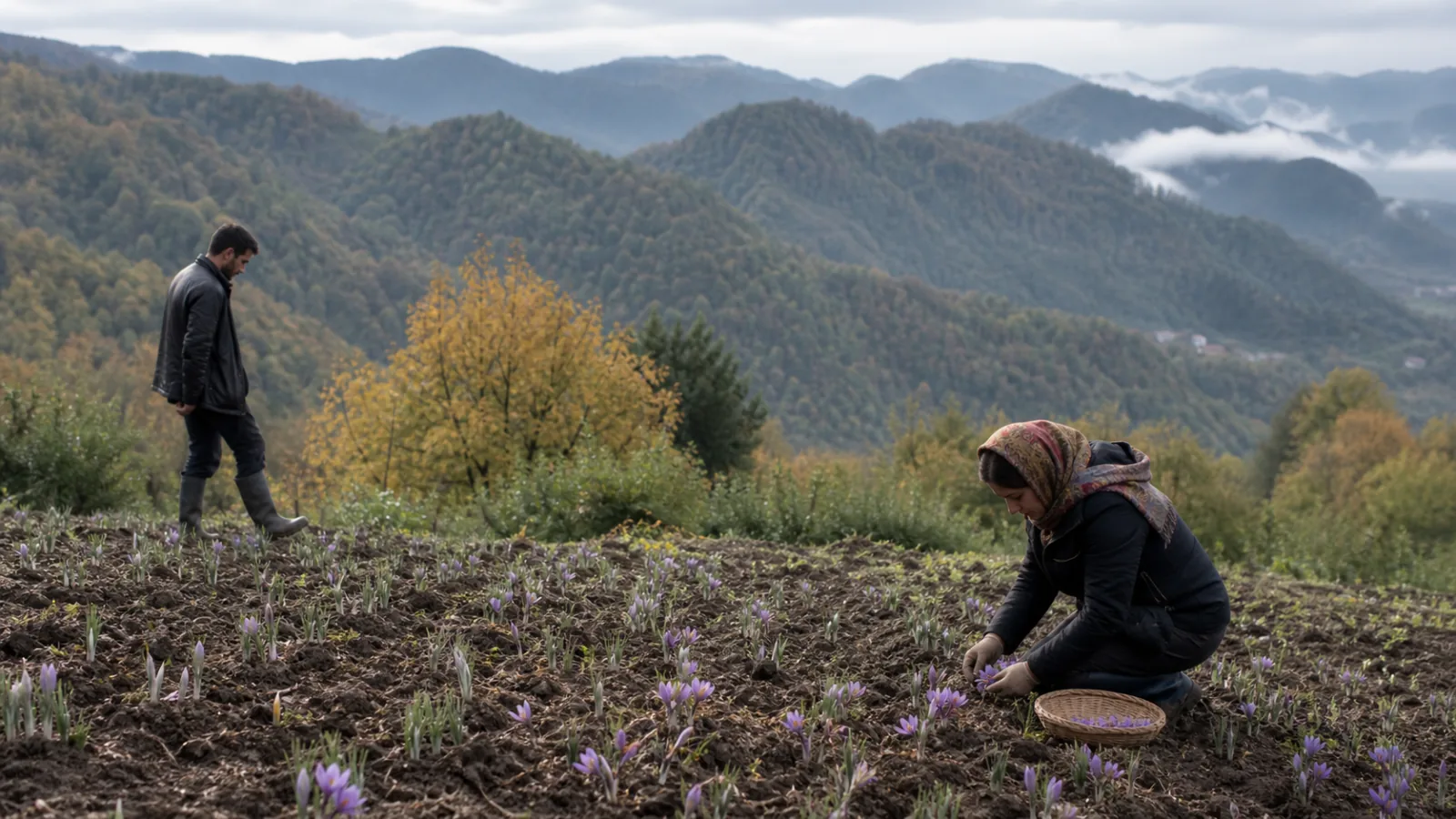
Saffron cultivation in Sari city has been tested in upland villages where steep fields, limited irrigation and modest returns from grain made farmers look for another crop. A 2018 report focused on Kosut village in Chahardangeh District and described several families experimenting with saffron on sloping land south of Sari.
The old English headline called this “saffron suction,” but suction was a translation error and has no agricultural meaning here. The subject was the emergence and expansion of saffron growing in Sari’s mountain districts.
How saffron reached Sari’s upland villages
For centuries, Iranian saffron production was associated mainly with Razavi and South Khorasan. The historical report noted more recent planting in Fars, Kerman, Lorestan, Qom, Gilan, Semnan and Mazandaran. Within Mazandaran, it referred to upland sites in Sari County and trials around other towns.
Kosut is a mountain village in Chahardangeh, away from the low coastal plain where rice is a familiar crop. The farmers interviewed in 2018 described sloping parcels where wheat, barley or vegetables had offered weak returns or were difficult to cultivate. Saffron was introduced as a change in cropping pattern, not as a replacement for every crop in the region.
What the Kosut farmers reported
One farmer said the village was entering its fourth consecutive saffron harvest and that about one hectare of sloping land had been planted. The damaged translation includes a reference to roughly one kilogram, but it does not reliably show whether that was the total crop or an increase from the previous year. Treating it as a precise yield would go beyond the source.
A 75-year-old resident, identified as Hajj Aghayi, explained why the trial appealed locally: rice and wheat were difficult on some of the slopes, while saffron offered another use for those parcels. He believed support from the Agricultural Jihad organisation could help the crop create income.
Zahra Khan, a 45-year-old farmer from Kosut, described cultivating about 2,500 square metres and harvesting around 300 grams that season. The source attached a figure of three million to her return, but its machine translation incorrectly labelled the amount as dollars and did not preserve a dependable local currency unit. Her more important point was clear: finding a buyer at a fair price remained the farmers’ main concern.
Why a sloping field may suit saffron
Saffron corms need soil that drains well. A slope can help shed excess water, which is useful in a province known for wetter conditions than the main Khorasan production zones. A slope alone does not make land suitable, however. Erosion, soil depth, access, aspect and the way water moves through the plot all need to be checked.
The original interviews praised sunny ground that retained enough moisture without needing heavy irrigation or fertiliser. Those observations apply to the specific village fields. Before planting elsewhere around Sari, a grower should inspect the site after rain, test the soil and avoid pockets where water stands around the corms. Our guide to weather and site conditions for saffron explains how temperature, drainage and local exposure fit together.
Reported yields and what they do not prove
The provincial official quoted in the article was a deputy responsible for crop production improvement, rendered in English as Shahidi-Far. He said about ten villages and three hectares of Mazandaran’s mountain land were involved in saffron cultivation at the time. He compared a national average of 4–6 kilograms per hectare with about 1–2 kilograms per hectare in the province’s research planting.
Those were historical trial figures. They do not establish a current provincial average, and they should not be used to promise a yield to a new grower. The age of the bed, corm size, planting density, flower count, harvest timing, drying losses and the exact area measured can all change a per-hectare result.
The report also referred to more than 10,000 units of potentially suitable land, but the unit was corrupted in translation as “metric tons of land.” Because the original measure is not recoverable from the surviving English text, it should not be converted into a firm acreage claim.
Elevation is a clue, not a guarantee
The 2018 article associated good saffron performance with elevations of roughly 1,300–2,300 metres and with cold tolerance, cool winters and warm summers. That range reflects an observed pattern in several Iranian production areas. It is not a rule that excludes every lower site or approves every mountain plot.
Elevation influences temperature, frost, snow, flowering time and summer dormancy, while distance from the Caspian Sea can affect humidity and rainfall. A site in Chahardangeh can behave very differently from a low field near Sari. The decision should be made from the field’s own soil, drainage and seasonal weather, ideally beginning with a small trial.
The labour and market test
The programme’s organisers linked saffron with higher rural income and reduced migration to the city. Naderi, identified in the translated report with Sari’s Basij Construction programme, said village surveys had led to the trial and hoped official support would encourage young people to remain or return.
That outcome depends on more than planting. Flowers emerge over a short period and need prompt picking, careful transport, clean stigma separation and controlled drying. Small mountain villages must have enough labour on peak days and a suitable processing space. Then the finished product needs grading, packaging and a buyer who recognises its quality.
Before expanding, a household should record:
- the true planted area and age of the bed;
- corm, land-preparation and irrigation costs;
- hours spent picking, separating and drying;
- fresh flowers and marketable dry saffron produced;
- quality grade and price actually received; and
- transport and buyer reliability.
A high price per gram can look attractive while labour and route-to-market costs remain invisible. These records show whether the crop strengthens household income in practice.
A realistic future for saffron around Sari
The Kosut story is valuable because it captures a genuine local experiment: farmers using sloping land, learning through several harvests and looking for a crop that could support village life. It also records their unresolved concern about selling at a fair price.
Saffron cultivation in Sari can be promising on selected upland sites, particularly where drainage is good and the seasonal pattern suits the crop. It is not automatically suited to Mazandaran’s wetter lowlands, nor is it profitable without careful harvest and marketing. A small measured plot, local agronomic support and a buyer identified before expansion are the sensible bridge between an encouraging trial and a durable village enterprise.

![Exporting Saffron to Turkey + Price Guide [Complete 0 to 100]](https://img.rowhanisaffron.com/20260827003933/saffron-export-turkey-quality-inspection.webp)



