


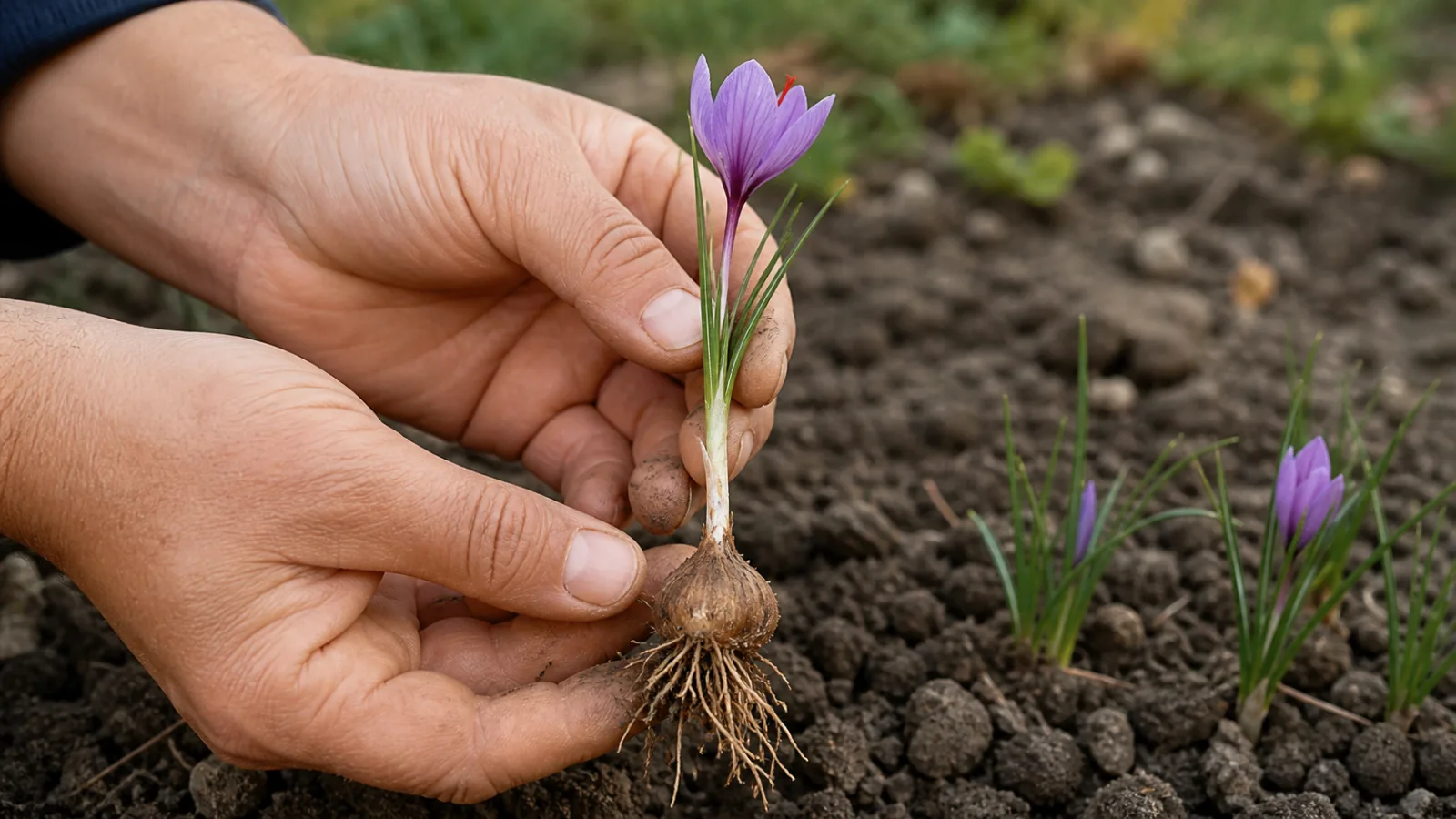
No, saffron is not a tree. It is a small flowering plant called Crocus sativus. The useful spice is made from the three red stigmas inside each purple flower. The plant has no woody trunk or branches, and it grows only a short distance above the soil.
People sometimes ask “is saffron a tree?” after seeing the words saffron bulb, saffron onion or saffron seed in translated growing guides. Those names can obscure a simple botanical fact: saffron is a fall-flowering crocus that grows from an underground corm.
What kind of plant is saffron?
The accepted botanical name is Crocus sativus, and it belongs to the iris family, Iridaceae. Kew Science classifies saffron as a tuberous geophyte. A geophyte stores the resources it needs to survive an unfavourable season below ground.
Saffron is often described as a perennial crop because a planted bed can produce for several years. The individual parent corm does not behave like the permanent trunk of a tree, however. It produces daughter corms, and those continue the planting in the following season.
Is it a bulb, corm or seed?
The rounded planting structure is a corm. Growers and sellers often call it a saffron bulb or onion in everyday language, but a corm is a compact underground stem rather than a layered true bulb.
Cultivated saffron is sterile and does not produce useful seed for propagation. New fields are established with corms, and each healthy corm can form daughter corms. The University of Vermont’s saffron cultivation guide explains this asexual cycle and describes the crop as a fall-blooming crocus.
This also corrects a confusing line in the original article which said saffron seeds came from the plant each October. What emerges from the soil is a shoot and flower; what multiplies below it is the corm. Our guide to saffron corm selection and handling shows what to inspect before planting.
The saffron growth cycle
Saffron’s calendar is unusual compared with many garden and field crops. Its exact timing varies with climate and location, but the sequence is consistent:
- Summer dormancy: the field can look bare and dry while the corms rest underground.
- Autumn growth and flowering: cooler conditions and suitable moisture trigger shoots and purple flowers.
- Winter and spring foliage: narrow green leaves continue feeding the developing daughter corms.
- Late-spring dieback: leaves yellow and dry as the new corms enter dormancy.
A bare summer field is therefore not necessarily dead. It can green again after the normal seasonal transition and appropriate irrigation. Equally, the absence of visible leaves is not proof that every corm is healthy; drainage, disease, rodents and poor planting material can still cause losses below ground.
How saffron corms are planted
The historical Mashhad report behind this article described land preparation by ploughing, followed by planting from early Shahrivar to 15 October. It referred to opening furrows with a tractor or by hand, placing corms in rows, covering them with soil, then continuing with irrigation and field care. That calendar records a regional practice and should not be treated as a fixed date for every climate.
A suitable bed needs free drainage and enough sun. Planting depth and spacing depend on soil, winter cold, cultivation period and whether the grower is producing spice, corms or both. Corms should be firm, healthy and placed with their growing point upward. A soil test and local agronomic advice are safer than copying a universal fertiliser dose.
Large plantings can use a furrow or adapted planter, while a home bed can be set out by hand. Either way, the purpose is the same: consistent depth, good soil contact and a layout that can be weeded and harvested without excessive compaction.
When does saffron flower?
The original account said flowers emerged in November. That can describe the local Khorasan season, but flowering shifts with weather and geography. Some fields begin earlier in autumn; others flower later. A grower should watch the field rather than rely on one calendar date.
First-year flower numbers are often modest. Production can increase as daughter corms multiply and the bed becomes established, which explains the older article’s reference to stronger harvests in the third and fourth years. Corm size, planting date, density, soil, water, weather and field health all affect the actual pattern.
Does a saffron planting last 30 years?
The original article claimed that a saffron “onion” lasts in the ground for 30 years. That is misleading if it means one corm or one unmanaged commercial bed. The lineage can continue as daughter corms multiply, but the parent corm is replaced, and crowding eventually reduces performance.
University of Vermont guidance says spice growers commonly keep corms in the same bed for at least four years and often see yield begin to decline after roughly three to six years as density increases. The right time to lift, sort and replant depends on annual yield and field condition, not a promise that the original corm will remain productive for decades.
How much irrigation does the plant need?
The Mashhad account referred to about five irrigations and routine weed control. That figure belongs to its local system. Saffron has a relatively modest water requirement, but the number and timing of irrigations vary with rainfall, soil water-holding capacity, drainage and climate. Too little water at an important stage can limit growth; standing water can rot corms.
Weeds compete with the short plant and make flower picking harder. They should be managed without damaging the shallow foliage or corm bed. Keeping clear field records is more useful than applying an automatic schedule year after year.
From flower to saffron spice
Each flower is picked by hand in many production systems because the crop is delicate and the flowering window is brief. The three red stigmas are separated, dried and stored; the petals and yellow stamens are not the saffron spice sold for cooking.
So the clearest answer is also the simplest: saffron is not a tree, and it does not grow on one. It is a compact crocus with an underground corm, a seasonal set of leaves and an autumn flower. Understanding that life cycle makes its planting, irrigation and multi-year management much easier to plan.

![Exporting Saffron to Turkey + Price Guide [Complete 0 to 100]](https://img.rowhanisaffron.com/20260827003933/saffron-export-turkey-quality-inspection.webp)



