


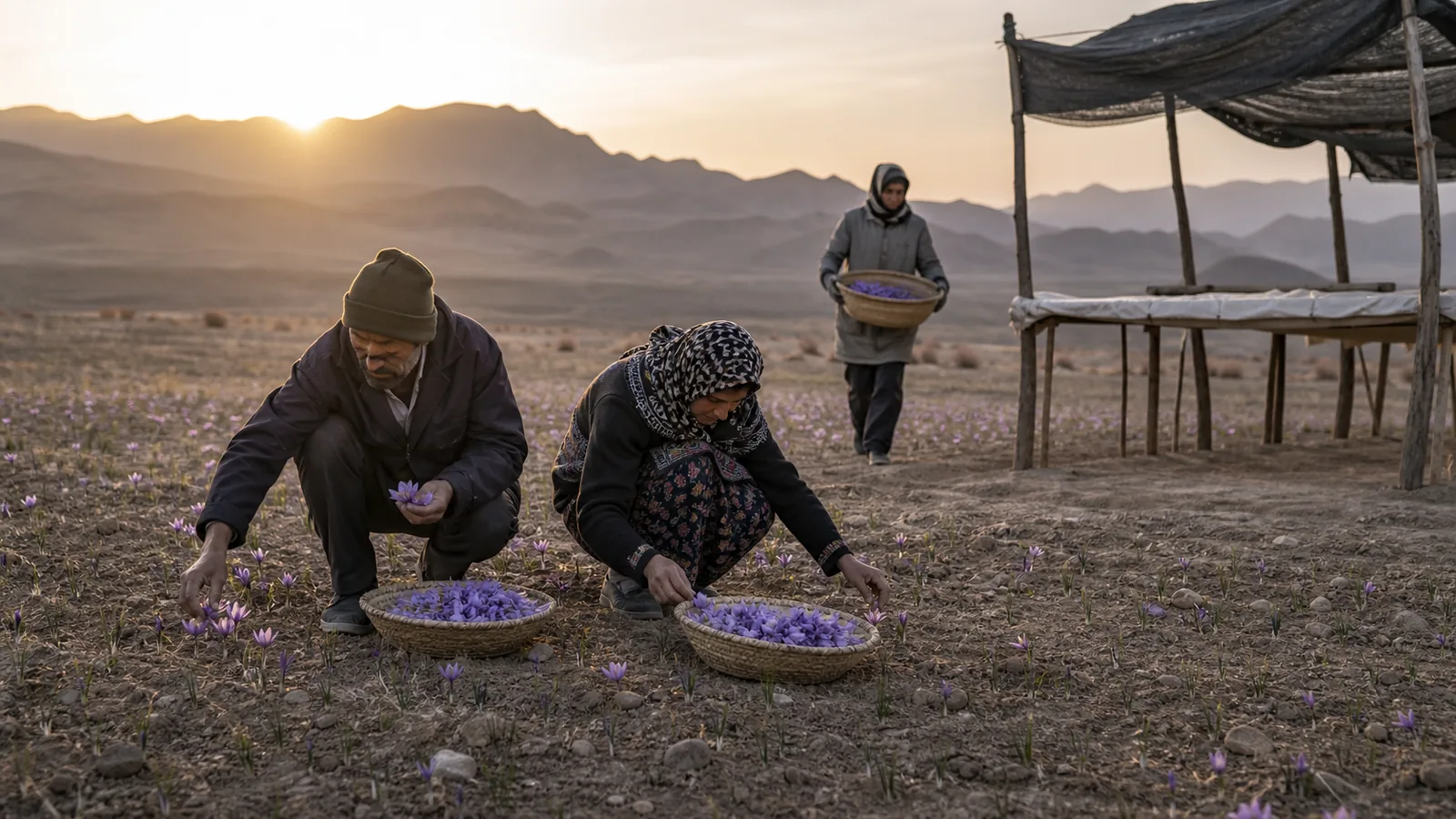
Birjand saffron is grown within South Khorasan’s long-established production belt, where an archived local report described more than 10,000 hectares under cultivation and annual output of about 50 tonnes. The same report placed the harvest from the second half of November into December and connected quality not to one slogan, but to the field, corms, plant nutrition, picking, processing, and packaging.
When the Birjand saffron harvest takes place
The historical account followed a visit to saffron fields managed by the Khavaran Agriculture and Technology Company. Its managing director, Sina Bari, said picking began in the second half of November and continued through December. That is a local, dated harvest window rather than a permanent calendar: flowering can move with weather, elevation, field conditions, and the timing of autumn irrigation.
Harvesting is concentrated because the flowers must be gathered during a brief bloom. The stigmas then have to be separated and dried. Delays or careless handling after picking can undo good work in the field, which is why a useful account of Birjand saffron must follow the crop beyond the flower basket.
South Khorasan’s scale in the archived report
Bari’s report gave three figures for the wider province:
- more than 10,000 hectares of saffron cultivation;
- annual production of roughly 50 tonnes; and
- more than 24,500 growers involved in production.
It also described South Khorasan as ranking first in quality and second in Iranian production at that time. That ranking should be read as the official’s historical statement, not as a current league table. Area, yield, and provincial rankings change, and “quality” needs defined sampling and test criteria before two crops can be compared objectively.
What the report said creates quality saffron
The strongest part of the original account is its practical quality chain. It identified suitable land, technically sound field preparation, healthy planting corms, appropriate plant nutrition, careful harvesting, and correct processing as connected influences. None can guarantee a premium finished batch on its own.
Start with the field and corms
Uniform, healthy corms and a suitable plot give the crop a sound starting point. Field preparation and nutrition then support growth over the plantation’s productive life. These decisions affect the flowers available at harvest, but visual field condition still cannot prove the chemical or microbiological quality of dried saffron.
Protect the crop after picking
Flowers need clean handling, prompt stigma separation, controlled drying, and protection from moisture and contamination. During a 2025 visit to Khorasan saffron farms and processors, FAO and Iranian agricultural officials emphasized post-harvest practices, standardization, and quality control as parts of the same value chain.
Test rather than judge by appearance alone
The current ISO 3632-1:2025 specification applies to dried saffron in filament, cut-filament, and powder forms and includes storage and transport recommendations. A buyer can still make sensible visual and aroma checks—our guide to identifying high-quality saffron explains them—but laboratory testing and traceability are needed to support formal quality and authenticity claims.
Processing, packaging, and the Fajr brand
The Birjand report said part of the company’s crop was processed and packaged under the Fajr brand before reaching consumers. It also used the word “organic” for part of that production. No current certificate or certification scope was included in the archived page, so the term should not be read here as a verified present-day organic claim.
The report further indicated that a large share of South Khorasan saffron moved beyond its immediate production area, naming European markets, Persian Gulf countries, and neighbouring Iranian provinces. The saved English translation is grammatically unclear about the exact 85% figure, and it supplies no customs period or shipment records. It therefore supports the broad historical point that the crop served external markets, but not a precise current export-share claim.
Marivan shows saffron expanding beyond Khorasan
A separate report from Marivan County in Kurdistan Province recorded saffron cultivation there for the first time as part of a group of agricultural projects. This was not part of the Birjand operation, and the two locations should not be confused. Its value is as a comparison: while South Khorasan already had thousands of hectares and an established processing chain, Marivan was documenting an initial local planting.
Seyyed Aziz Hashemi, then head of Agriculture Jihad in Marivan, said 24 projects worth 15.17 billion rials opened during Government Week. The programme included the first saffron cultivation plan, a 20-hectare pressurized-irrigation project, and livestock and poultry projects. The archived wording reports 16 newly created jobs and says the projects provided work or benefits for 24 people; it does not clearly separate those two measures, so they should not be collapsed into one exact employment total.
What the Birjand and Marivan reports show together
Birjand represents an established saffron system: many growers, a defined harvest season, processing and packaging, and trade beyond the province. Marivan represents early diversification into a new crop within a broader agricultural investment programme. Their scales and purposes are different, but both show why saffron is more than the moment of picking.
For the grower, results depend on the field, corms, labour, and timing. For the processor and buyer, drying, testing, packaging, storage, and traceability determine whether the harvested stigmas become a consistent product. That complete chain—not an unsupported superlative—is the useful story behind picking saffron in Birjand.

![Exporting Saffron to Turkey + Price Guide [Complete 0 to 100]](https://img.rowhanisaffron.com/20260827003933/saffron-export-turkey-quality-inspection.webp)



