


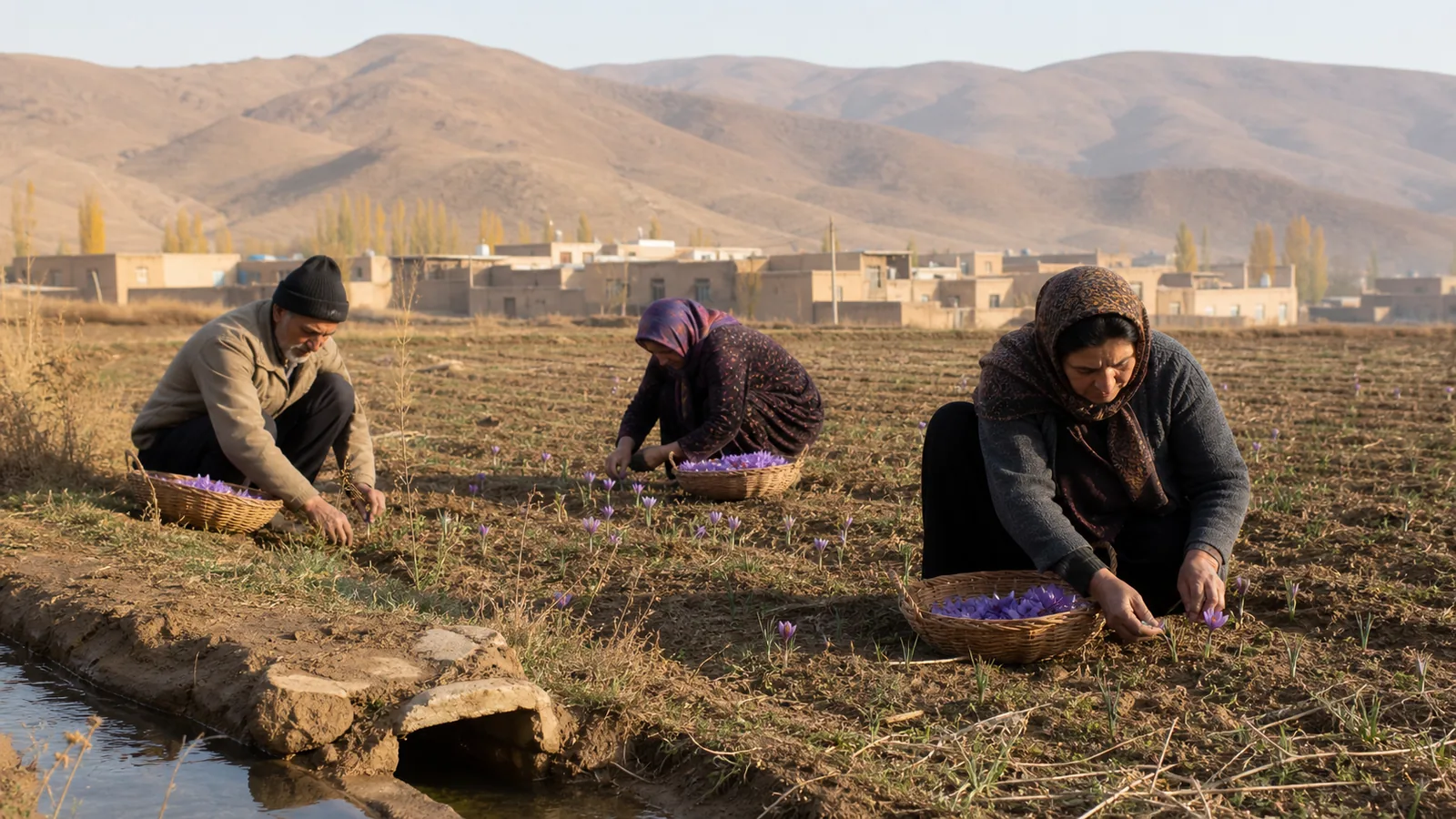
Azan village saffron was the centre of a local harvest-and-tourism festival designed to support growers, improve handling, and introduce visitors to the farming culture of Meymeh in Isfahan Province. An archived report put Azan’s saffron area at more than 80 hectares and annual dried production above 250 kilograms. A second village report from nearby Kashan adds a useful comparison: Alavi had a smaller area but a more detailed plan for drying equipment, a cooperative, and direct sales.
Picking saffron in Azan village
The Azan account was built around the village’s first Saffron and Tourism Festival. Mohammad Reza Ebrahimi, identified as the village Islamic Council chairman and festival secretary, said the event was intended to promote a crop suited to a water-constrained agricultural economy while helping farmers improve both the amount and quality of their production.
The report described more than 80 hectares of saffron plots. Because many holdings were small and scattered, the figure had been assembled with Agriculture Jihad during land-insurance work rather than from one continuous plantation. Estimated annual production exceeded 250 kilograms. Ebrahimi also said saffron had been grown in the village for 48 years at the time of the report.
Why the festival joined farming and tourism
The festival’s purpose went beyond celebrating the harvest. Organizers wanted officials to hear growers’ problems, farmers to learn about picking, processing, hygiene, packaging, and sales, and the village to develop a recognizable saffron identity. Plans also included honouring leading growers and explaining Azan’s agricultural history to visitors.
The tourism part was rooted in the village rather than added as generic promotion. The report named local mountain scenery, qanat heritage, and the shrine of Seyedeh Saleheh Khatoon among the area’s attractions. It presented saffron and Damask rose cultivation as part of that same rural landscape. These are historical festival aims; visitors should confirm present access, event dates, and local services before planning a trip.
Water, qanats, and a high-value crop
Azan’s report credited fertile soil and qanat water for the local crop. It also proposed a company through which farmers could pool suitable land and introduce more mechanized cultivation of saffron and Damask roses. The plan was forward-looking, so it should not be described as completed without later records.
The connection between qanats and dryland agriculture is well established in the region. FAO’s account of the qanat-irrigated agricultural heritage system of Kashan describes these underground channels as a long-standing source of reliable water for crops including saffron. That does not prove the quality of any individual batch, but it explains why water management and local farming knowledge belong in this village story.
Quality needs more than a local superlative
The original Azan article praised the saffron’s aroma and purity and printed an unexplained “above 86%” result. It did not identify the laboratory, sample, measured compound, test method, or certificate. That percentage therefore cannot be used as a meaningful purity grade. Nor can a claim that the village crop is superior to every market alternative be supported from the saved report alone.
A defensible quality description starts with careful picking, prompt separation, controlled drying, clean packaging, and traceable storage. Formal comparison requires defined tests. The current ISO 3632-1:2025 specification applies to dried saffron in filament, cut-filament, and powder forms and includes recommendations for storage and transport. Festival education can help growers understand the chain, but branding cannot replace evidence.
Alavi village: a second Kashan-area model
An archived report from Alavi village—spelled “Alawi” in its old English title—described another community using saffron alongside its established Damask rose production. Village council chairman Vahid Reza Ramezani said about 25 of the Kashan region’s 65 saffron hectares were in Alavi, making it the region’s largest saffron-producing village in that report. He gave its dried harvest as 120 kilograms and said cultivation had begun about 20 years earlier.
The report linked the crop to 70 direct and 150 indirect jobs. It also described an October 20 to November 20 harvest window and a productive field life of up to seven years. These are dated local figures, not present-day employment or agronomic guarantees, but they show how much village labour can gather around a relatively small cultivated area.
Drying machines, cooperative sales, and a festival
Alavi’s next steps addressed what happens after flowers are picked. Kashan Agriculture Jihad had allocated 10 saffron-drying machines, and the village planned a cooperative to reduce dependence on intermediaries and sell more directly. A local saffron festival was also proposed. One grower reported reaching six kilograms per hectare with a newer cultivation method; it is a single reported result, not a yield promise for every plot.
These measures complement Azan’s festival agenda. Drying equipment can improve consistency only when it is clean, correctly operated, and matched to the product. A cooperative can strengthen marketing only if its grading, records, payment terms, and quality rules are transparent. A festival can attract buyers and visitors, but the product still has to earn trust batch by batch.
What the two village accounts teach
Azan’s strengths in the report were its larger cultivated area, long local history, qanat setting, and attempt to combine agricultural education with tourism. Alavi’s account supplied a concrete harvest total, employment figures, drying equipment, and a cooperative plan. Neither village should be folded into the other; each contributes a different example of how a small farming community can retain more value from saffron.
The useful path is continuous. Pick the flowers in their brief season, separate and dry the stigmas carefully, document quality, package them cleanly, and give growers a fair route to market. Tourism and festivals can tell that story, provided the claims made to visitors remain as careful as the work in the fields.

![Exporting Saffron to Turkey + Price Guide [Complete 0 to 100]](https://img.rowhanisaffron.com/20260827003933/saffron-export-turkey-quality-inspection.webp)



