


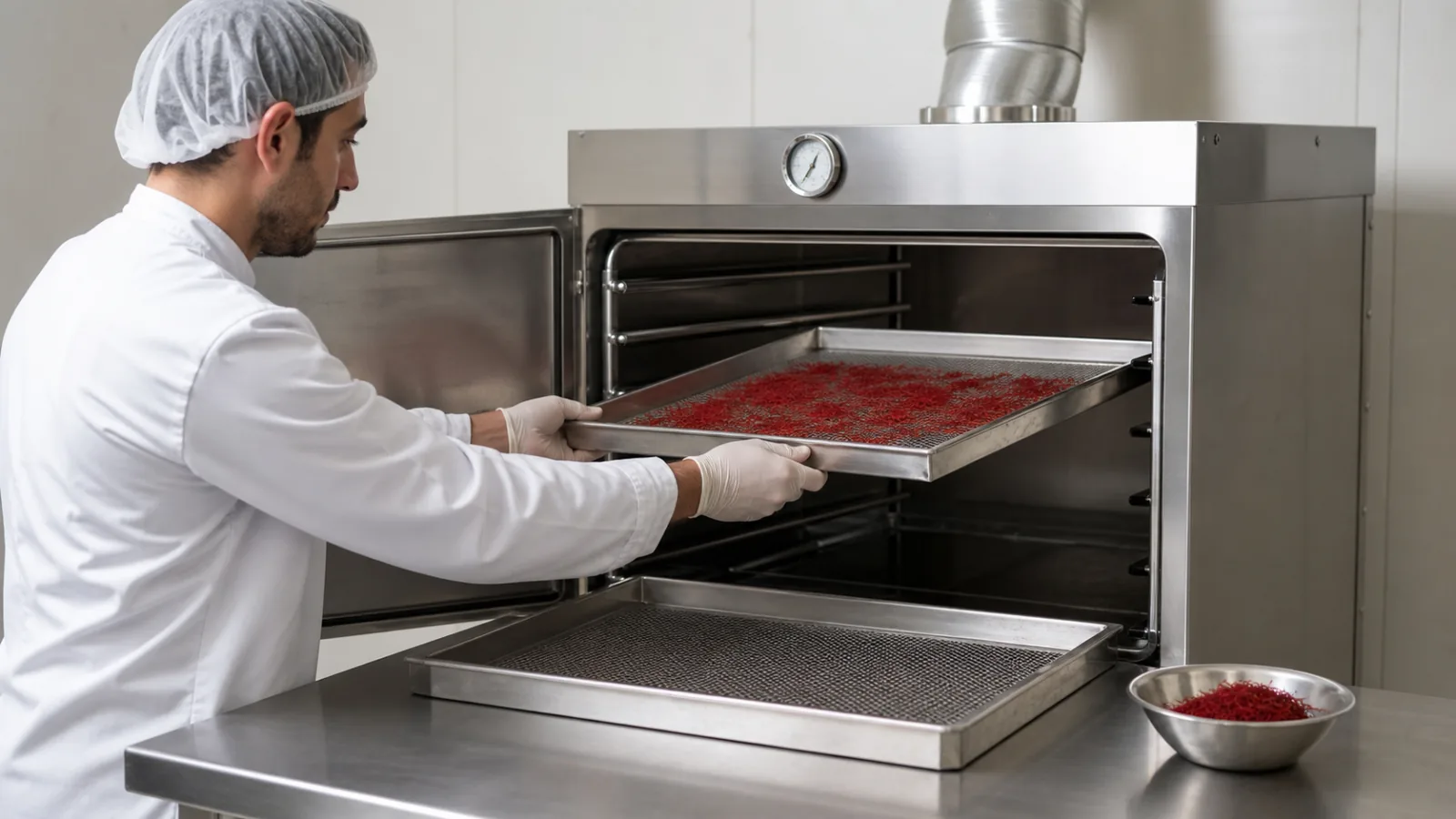
A saffron drying machine was produced to address one of the most delicate stages in processing: removing moisture from fresh stigmas without unnecessarily sacrificing colour, aroma or flavour. The device appeared in an Iranian news report as a drying reactor for saffron, barberry and vegetables. Its inventor, Abolghasem Chapari, described a closed system that circulated air, removed moisture and used filters to keep lightweight plant material inside the chamber.
The report is brief and does not provide a model number, patent, test certificate, capacity or operating settings. It should therefore be read as a historical account of a prototype or product announcement, not independent proof that the machine outperformed every other dryer.
What the reported saffron drying machine did
Chapari called the equipment a reactor and said its purpose was to reduce the loss of volatile aromatic compounds while drying. The translated article originally reversed part of that meaning, suggesting that the machine reduced aromatic substances themselves. In context, the claim was about reducing their loss and limiting the overall decline in quality.
The description points to three main parts:
- an enclosed chamber where saffron or another plant product was held;
- circulating air with moisture removed from the loop; and
- a filter arrangement intended to stop light material from being pulled out of the chamber.
The English source also used the words “vacuum cleaner,” but it did not publish a pressure range or enough engineering detail to establish that this was a controlled vacuum dryer. It is safer to describe it as an enclosed drying reactor with air-handling and filtration unless its technical documentation is available.
Drying is one part of saffron processing
Searches for a saffron machine can refer to very different equipment. A saffron harvesting machine works in or near the field to collect flowers. A flower-separation system attempts to separate stigmas from petals. A saffron processing machine may cover sorting, drying, grading or packing. The device reported here was for drying after the red stigmas had already been separated.
That distinction keeps expectations realistic. This reactor did not replace flower picking, stigma separation or final quality control, and the report did not say that it harvested saffron. Readers comparing field equipment can see our separate article on the development of saffron harvesting and processing machines.
Why controlled drying matters
Fresh saffron stigmas contain too much moisture for stable storage. Drying reduces that moisture and develops the characteristics associated with the finished spice, but the process has to be controlled. Too little drying leaves a product vulnerable to deterioration. Excessive heat, time or uneven airflow may damage colour and aroma or make one tray behave differently from another.
The important quality compounds do not respond identically to every process. Crocins are associated with colour, picrocrocin with taste and safranal with aroma. Peer-reviewed comparisons have found meaningful differences among vacuum, oven, microwave, infrared and freeze-drying conditions. A study comparing vacuum and electric-oven drying, for example, examined drying kinetics and changes in saffron’s structure and chemical profile rather than declaring that the word “vacuum” alone guaranteed quality.
This is why a machine needs a validated process as well as hardware. Temperature, pressure where applicable, air movement, sample depth, load size and time work together. Settings that succeed with a thin laboratory sample cannot be assumed to work unchanged with a full commercial tray.
How to assess a saffron drying machine
A buyer or processor should ask for evidence produced with saffron, at the load size the machine is expected to handle. Useful checks include:
- Control: Can the operator set, monitor and record temperature, time, airflow and pressure where relevant?
- Uniformity: Do stigmas at the centre and edges of every tray reach a similar final condition?
- Capacity: Is the stated throughput based on fresh stigmas, dried saffron or whole flowers?
- Hygiene: Are all food-contact surfaces suitable, accessible and easy to clean between batches?
- Containment: Do filters retain light stigmas without restricting the air circuit as they load with particles?
- Measurement: Is final moisture checked by a reliable method rather than judged by colour or touch alone?
- Quality: Have representative batches been tested for colour, aroma, flavour, contaminants and consistency?
- Service: Are spare parts, calibration, operating instructions and technical support actually available?
Energy use and cleaning time also belong in the calculation. A fast cycle may not be economical if it handles only a small load, needs long preparation or produces uneven batches.
What the barberry and vegetable claim means
The original announcement said the same reactor could dry saffron, barberry and vegetables. That suggests a flexible chamber, but it does not mean one programme is suitable for all three. A berry, a leafy vegetable and a saffron stigma differ in size, moisture, structure and valuable compounds. Each material needs its own tested loading pattern and settings.
Cross-use creates practical hygiene questions as well. Residue, dust and aroma from one product should not carry into another batch. A multi-product machine needs cleaning instructions that cover its chamber, trays, ducts, filters and moisture-removal components.
Where the machine fits in a sound workflow
Mechanical drying can improve repeatability, but only if the material entering the machine is handled properly. Flowers should be protected from crushing and contamination, stigmas should be separated on clean surfaces, and waiting time before drying should be controlled. The finished saffron then needs cooling, grading and packaging that protects it from moisture, strong light and unwanted odours.
Our guide to saffron drying methods explains the wider process and the trade-offs among common approaches. It also helps distinguish a useful controlled dryer from an impressive-looking chamber with no verified operating method.
What can responsibly be concluded
The historical report documents that Abolghasem Chapari presented a saffron drying machine built around a recirculating chamber, moisture removal and filtration. Its intended benefit was to dry delicate plant products while limiting quality loss. Those are sensible engineering aims.
What the report does not establish is the machine’s commercial availability, present specification, certified capacity or measured advantage over alternatives. Anyone evaluating this or another saffron processing machine should ask for technical records and side-by-side batch results. In drying, a credible outcome comes from controlled settings, uniform product and verified quality—not from the machine’s name alone.

![Exporting Saffron to Turkey + Price Guide [Complete 0 to 100]](https://img.rowhanisaffron.com/20260827003933/saffron-export-turkey-quality-inspection.webp)



