


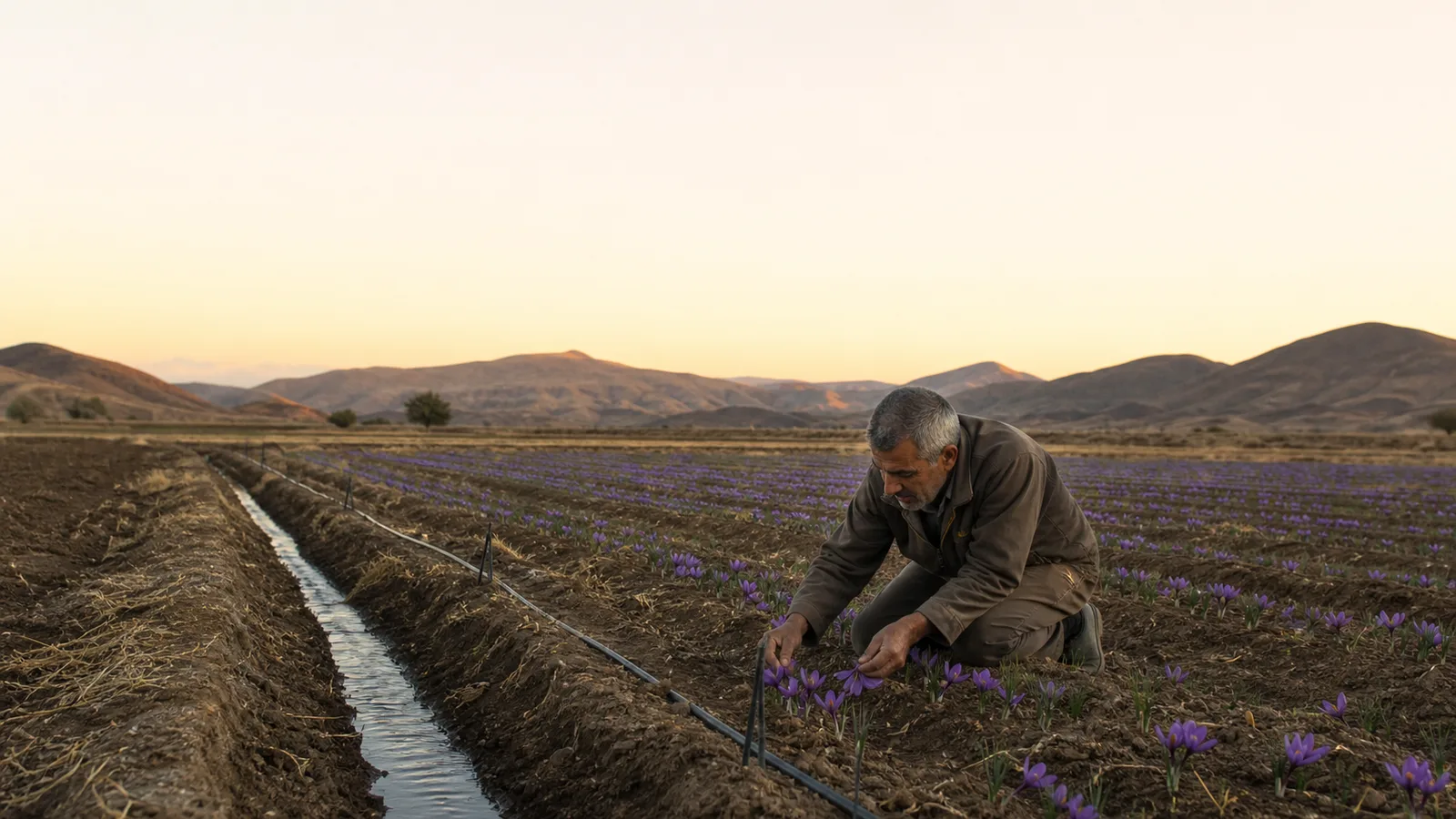
Kermani Farmer’s Threat to Drop is the inherited English title of a report about a much clearer issue: prolonged drought was making established crops harder to sustain, and farmers in parts of Kerman were testing saffron as an alternative. The story was never simply that one crop could solve the province’s water crisis. It was about the difficult choices behind changing a cropping pattern.
Kerman is often described as desert, yet agriculture has long shaped many of its districts. Its farms and orchards have supplied pistachios, dates, walnuts, cherries and other fruit, while southern areas have produced continuous crops such as potatoes and onions. That productivity sits beside severe water stress. In the period covered by the original report, Kerman had endured roughly 17 years of drought, with cultivated area, yield and product quality all under pressure.
This article preserves that historical account while correcting its mistranslated passages and separating reported figures from current advice. The old numbers should not be read as a present-day water audit or price quotation.
Why Kerman’s cropping pattern came under pressure
The report said agriculture accounted for about 90% of water use in Kerman at the time. It also repeated an estimate that around 70% of water used in traditional flood irrigation could be lost before it benefited the crop. Those figures have appeared in later provincial reporting, but estimates vary depending on whether they measure withdrawals, consumption, conveyance loss or field efficiency. Their value here is historical: they show why water management had become central to the farming debate.
Replacing flood irrigation with a pressurised system sounded straightforward on paper. Farmers described a more complicated reality. Conversion required capital, equipment costs were rising, and hard or saline water could block emitters or shorten the life of a poorly designed system. A method that works in one orchard may not suit another water source, soil or crop. Mechanisation therefore moved more slowly than farmers and officials wanted, even where growers were willing to change.
The economic problem was just as serious. Some water-intensive crops could consume water whose local value exceeded the return from the harvested product. Officials repeatedly called for reform of the cultivation pattern, but a viable replacement also had to provide income, fit the climate and have a reliable route to market. Telling a farmer to use less water without solving those practical questions was not a plan.
Why saffron became part of the discussion
Farmers in several parts of Kerman turned to saffron cultivation because it can require less irrigation than many conventional field crops, has a high value relative to its harvested weight and suits some dry, cold-winter environments. Corms and growing knowledge had travelled from the established saffron areas of Khorasan and Qaenat.
That does not make saffron a water-free crop or a universal replacement. The FAO’s account of qanat-based saffron farming in Gonabad describes a system adapted to severe water scarcity and notes that saffron does not require large quantities of water. Research on Iranian production adds an important qualification: saffron’s water footprint varies widely between provinces, and irrigation efficiency and yield still matter. A field needs an adequate, timed water supply, suitable drainage and healthy corms.
For Kerman, rising saffron prices strengthened the appeal. But price alone could not decide whether a field should change crops. Labour is concentrated into a short flowering period, every flower must be picked promptly, and the stigmas need careful separation and drying. A grower without enough harvest labour or a trustworthy buyer can lose value even after producing a good crop.
Dasht-e Khak: when the soil plain became a flower plain
Zarand, especially the village of Dasht-e Khak, became one of the report’s main examples. Its English translation rendered the village name as “Soil Plain” and described it becoming a “flower plain” as purple crocuses opened. Nearby place names were also distorted. The original list appears to refer to Dasht-e Khak, Hatkan and Sarbanan, three recognised settlements in the Zarand area.
Mohammad Barazandeh, identified in the report as an agricultural economist and university professor, argued that Kerman urgently needed credible alternative-cultivation plans. Surveys had indicated that some plains could support saffron, so corms were brought from Khorasan and cultivation in Zarand and Dasht-e Khak received particular attention. He linked the move to drought and described the harvested saffron as high quality.
Quality at the farm gate, however, was only part of the opportunity. Barazandeh warned that Kerman could repeat problems already familiar in established producing provinces: farmers selling flowers or undifferentiated saffron in bulk, brokers capturing too much of the value, and too little local capacity for controlled drying and processing.
His practical point remains sound. Fresh saffron flowers are perishable. If stigmas are not separated and dried correctly, colour, aroma and food safety can suffer. Local training, hygienic drying, lot separation, traceability and access to testing allow more of the product’s value to stay with the grower. Simply increasing planted area without building that chain can produce more flowers without producing a better farm business.
The harvest celebration and the reported 170 hectares
Reza Karami, then identified as governor of Zarand, linked saffron’s growth to farmer education and the strong response in local villages. The district marked the harvest season with an annual celebration in Dasht-e Khak while hand-picking was under way.
The report attributed roughly 170 hectares of saffron to Dasht-e Khak, Hatkan and Sarbanan. Because the surviving English text garbled two of those names and did not specify the statistical year clearly, that acreage should be treated as a historical figure reported by the official, not as a current land-area estimate. Its significance is that cultivation had moved beyond a single demonstration plot into several nearby communities.
Rafsanjan and the Raviz trial
Alternative cultivation was also being explored in Rafsanjan. Reza Bemani, identified as a local agricultural official, said saffron harvesting had begun on more than 10 hectares in the Raviz district. A surviving account of the same figures expected a yield of two to three kilograms per hectare, rather than the mistranslated “more than three” in the old English version.
The reported price was 45 million rials per kilogram. That was a figure for the season covered by the report, not a usable saffron price today. Currency changes, grade, moisture, testing, packaging, sales channel and contract terms make a direct modern comparison misleading.
Bemani also referred to the “sweetness” of the Raviz qanat. In agricultural usage, this meant comparatively fresh, lower-salinity water rather than a sweet taste. Water quality matters because salinity can affect emergence, corm development and yield. Raviz’s result showed potential, but the claim that saffron could be planted throughout Rafsanjan still required field-by-field assessment.
Saffron is an option, not a substitute for water planning
The historical report captured a real shift: as drought exposed the cost of existing cropping choices, saffron gave some Kerman farmers a high-value crop to test. It also showed why changing the crop name on a plan is not enough.
Before converting land, a grower needs to examine:
- Available water: seasonal volume, timing, reliability and the true efficiency of delivery to the root zone.
- Water and soil quality: salinity, drainage, texture, pH and risks to emitters or corm health.
- Climate and field position: winter cold, autumn flowering conditions, summer heat and frost exposure.
- Planting material: healthy, correctly identified corms from a traceable source, without bringing pests or disease into a new district.
- Harvest capacity: enough trained labour to pick flowers quickly and separate the stigmas cleanly.
- Post-harvest control: hygienic drying, storage away from heat, light and moisture, and testing appropriate to the intended market.
- A sales route: realistic demand, grading and buyer terms rather than a decision based only on a headline price.
A small trial can answer those questions more safely than an immediate whole-farm conversion. Recording irrigation, labour, yield and saleable grade over more than one season also gives the farmer evidence that a good first flowering cannot provide.
What the Kerman experience ultimately shows
Kerman’s farmers were not abandoning agriculture. They were looking for a crop that could make better economic use of limited water while keeping rural land productive. Zarand’s flower-covered fields and Raviz’s first harvests showed that saffron could contribute to that response in suitable places.
The caution in the original interviews matters just as much as their optimism. Cultivation needs to be matched with efficient irrigation, sound agronomy, skilled hand harvesting, controlled drying and fair access to markets. When those pieces are planned together, saffron can be a useful part of crop diversification. When they are not, farmers may exchange one set of risks for another.
Sources and context
- The historical Kerman, Zarand and Rafsanjan statements are preserved from the 2018 news report originally published on this URL and attributed there to YJC and Mehr interviews.
- FAO: Qanat-based Saffron Farming System in Gonabad, Iran.
- Agricultural Water Management: water-footprint accounting for saffron production in Iran.
- Iran Pistachio Association archive: the Raviz cultivation, yield and historical price figures.

![Exporting Saffron to Turkey + Price Guide [Complete 0 to 100]](https://img.rowhanisaffron.com/20260827003933/saffron-export-turkey-quality-inspection.webp)



