


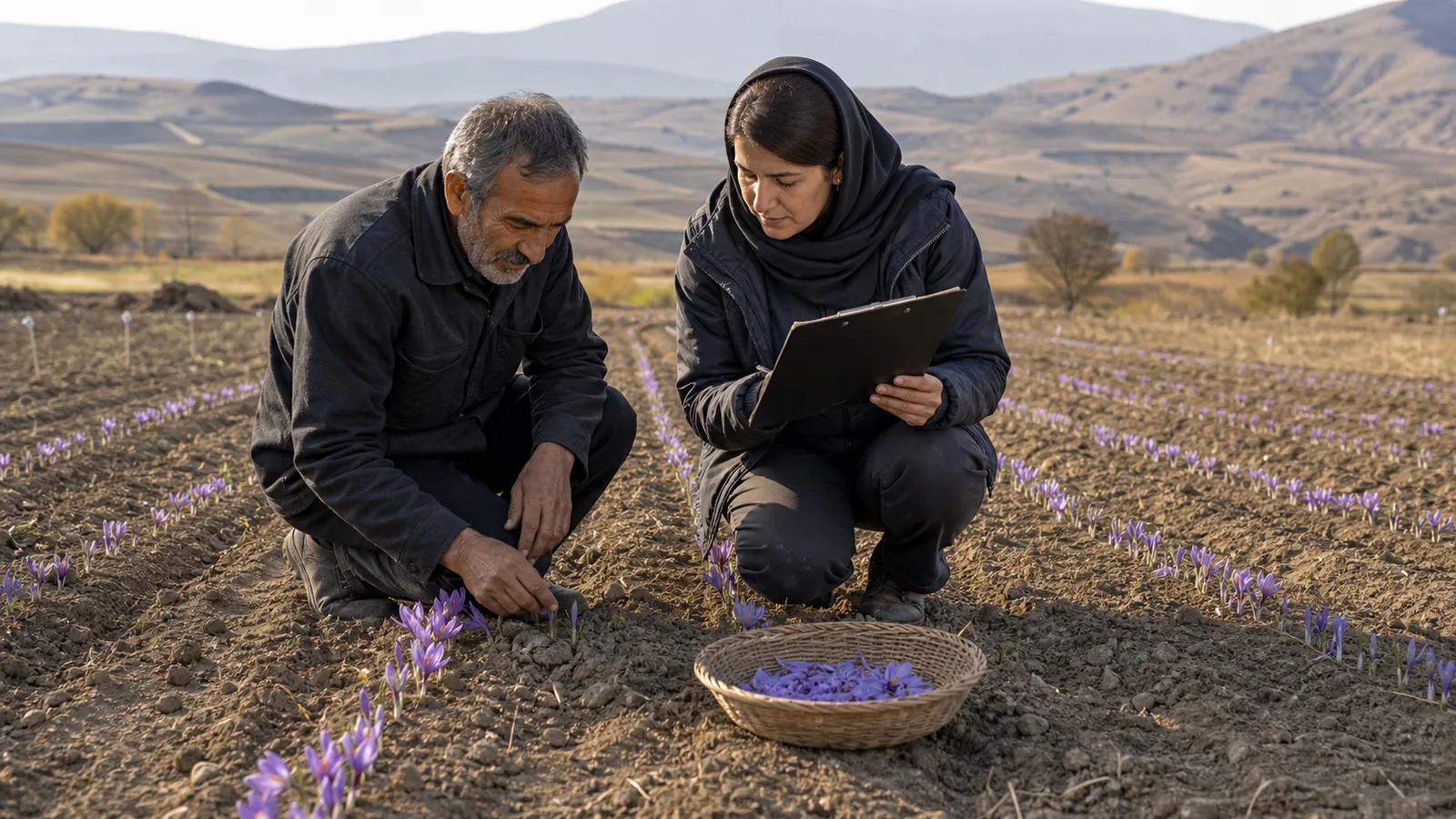
Two historical reports described early saffron planting trials outside Iran’s main Khorasan production belt: a small model plot near Saqez in Kurdistan Province and a three-hectare planting in Firoozabad, Fars Province. The Saqez grower was testing whether saffron suited local conditions. In Firoozabad, agricultural scientist Mahboubeh Jafari reportedly harvested 15 kilograms of dried saffron after two years of preparation and one planting season.
These accounts are useful as local case studies, not proof that saffron will succeed on every farm. Site selection, healthy corms, soil drainage, temperature, irrigation, labor, drying, and a dependable buyer all determine whether a promising trial becomes a durable crop.
Why saffron planting trials moved beyond Khorasan
Iran’s established saffron economy is concentrated in Greater Khorasan, where growers, workers, processors, and buyers have generations of experience. The Kurdistan and Firoozabad reports show a different stage: farmers and researchers testing the crop in places without the same mature supply chain.
Both reports emphasized crop diversification. Saffron flowers in autumn, when work on many other crops has eased, and a field can remain productive for several seasons. Its irrigation needs can be lower than those of many competing crops, but “lower water use” does not mean no water, no management, or suitability for every soil.
The FAO’s account of the qanat-based saffron system in Gonabad likewise describes saffron as adapted to an arid and semi-arid region and not requiring large quantities of water. It also places that advantage within a functioning irrigation and farming system.
The early saffron trial near Saqez, Kurdistan
The destination article attributed the Kurdistan trial to a Saqez resident named Alaei. He described strong personal interest in agriculture and wanted to test whether a different crop could fit the local climate and cropping pattern.
The translated report says he had planted saffron three years earlier as a model cultivation. It calls this the first planting in Kurdistan Province, but it provides no provincial survey or official record proving that no one had planted saffron there before. “Early reported trial” is therefore safer than an absolute first-ever claim.
Alaei expected saffron work to complement the agricultural calendar because autumn flowering begins after many other crops have been gathered. That can help with farm scheduling, although the flower-picking window is short and labor-intensive in its own right.
First-year production is not the same on every field
The old translation says saffron produces nothing in its first year and yields in later years. That is too absolute. Newly planted corms may flower in their first autumn, depending on corm size and health, planting date, climate, and management. Yield often changes as the underground corm population develops over subsequent seasons.
A new grower should separate three questions: whether the plants emerge and flower, how much dried saffron is recovered, and whether the crop is commercially viable after labor and processing costs. One successful flowering season answers only the first part of that test.
Firoozabad’s three-hectare planting
The assigned source moves to Firoozabad in Fars Province. It identified Mahboubeh Jafari as a senior agricultural scientist who spent two years researching the crop before planting three hectares in September.
The report says she collected 15 kilograms of dried saffron about three months later. If the full three hectares were productive, that equals five kilograms per hectare. This is a calculated average from the article’s figures, not a separately audited field measurement.
Jafari’s stated purpose was to encourage Firoozabad farmers to consider saffron. Demonstrating the crop locally is valuable because it exposes problems that broad climate comparisons miss: planting-material quality, actual emergence, frost timing, harvest labor, stigma separation, drying conditions, and access to buyers.
Firoozabad’s agricultural setting
The archived report assigned Firoozabad 33,000 hectares of agricultural land and said 70% of local people were engaged in farming. It does not identify the census year, boundaries, or whether the percentage refers to residents, households, or the working population. The figures should be treated as attributed historical context rather than current demographic data.
A large farming base can make crop trials easier to observe and discuss. It does not itself show how much land is suitable for saffron. A three-hectare demonstration is still a small fraction of the reported agricultural area.
Planting and harvest timing in the report
The Firoozabad article placed planting in September and harvest from mid-November to early December. That calendar describes the reported local trial. Exact timing varies with elevation, autumn temperatures, soil moisture, corm dormancy, and planting date.
Growers need enough moisture for root and shoot development without leaving corms in waterlogged soil. Harvest then requires daily attention as flowers open. Delayed picking or slow stigma separation can reduce quality before drying even begins.
Saffron needs the right field, not “every land”
The Saqez translation claims saffron can grow on every type of land, especially rainfed ground. That wording is misleading. Saffron is resilient in dry climates, but it still performs best where soil drains well, corms are healthy, temperatures suit its annual cycle, and moisture arrives at the right times.
Heavy waterlogging raises the risk of corm disease. Very weak soil structure, unsuitable salinity, severe weather, or a lack of establishment water can undermine a planting. Rainfed production may work in some local conditions, but it cannot be promised from the crop name alone.
What should be measured before expanding a trial
A responsible trial records more than the first dried yield. Farmers need to follow the same plot for several seasons and document:
- corm source, size, health, planting depth, and density;
- emergence, flowering dates, flower count, and dried yield;
- irrigation, rainfall, soil drainage, weeds, pests, and disease;
- hours required for picking, stigma separation, and drying;
- quality-test results, buyer requirements, sale price, and total cost; and
- corm multiplication and field performance in later years.
Those records make it possible to compare saffron with local alternatives instead of assuming a high retail price guarantees farm profit.
From a promising plot to a local crop
The Saqez and Firoozabad stories share a practical message: expansion begins with observation at field scale. The growers did not merely copy Khorasan’s reputation; they tested how the plant behaved in their own agricultural setting.
For a national view of other trial regions and the continued importance of the established production provinces, read our guide to the expansion of saffron cultivation in Iran.
A successful first harvest is encouraging. A coherent local industry requires repeatable yields, healthy planting material, trained harvest labor, controlled drying, quality verification, and a market that pays enough to cover the work.

![Exporting Saffron to Turkey + Price Guide [Complete 0 to 100]](https://img.rowhanisaffron.com/20260827003933/saffron-export-turkey-quality-inspection.webp)



