


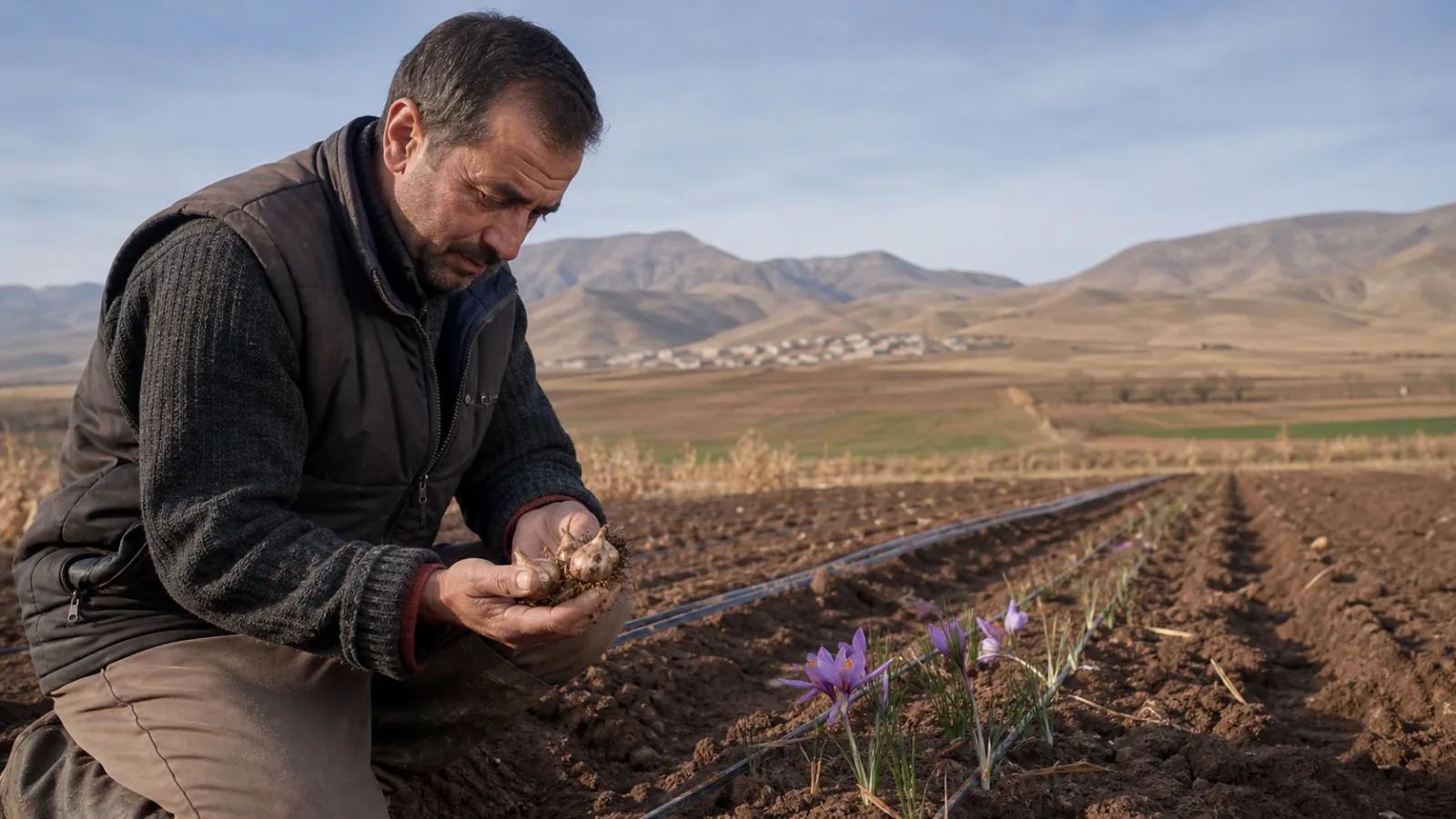
Planting saffron in East Azarbaijan has been encouraged for a practical reason: the crop’s main irrigation periods do not overlap in the same way with many summer crops, and its water demand is comparatively modest. That does not make saffron a dry-farmed crop, but it can make it a useful option where water is limited and farmers need more value from a small area.
A provincial report published in 2018 attributed this reasoning to Saadollah Eskandari, then director of horticulture at the East Azarbaijan Agricultural Jihad Organization. He described drought and water restrictions as important motives for expanding cultivation. Marand was identified as the province’s leading saffron-growing county, with 75 hectares under the crop at the time.
Why growers were considering saffron
The original report was damaged by translation. Its opening appeared to say that saffron had a high water requirement. The intended point was the opposite: many established crops need substantial water, while saffron uses relatively little and requires it at a different point in the agricultural calendar.
That seasonal difference matters. Saffron corms lie dormant through summer and begin active growth as temperatures fall. Irrigation before flowering and during the cool growing period must still be managed carefully, but the crop does not impose the same summer demand as an actively growing orchard or field crop. The FAO’s description of Iran’s qanat-based saffron system likewise treats saffron as a crop adapted to severe water scarcity, while making clear that reliable water management remains part of production.
The historical picture in East Azarbaijan
Eskandari’s 2018 account named Tabriz, Osku, Azarshahr and Shabestar among the counties using saffron in model or trial plantings. It also recorded Marand as the largest producing area in the province at that time. These details are a historical snapshot, not a statement of today’s planted area.
The direction was not new. An earlier Iranian Agricultural News Agency report from 2012 also quoted Eskandari on the province’s saffron programme. It discussed demonstration fields, Marand’s role and the advantage of avoiding competition between saffron irrigation and other farm irrigation. The two reports use different acreage figures because they describe different dates.
What makes a field suitable
A province can have promising conditions without every parcel being suitable. Saffron needs a site that drains freely. Water standing around dormant or growing corms raises the risk of rot, while compacted ground makes root and corm development harder. Before planting, the grower should inspect the soil profile, drainage after irrigation and any history of soil-borne disease.
Winter cold is another local consideration. Saffron tolerates cold conditions, but exposure, snow cover, planting depth and abrupt freeze-thaw cycles can change the risk at field level. Advice developed for a warmer producing area should not be copied automatically in East Azarbaijan. Local trial plots and guidance from the provincial agricultural service are more reliable than a universal calendar.
Planting material deserves the same scrutiny. Sound saffron corms should be firm and free from visible rot or injury. Their source, storage conditions and health matter because a field may remain in place for several years. Our practical guide to selecting and handling saffron corms covers the checks to make before they go into the ground.
Water saving is only one part of the decision
Water scarcity may motivate a change of crop, but it cannot establish profitability on its own. A farmer also needs to calculate the cost of corms, soil preparation, weeding, irrigation, harvest labour, stigma separation, drying, packaging and sale. The flower season is brief, and a shortage of trained hands on peak days can reduce both yield and quality.
Market access matters just as much. Saffron is valuable by weight, yet the return depends on clean handling, consistent drying, grade, traceability and the terms offered by the buyer. “High value” is not the same as guaranteed high profit.
A useful farm comparison records:
- water applied to the saffron plot and to the crop it may replace;
- marketable dry saffron rather than fresh flower weight;
- all establishment and annual labour costs;
- quality grade and the price actually received; and
- performance over several seasons, including corm multiplication and field decline.
These figures reveal whether planting saffron improves water productivity and household income under the farm’s own conditions.
Employment during the harvest
The 2018 report also presented saffron as a source of seasonal employment and connected it with support for Iranian labour and production. That benefit is plausible, but it comes from real work that must be planned. Flowers are picked promptly, transported without crushing, separated on clean surfaces and dried under controlled conditions. Delays at any of these stages can waste the value created in the field.
For villages with available harvest labour and a dependable route to market, this concentrated workload can be an advantage. Where labour is scarce or processing space is unsuitable, it can become a bottleneck. A development plan should therefore include people, hygiene and post-harvest capacity, not acreage alone.
A careful path to expansion
The motivation for planting saffron in East Azarbaijan is understandable: drought pressure, a cool-season growth cycle, comparatively low water demand and the possibility of a valuable crop from limited land. The historical experience in Marand, Tabriz, Osku, Azarshahr and Shabestar shows why the option attracted official attention.
The safest next step for an individual grower is still a measured one. Test the crop on suitable, well-drained ground; document water, labour, dry yield and sale price; and judge the results across more than one season. Saffron can fit a water-conscious farming plan, but good corms, local agronomy, disciplined harvesting and a real buyer determine whether that promise survives beyond the first planting.

![Exporting Saffron to Turkey + Price Guide [Complete 0 to 100]](https://img.rowhanisaffron.com/20260827003933/saffron-export-turkey-quality-inspection.webp)



