


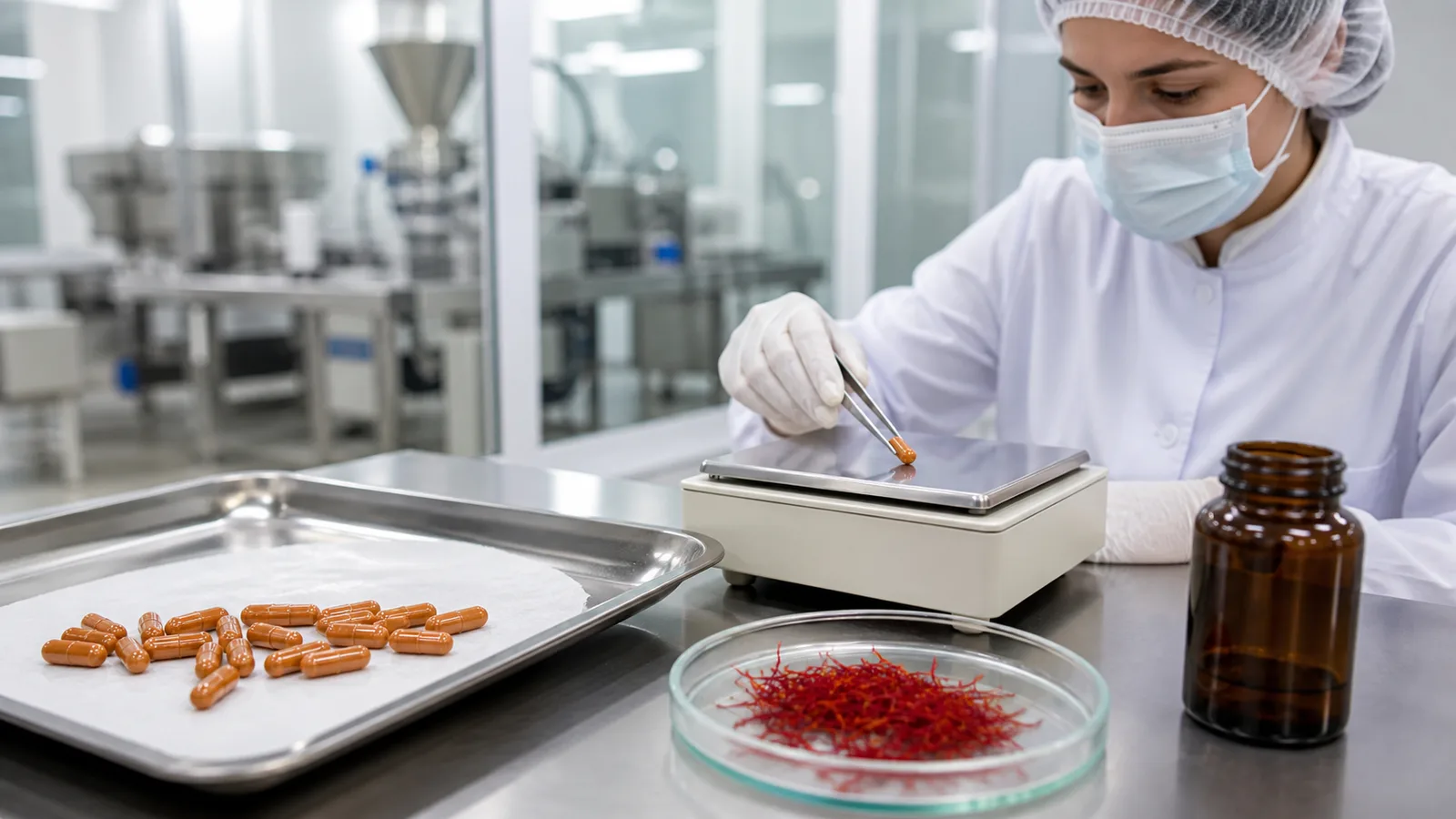
Saffron capsules in Iran were announced in an old news report about domestic herbal products. The report said a capsule was being produced, but it did not name the manufacturer, formulation, regulatory authorisation, extract standard, dose, intended indication or launch date. It is therefore evidence of an announcement—not enough information to identify a product sold now.
Modern clinical research has examined standardised saffron preparations for mood and several other outcomes. Results from one capsule or extract cannot be transferred automatically to every product labelled “saffron.” The raw material, plant part, extraction method, active-marker content and amount per capsule all affect what a person is taking.
What the original Iranian announcement said
The archived item quoted Dr Mirfakhraei, described as secretary of the country’s Association of Herbal Medicines and Medicines, in a report attributed to the Journalists’ Club/YJC. He announced the production of saffron capsules and referred to saffron’s traditional and herbal-medicine uses.
The translated report said saffron promoted “a sense of goodness and a good sense of life,” helped relieve depression, facilitated blood flow and aided “cardiopulmonary bypass.” That last phrase is medically implausible as written and appears to be a translation error—possibly a reference to cardiovascular circulation. It should not be interpreted as a claim that saffron supports a heart-lung machine, replaces cardiac treatment or improves bypass-surgery outcomes.
The same article claimed that saffron’s antioxidant effect could slow ageing and fight free radicals and cancer. Antioxidant activity can be measured in laboratory systems, but it does not demonstrate that a capsule prevents ageing or treats cancer in people. A product claim needs evidence for the exact preparation and clinical outcome.
The unrelated mouthwash paragraph
The story also included a heavily garbled announcement about a mouthwash. It appeared to say that chemical mouthwashes contained substances that could irritate mucous membranes, that the first domestic herbal mouthwash had been produced, and that it would enter the pharmaceutical market the following year with less bitterness and a more acceptable taste.
No product name, ingredients, licence, study or launch year survived in the translation. The mouthwash was not described as a saffron capsule, so it should not be merged into the capsule’s benefits. It remains part of the historical press report, but a current product claim would need a traceable label and regulatory record.
What research says about saffron and mood
Saffron’s best-known human research concerns depressive and anxiety symptoms. A 2019 systematic review and meta-analysis found positive effects compared with placebo and as an adjunct in some studies, but also detected publication bias and limited regional diversity. A 2026 GRADE-assessed review of 34 randomised trials found improvements on some self-reported scales but not on every clinician-rated or mood measure; certainty was rated moderate and heterogeneity was high.
These results are promising, not a licence to self-diagnose or stop prescribed treatment. Trials generally used a defined saffron stigma preparation, extract or constituent for a set duration, selected participants by study criteria and monitored outcomes. A consumer capsule may not match that intervention.
Depression also varies in severity and can involve self-harm risk. Anyone with persistent low mood, loss of interest, major changes in sleep or appetite, or thoughts of self-harm needs qualified care. A supplement should not delay assessment or replace a treatment plan.
Blood flow, heart claims and cancer claims
The original phrase “facilitating blood flow” did not specify whether it meant blood pressure, vessel function, clotting, oxygen delivery or another measurement. Clinical evidence maps have found possible changes in some metabolic and cardiovascular risk markers, but study quality and results vary. That cannot support a broad circulation claim.
Likewise, laboratory work on free radicals, cell signalling or tumour cells is not evidence that a capsule prevents or treats cancer. Products should never be marketed as substitutes for oncology care on the strength of antioxidant language.
Saffron capsules are also not established protection against heart attack or atherosclerosis. People using medicines for blood pressure, clotting, mood or another condition should discuss supplements with their clinician or pharmacist because a concentrated herbal preparation is a different exposure from saffron used sparingly in food.
What makes a saffron capsule credible
A credible finished product should let the buyer and regulator identify exactly what is inside. At minimum, its label and supporting quality system should make clear:
- the botanical name, Crocus sativus, and plant part used;
- whether the ingredient is powdered stigma, an extract or an isolated constituent;
- the amount per capsule and recommended use;
- any standardised marker, with a validated test method;
- all capsule-shell, filler and excipient ingredients;
- manufacturer, batch or lot, production and expiry information;
- storage conditions, warnings and contraindications; and
- the applicable authorisation or registration in the market where it is sold.
WHO guidance on herbal medicines treats good processing, manufacturing and quality control as linked requirements. Identity testing helps prevent substitution. Finished-product specifications should address active or marker constituents where appropriate, contaminants, microbiology, uniformity and stability rather than relying on colour or a marketing story.
This is especially important for saffron because its value creates incentives for dilution or substitution. Our guide to recognising authentic saffron explains checks for culinary threads, but a sealed capsule cannot be authenticated by sight. It depends on traceable manufacturing and analytical records.
Safety is product- and exposure-specific
A 2026 systematic review collected human safety data from 102 trials of saffron monopreparations and one case report. It estimated adverse events in about 17.5% of participants, with gastrointestinal symptoms most often reported and usually mild. The authors found saffron generally well tolerated while advising clinical monitoring for higher-dose or prolonged medicinal use because potentially significant events can occur.
That review does not make every capsule safe. A trial product with verified content is not equivalent to an anonymous bottle. Pregnancy, medical conditions, allergies, planned surgery and concurrent medicines can change the risk. The appropriate advice depends on the actual product and person, not saffron’s reputation as a food.
How to read the old announcement today
The YJC item recorded interest in producing saffron capsules in Iran and paired that announcement with optimistic traditional and antioxidant claims. It did not provide enough identifying information to confirm whether the proposed capsule reached the market, under what name, or with what approved use. The mouthwash passage was a separate product announcement and should remain separate.
The strongest current conclusion is narrower. Saffron preparations have been studied in people, particularly for mood, and some results justify continued research. A capsule should be judged by its exact formulation, evidence, manufacturing quality, safety information and regulatory status. “Made with saffron” is the beginning of that evaluation, not the end.
Sources reviewed: systematic reviews of saffron for depression and anxiety symptoms and a 2026 GRADE-assessed mood evidence synthesis; the systematic review of adverse events from saffron preparations; the WHO Expert Committee report adopting good processing and manufacturing guidance for herbal medicines; and WHO guidance on herbal marker substances and quality control. All accessed 25 August 2026.

![Exporting Saffron to Turkey + Price Guide [Complete 0 to 100]](https://img.rowhanisaffron.com/20260827003933/saffron-export-turkey-quality-inspection.webp)



