


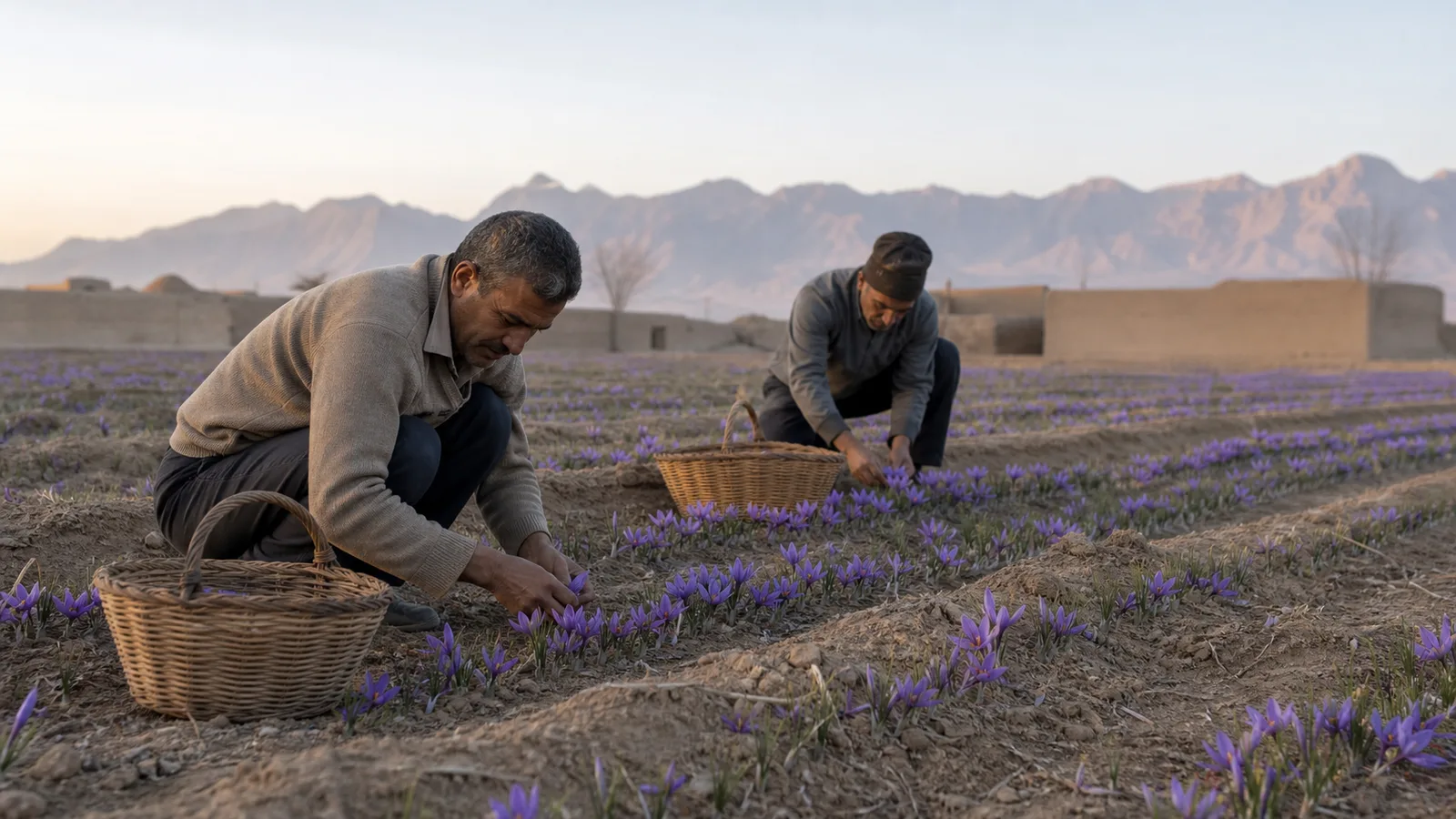
Beginning of harvesting saffron from Yazd province was the title of a short 2018 field notice from Behabad. It reported that saffron picking had started in a village rendered as “Simkooyiyeh” in the surviving English text. Though the original item was only a sentence and two photographs, it recorded the first stage in a demanding chain of work: picking delicate flowers, separating their red stigmas and drying them without losing quality.
This is a historical report, not a live notice that the current season has begun. Harvest dates change with district, elevation, irrigation and autumn temperature. In Yazd, the broader harvest has commonly run from early Aban into Azar, roughly late October through early December, but the field decides the day.
Why Behabad matters to Yazd saffron
Behabad lies in the dry interior of Yazd Province, where farmers have developed crops suited to limited water and sharp seasonal temperature changes. Saffron has been cultivated in the county for decades. Agriculture reporting has repeatedly identified Behabad among Yazd’s leading saffron areas, alongside districts such as Bafq, Mehriz and Abarkuh.
The appeal is understandable. Saffron uses less irrigation than many conventional crops and produces a high-value spice from a small harvested weight. It is not water-free, however, and yield still depends on the timing and quality of irrigation, soil drainage, temperature, corm health and field management.
A 2023 report from Yazd’s provincial agricultural organisation described 750 hectares of bearing saffron across the province and an expected dry-stigma harvest of about 4,000 kilograms. It placed average yield at roughly 5 to 5.5 kilograms per hectare. Those dated provincial figures provide scale; they should not be treated as the current total for every season or as a guarantee for an individual farm.
What “the beginning of harvest” means in the field
Saffron does not ripen as a visible bulk crop. Flowering begins after the corms respond to autumn conditions and the first irrigation pattern. A few flowers may appear first, followed by a rapid flush. The grower must watch the field daily because an unpicked flower loses freshness and is more exposed to dust, sun and weather.
Once flowering accelerates, several tasks happen in sequence:
- Pick early. Closed or newly opened flowers are collected in the cool morning, before strong sunlight and field heat affect them.
- Protect the flowers. Baskets or shallow clean containers prevent crushing. Flowers should not be packed into deep, warm piles.
- Separate promptly. Workers open each flower and remove its three red stigmas, keeping unwanted plant material and contamination out of the lot.
- Dry under control. Drying must remove moisture consistently without scorching the stigmas or exposing them to smoke, dust or an uncontrolled surface.
- Condition and store. The dried saffron needs a clean food-grade container, protection from humidity, light and heat, and lot identification for traceability.
The first flower is therefore only the start. Much of the product’s final aroma, appearance, shelf stability and commercial grade depends on what happens in the hours after picking.
Why farmers pick saffron in the morning
Cool-morning harvest is both a quality practice and a labour strategy. The flowers are firmer and easier to handle, and workers can collect them before the petals fully open. Provincial guidance in Yazd has specifically recommended early-morning picking with hygienic handling.
Morning work also protects the short schedule that follows. If flowers arrive at the separation area earlier, the team has more time to process the day’s crop before it wilts or heats. Large farms often stagger irrigation between plots so all flowers do not reach peak bloom on the same day.
Separating the stigma without losing the lot
Each Crocus sativus flower carries three red stigma branches. Workers may keep only the red section or retain different lengths of the pale style, depending on the intended grade. Consistency matters: mixing very different cuts makes the lot harder to classify and value.
Hands, work surfaces, trays and containers should be clean and dry. Flowers should be protected from soil, hair, insects and unrelated plant matter. Saffron readily absorbs odours, so fuel, smoke, perfume and strong foods do not belong near the separation or drying area.
Drying is where fresh flowers become a stable spice
Fresh stigmas contain enough moisture to deteriorate quickly. Controlled drying reduces that moisture while preserving the compounds responsible for saffron’s colour, taste and aroma. The exact time and temperature depend on the equipment, load depth and airflow; a single household time-and-temperature rule cannot be assumed to suit every dryer.
The practical target is an evenly dried lot, without wet pockets, scorching or contamination. Growers selling into a formal supply chain should follow the buyer’s documented process and use appropriate testing. Food-safety requirements, moisture specifications and traceability can matter as much as visual colour.
How Yazd’s conditions shape the crop
Saffron’s cycle is well matched to dry-summer regions when the field also receives the winter and spring conditions needed for leaf and daughter-corm growth. The corm remains dormant through much of summer. Autumn irrigation and cooling support emergence and flowering; leaves then remain active after harvest and help build the corms that carry the next season.
Behabad’s elevation, clean air and dry climate have been cited locally as contributors to quality. Those advantages do not remove field-level risks. Saline water, compacted soil, poor drainage, diseased planting material or unusually warm autumn weather can reduce stand health and flower numbers.
Growers considering a new plot should begin with soil and water tests, healthy traceable corms and a realistic labour plan. Our guide to planting saffron corms explains why depth, spacing and site preparation must be decided before the first irrigation.
From a village harvest to a recognisable Yazd product
The 2018 notice from Simkooyiyeh captured a local event, but regional value depends on more than expanding the planted area. Clean drying, consistent grading, laboratory checks where required, credible origin records and suitable packaging allow buyers to distinguish one lot from another.
Yazd agriculture reporting has also noted that much of the province’s saffron historically left for processing or packing elsewhere. Building sound local post-harvest capacity can retain more value, provided claims about origin and quality are supported rather than added as marketing language.
What this early harvest report tells us
The original post made one narrow, useful statement: saffron harvest had begun in a Behabad village during the 2018 season. Its photographs showed the field work, but it did not provide acreage, yield, price or quality-test results for that village. Those details should not be filled in by assumption.
Placed in context, the notice shows how an autumn harvest begins across Yazd: field observation leads to morning picking, rapid separation, controlled drying and careful storage. The quality attached to the name “Yazd saffron” is built through that whole sequence, one day’s flowers at a time.
Sources and context
- The 2018 Behabad and Simkooyiyeh harvest notice is preserved from the YJC item originally stored on this URL.
- Iran Agricultural News Agency, Yazd: 2023 harvest timing, area and yield guidance.
- FAO: Qanat-based Saffron Farming System in Iran.

![Exporting Saffron to Turkey + Price Guide [Complete 0 to 100]](https://img.rowhanisaffron.com/20260827003933/saffron-export-turkey-quality-inspection.webp)



