


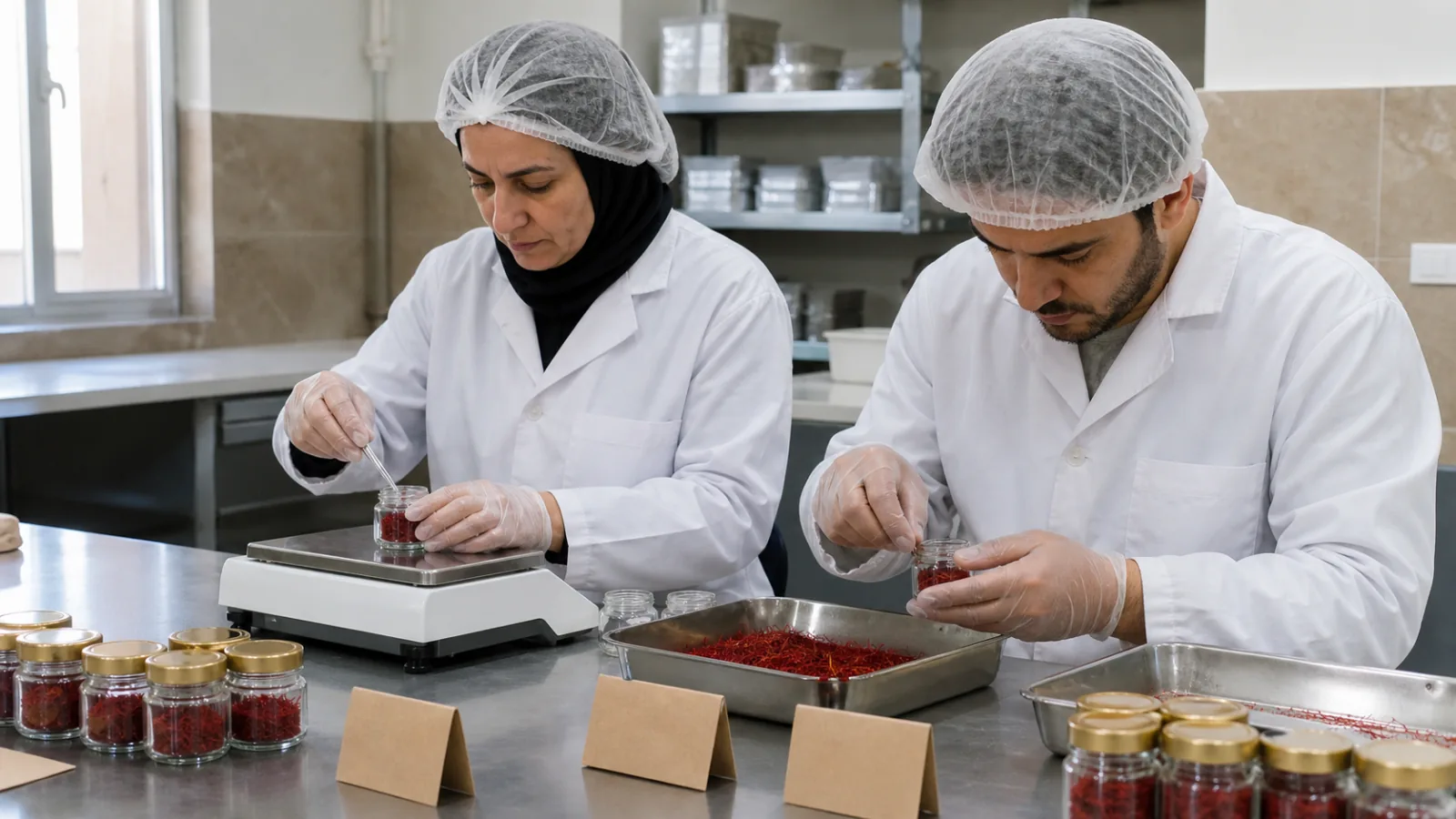
A 2018 plan brought the Barakat Foundation and a private agricultural company together on a saffron packaging project in Qaen, South Khorasan. The proposed Nafis Zafaran Qohestan factory was intended to sort and package local saffron close to the producing area, create jobs and give growers another route to market besides selling in bulk.
The original English headline called the organisation the “Blessing Institute” and described the arrangement as a cooperative. Barakat is the foundation’s proper name, and the report described an investment partnership rather than a farmer cooperative. The project figures below record what its participants announced while the plant was under construction; they are not evidence of the factory’s current operating status.
The problem the project was designed to address
The source referred awkwardly to a problem with saffron “raw material.” It meant raw or bulk selling: saffron leaving a producing region without local sorting, testing, branding or consumer-ready packaging. Farmers may receive less of the final retail value when those later stages happen elsewhere.
Local packaging cannot solve every market problem, but it can retain more work in the region. A well-run plant may provide cleaning, classification, controlled storage, measured filling, lot identification and packaging suited to the buyer. It can also give farmers a more transparent specification for what the plant will accept and how each grade is priced.
The Nafis Zafaran Qohestan proposal
Javid Rahimi, identified as director of the Eslamabad Agricultural Company, represented the private side of the project. He said its first phase had begun in Qaen’s industrial area with approximately 3 billion rials from the foundation and its investment partner.
The announced site covered about 3,000 square metres. Once launched, the factory was expected to process and package up to 5 tonnes of saffron per year. The article also said a further 10 billion rials in finance had been requested and approved through South Khorasan’s agricultural development process, with Bank Keshavarzi named as the agent bank.
These are dated project announcements. Capacity describes what a line is designed or expected to handle; it does not show annual throughput, sales or utilisation. No current operating report or audited production record was supplied in the original article.
Jobs and the local value chain
Rahimi forecast 30 direct jobs and more than 100 indirect jobs after construction. Direct roles could include receiving, quality control, packing, warehousing and administration. Indirect work might arise in farming, transport, printing, packaging supply and sales. The numbers were projections, not a verified employment count.
The report also claimed that local factories bought and packaged only about 20% of the area’s saffron at the time, with the rest moving in bulk through traders. That figure helps explain the project’s logic, but it belongs to the historical speaker and should not be presented as today’s market share.
Would packaging remove intermediaries?
The visible search demand for this page includes “saffron for intermediaries.” The historical argument was that another local buyer could reduce farmers’ dependence on brokers and help stabilise price formation. It is more accurate to say that packaging changes the chain than that it removes every intermediary.
Traders can provide aggregation, immediate payment, transport, credit and access to distant buyers. Problems arise when farmers have little price information, no alternative buyer or no transparent grade standard. A local plant is most useful when it publishes purchasing criteria, weighs accurately, samples fairly, pays on agreed terms and provides records that a grower can reconcile with the delivered lot.
The original price example said premium saffron was about 5.425 million tomans per kilogram and that packaged saffron could command at least 1.5 million tomans more per kilogram. Those 2018 figures are stale and the translation is imperfect, so they are preserved only as an attributed illustration of the perceived bulk-to-packaged value gap.
Packaging must do more than look attractive
A box or jar does not improve weak saffron. The value comes from protecting a correctly identified, hygienically handled product and giving the buyer dependable information. For a credible saffron packaging line, that means:
- documented supplier and lot identity from receiving onward;
- sampling and grade criteria that are applied consistently;
- clean food-contact surfaces and controls against cross-contamination;
- verified net weight and a packaging material suited to the product;
- protection from moisture, strong light and unwanted odours;
- labels that meet the law of the destination market; and
- records that support stock rotation, complaints and recalls.
The current Codex standard for dried saffron (CXS 351-2022) sits within a wider framework for food hygiene and labelling. Codex’s General Principles of Food Hygiene also emphasise lot identification and traceability. National and destination-market requirements still apply; a voluntary international standard does not replace them.
Why Qaen was central to the plan
The old report described Qaenat saffron as the country’s finest and most aromatic. That is a promotional claim rather than an objective national ranking. What can safely be said is that Qaen and the wider South Khorasan region have a long saffron-growing history and that local colour, aroma and flavour underpin the product’s reputation.
Locating processing near production can reduce unnecessary handling and make grower relationships easier to manage. It also creates an opportunity to connect a packaged lot with its source. Our article on packaging saffron for customer requirements explains why format should follow product condition, buyer needs and the intended market rather than decoration alone.
How the Barakat partnership was described
The 2018 article placed the project within the Barakat Foundation’s work with private investors in less-developed areas. It cited a broader target of 40 trillion rials for entrepreneurship and empowerment and said more than 13.6 trillion rials had already been invested. Those are historical programme figures and have not been converted into current money or treated as a present balance sheet.
The reported partnership model required at least 51% private-sector ownership. It also anticipated the foundation selling its holding to the partner after roughly two to five years, in cash or instalments. If the partner declined, the report said shares could be transferred to qualified local people working in the project. These were the stated programme terms, not legal advice or a description of what ultimately happened in this factory.
What the project can be judged on
The proposal had a sound development idea: move part of the saffron value chain closer to Qaen’s growers, build food-processing capability and create another buyer. Its success cannot be measured from construction spending or announced capacity alone.
The useful questions are whether the plant became operational, how much saffron it actually bought, whether growers received clear and timely terms, whether lots were tested and traceable, and whether packaged sales sustained the projected jobs. Until those records are available, the responsible conclusion is that the Nafis Zafaran Qohestan factory was a documented packaging initiative with specific aims—not proof that the local intermediary problem was solved.

![Exporting Saffron to Turkey + Price Guide [Complete 0 to 100]](https://img.rowhanisaffron.com/20260827003933/saffron-export-turkey-quality-inspection.webp)



