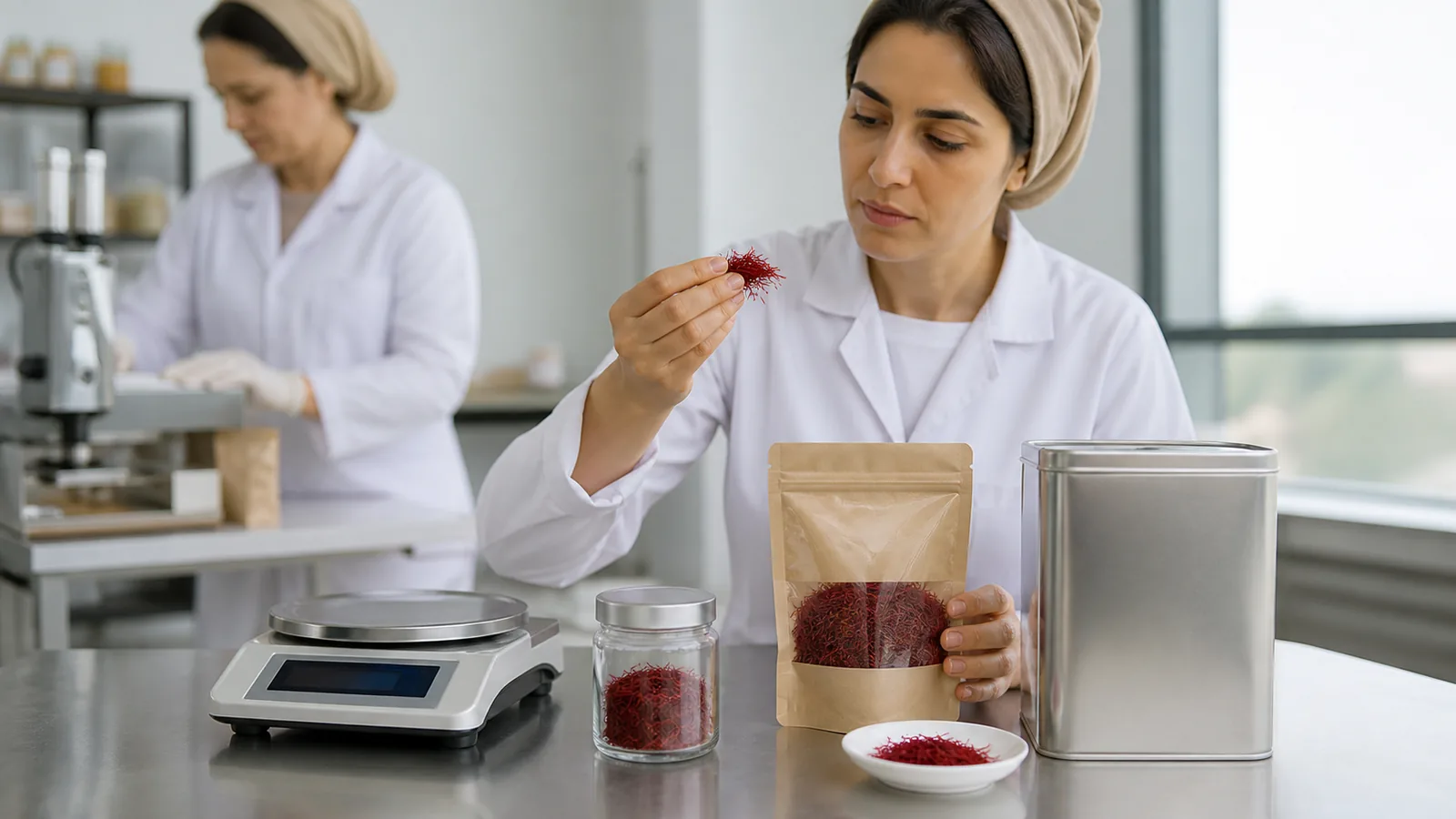
Saffron is packaged to suit customer requirements was the commercial lesson in a 2016 harvest report from Roshtkhar, in Razavi Khorasan. The local agriculture director, Mohammad Abbaspoor, expected 15 to 17 tonnes of dried saffron from about 5,500 hectares. He argued that producing the spice was only the first step: sorting, quality control and packaging also had to match the market in which it would be sold.
The figures and official comments on this page belong to that harvest season. They are not a current production forecast or a present-day product specification. What remains useful is the connection the report makes between field work, rapid post-harvest handling, dependable quality and packaging designed around a real buyer’s needs.
The 2016 Roshtkhar saffron harvest
Speaking to the Khorasan service of the Iranian Students News Agency (ISNA), Abbaspoor said harvesting had begun across approximately 5,500 hectares of Roshtkhar farmland. The translated report gives an expected dried-saffron crop of 15 to 17 tonnes and an average yield of 3.2 kg per hectare.
The arithmetic is broadly consistent. At 3.2 kg per hectare, 5,500 hectares would produce about 17.6 tonnes before allowing for differences among fields. An official estimate is still not a measured final harvest, however. Weather, flowering, labour availability, picking speed, separation losses and drying all affect the quantity ultimately recorded as saleable dried saffron.
Abbaspoor identified Fath Abad and the surrounding villages as the largest production area. The translated copy also names Brakv and Eshrat Abad among the communities where saffron was a dominant crop. “Brakv” may be a damaged place-name, so it is retained as it appears in the source rather than silently replaced with a guess.
Harvest season changed the rhythm of the city
The harvest was expected to continue until the end of November. Abbaspoor described the second month of autumn as the point when Roshtkhar took on a different atmosphere and the “red gold” harvest gathered pace.
That change was practical, not merely picturesque. Saffron flowers open over a short season, and the crop requires people to pick blossoms, separate the red stigmas and prepare them for drying. The report says the work created valuable seasonal employment in and around the city, while also exposing a persistent labour shortage.
Abbaspoor called Roshtkhar the second centre of saffron cultivation in the wider Torbat area of Khorasan. This was a local official’s description in 2016, not a permanent league table. Cultivated area and production rankings can change with the year and the geographic boundary used.
Drought, limited water and expanding acreage
The report describes drought and reduced water resources at the same time as an increase in the area planted with saffron. Abbaspoor said the local agricultural administration supported that expansion because saffron was economically important and generally fitted the region better than more water-demanding alternatives.
That does not make saffron a crop that needs no water. Irrigation timing, soil condition, corm health, temperature and field age still influence flowering and yield. Expansion also creates a planning question: more hectares increase the amount of flowers that must be harvested and processed during the same narrow period.
The director listed drought, insufficient water and limited production technology among growers’ major problems. These pressures should be assessed together. New acreage without enough trained labour, drying capacity or market access can move a bottleneck rather than remove it.
The UNIDO saffron development work
Abbaspoor said a United Nations Industrial Development Organization (UNIDO) saffron-development project had begun local activity that September. The report mentions training local specialists, creating an integrated network of operators, teaching cultivation and harvest practices, and establishing practical plans and a model for saffron cultivation in Roshtkhar.
He also referred to fertilizer being supplied to assist farmers that year. The source does not identify the product, rate, eligibility or whether it was part of the UNIDO work. It would therefore be unsafe to turn that brief statement into a fertilizer recommendation.
A UNIDO diagnostic report on Iran’s saffron value chain provides the wider context. It found that many farms were small, average yields commonly sat around 3.3 to 3.5 kg per hectare in the period it studied, and growers did not always have good access to suitable corms or commercialised research. It also identified drying, standardisation, quality control, packaging, traceability and direct knowledge of end markets as linked weaknesses—not isolated tasks.
The project language in the 2016 article describes activities, not verified outcomes. The source does not report how many farmers completed training or whether the model plots later improved yield. Those results should not be invented.
Why customer requirements begin before packaging
“Package it for the customer” can sound like a request for a different box. In practice, a buyer’s requirement may start much earlier. A useful specification can cover:
- filaments, cut filaments or powder;
- colouring strength and other agreed quality measures;
- moisture, physical purity and authenticity controls;
- lot size and traceability;
- food-contact packaging and closure;
- retail, food-service or industrial pack weight;
- labelling language and destination-market rules; and
- storage, transport and shelf-life expectations.
The current ISO 3632-1 saffron specification applies to dried saffron in filaments, cut filaments and powder. It gives a shared product framework, but a sales contract still has to identify the exact grade, form, quantity, testing and packing the customer has ordered.
Spain was presented as the packaging benchmark
The historical report says Razavi Khorasan produced about 180 tonnes annually and was the world’s largest production centre. It then presents Spain as the largest saffron exporter, crediting advanced technology, standards and customer-oriented packaging. Those are Abbaspoor’s 2016 comparisons and should not be used as current rankings without matching trade data.
His strategic point was that Iran’s large crop did not automatically produce the strongest position in finished markets. He believed insufficient sorting and advanced export packaging reduced the value retained by Iranian suppliers. UNIDO’s sector analysis reached a similar conclusion: bulk sales, uneven standardisation and weak links to end customers limited incentives for better packaging, labelling, quality management and traceability.
Packaging should therefore protect and communicate an already-controlled product. An attractive container cannot repair poor drying, mixed grades or an untraceable lot. Nor should a supplier select a package only because it looks premium; it has to suit the product form, distribution conditions and the customer’s use.
Quality can be lost between flower and pack
Abbaspoor said saffron’s colour, taste and aroma had to be protected. The translation refers to “four” qualities but names only those three, so a fourth is not supplied here. He recommended collecting flowers before sunrise, separating the stigmas promptly, drying them correctly and storing the dried saffron appropriately.
The exact picking hour may vary with local conditions and farm practice, but the need to limit delay and damage is well established. ISO 21983 provides current guidelines for harvesting, transporting flowers, separating stigmas, drying and storing saffron before packing. It was confirmed in 2025 and treats these stages as one connected process.
Current FAO work in Iran follows the same chain. Its saffron-quality programme combines laboratory verification with field-ready post-harvest guidance because colour, flavour and aroma measured later depend partly on what happened immediately after the flower was picked.
Labour remains part of the quality system
The report identifies labour as a major constraint at harvest and during the separation of stigmas from the flower. These tasks have to be completed quickly, yet carelessness can introduce foreign matter, damage filaments or create uneven material for drying.
Abbaspoor called for new technology to reduce the labour shortfall. Mechanisation can help where it is validated, but replacing people is not an objective by itself. A useful tool has to maintain product integrity, hygiene and traceability while working at the pace the harvest demands.
Labour planning belongs in the production plan before flowering begins. Farms and processors need realistic capacity for picking, transport, separation, drying, testing and packing. If one stage is undersized, the quality risk appears before the final package reaches the line.
How to specify saffron packaging for a customer
A clear order should answer five questions. What exactly is inside? Which evidence confirms its quality? How much is in each unit? What conditions will the pack face? What information must appear on it?
For retail, the customer may need a small tamper-evident pack with compliant consumer information. A restaurant may prefer a larger format that can be opened repeatedly without exposing the entire stock to moisture and light. An industrial buyer may prioritise batch documentation, sampling access and efficient outer cartons. None of these is universally “best.” The best package is the smallest practical system that protects the specified saffron through its actual journey.
The 2016 Roshtkhar report was right to connect packaging with customer demand. Its fuller lesson is that the package is the final visible part of a much longer quality process. The crop estimate, seasonal labour, timely separation, drying, grading, testing and storage all have to work before a supplier can confidently pack saffron to suit customer requirements.
Sources reviewed
- The immutable 2016 site copy of Mohammad Abbaspoor’s Roshtkhar interview attributed to ISNA.
- UNIDO: Saffron Industry Value Chain Development in Iran, diagnostic study.
- ISO 3632-1:2025 dried-saffron specification.
- ISO 21983:2019 post-harvest guidelines, confirmed in 2025.
- FAO: saffron authenticity testing and post-harvest guidance in Iran.